Anchorpoint Rescue-Ready Spring Assisted Knife - Brown Pakkawood
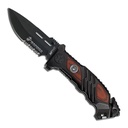
You don’t carry a spring assisted knife just to have another blade. You carry it so when glass shatters, metal twists, or a seat belt jams, you aren’t the one standing there empty-handed. The Marine markings, the warm brown pakkawood, the snap of that assisted opening—they all say the same thing: you’re the person who steps toward the problem, not away from it.
| Blade Length (inches) | 3.75 |
| Overall Length (inches) | 9 |
| Closed Length (inches) | 5 |
| Weight (oz.) | 7.12 |
| Blade Color | Black |
| Blade Finish | Matte |
| Blade Style | Drop Point |
| Blade Edge | Partial-Serrated |
| Blade Material | 440 Stainless Steel |
| Handle Finish | Anodized |
| Handle Material | Pakkawood |
| Theme | Marine Theme |
| Safety | Seat belt cutter |
| Pocket Clip | Yes |
| Deployment Method | Spring-assisted |
| Lock Type | Liner lock |
The moment you realize a spring assisted knife isn’t just gear
You don’t start wanting a spring assisted knife on a range, or in a shop window. It usually starts in a smaller, messier moment—standing by a crumpled fender, watching someone fumble with a dull multitool on a stuck seat belt. Or maybe it’s on a stormy night, keys in your hand, when you catch yourself thinking, “If something went sideways right now… what do I actually have on me?”
That’s the moment this knife lives in. Not fantasy. Not hype. Just that quiet, private line in your head where you decide you’re done hoping someone else will be prepared. You want to be the one who is.
How a spring assisted knife quietly changes your daily carry
Carry this long enough and a pattern forms. You’ll open more boxes than emergencies, cut more cord than seat belts—but the way it opens never stops feeling like a decision made on purpose. That fast, one-handed deployment is why people search for a spring assisted knife instead of a basic folder: your thumb starts the motion, the spring finishes it with a clean snap, and suddenly you’re not wrestling a blade open while juggling whatever needs your other hand.
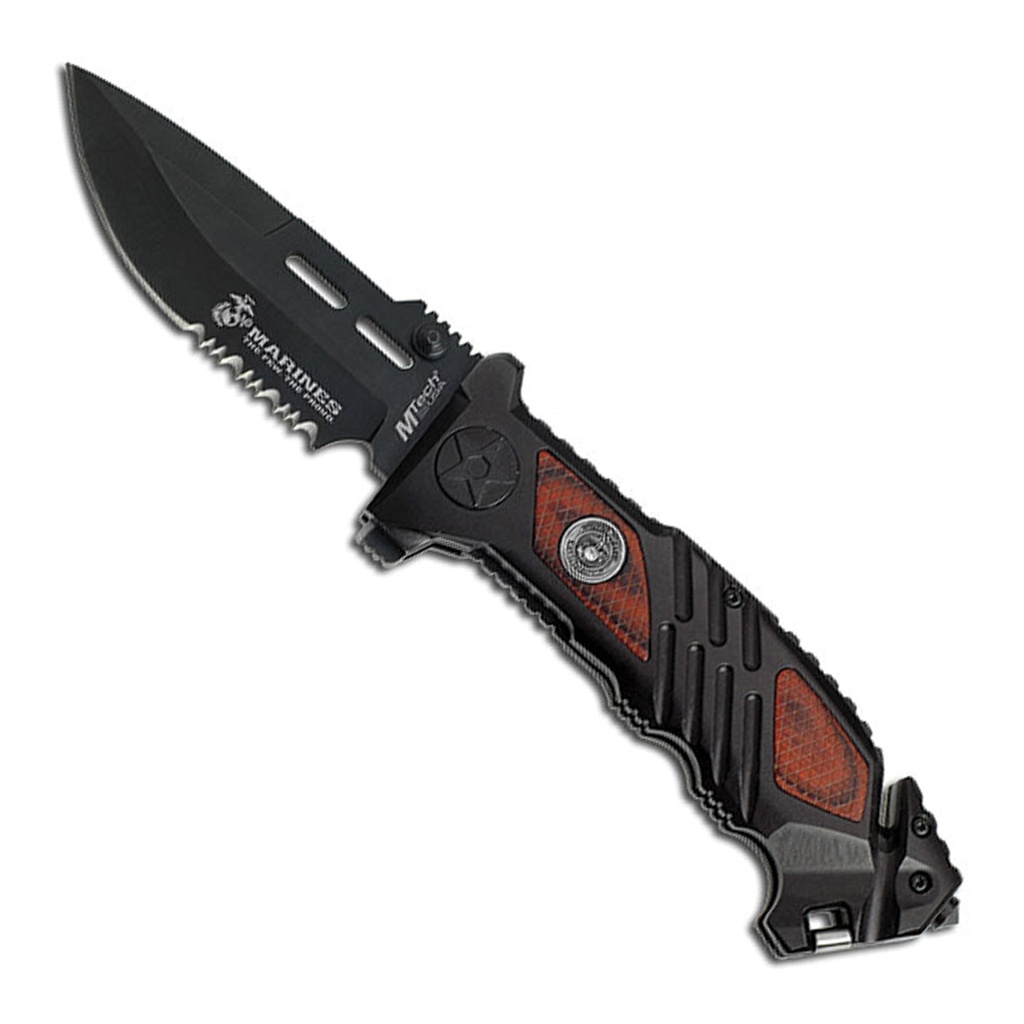
The drop point blade gives you the everyday usefulness—slicing, puncturing, precision cuts—while the partial serrations handle rope, webbing, and stubborn straps without drama. You feel the Marine emblem at the base of the blade as more than just branding; it’s a reminder of people who carried tools like this in places where hesitation actually costs lives. You’re not on deployment, but you still have moments where seconds matter. This fits that mental math.
The sound, the feel, the little rituals
What makes this different from any random pocket knife is how it becomes part of your personal ritual. You feel the weight—just over seven ounces—settle into your pocket each morning. Your fingers learn the texture of the brown pakkawood against the black metal, the way the grooves lock your hand in without needing to think about it. The assisted action has that low, confident thwack that tells you it’s fully locked, no visual check required.
Why this spring assisted knife feels like service in your hand
Look closely and you’ll see what the designer was trying to do. The black matte 440 stainless blade is all business—non-reflective, practical, easy to maintain. But then there’s that warm brown pakkawood inlay set into the handle. It softens the tactical profile just enough that it doesn’t scream for attention. It looks like something that belongs in a glove box, a duty belt, or the nightstand of someone who has lived through a few things.
The Marines branding and emblem are not just decoration; they shift how you treat the knife. You’re less likely to abuse it, more likely to respect it. That respect shows up in how you clean the blade after cutting through cardboard, how you check the liner lock, how you wipe down the edge because you know a dependable spring assisted knife only stays dependable when you treat it like a tool, not a toy.
Design details you only notice after a month of carry
The jimping along the spine that bites gently into your thumb when you bear down. The star-shaped pivot that catches the light just enough that you notice it, but no one else does. The way the glass breaker sits proud at the pommel, never in the way, but right where your instinctive hammer grip will land if you ever have to break a window. These aren’t catalog specs when you own it—they’re the tiny assurances that in a bad moment, this knife won’t fight you.
Carrying a spring assisted knife when normal days turn sideways
Most days, this rides as a quiet everyday carry knife. You’ll use the pocket clip to keep it anchored on the same spot of your jeans or work pants, so your hand finds it automatically. Closed, it sits around five inches—enough presence to feel solid, not so big that it prints loudly or digs into your hip when you sit in the car.
And then there are the sideways days: the stalled car on the highway shoulder, the neighbor who locks their keys in the running vehicle with a child inside, the dog snared in a length of nylon cord. In those moments, the seat belt cutter is no longer a bullet point; it is that strange calm you feel when everyone else is panicking and you’re already working the trapped strap free. The glass breaker is not theoretical; it’s one more way out when the usual ways fail.
You don’t buy a spring assisted knife because you crave drama. You buy it so that if drama arrives uninvited, you don’t have to borrow readiness from someone else.
Comfort, control, and the way it actually carries
Grip it hard and you’ll feel why the handle is shaped the way it is. The finger grooves keep your hand from sliding forward on a hard thrust cut. The pakkawood inlay gives you subtle warmth in cold weather and just enough bite in sweaty hands. That anodized black frame under the inlay is where the real strength lives, tying the Marine aesthetic back to actual function.
When a spring assisted knife beats a basic pocket blade
If you’ve carried a simple folding knife before, you already know its limits. Two hands to open when you’re holding a load of gear. A smooth blade that chews clumsily through webbing. A tool that feels fine on easy days and strangely inadequate on the hard ones. That’s the gap this kind of spring assisted knife fills.
With the assisted opening, you get one-handed speed that stays under your control—no surprise snap like some automatics, just a predictable arc finished by the spring. The partial serrations give you a built-in answer when someone says, “Does anyone have something sharp enough for this?” The liner lock holds the blade in place without drama, clicking into position so reliably that you stop thinking about it completely. And because the blade steel is 440 stainless, you get that balance of easy maintenance and reliable edge retention that works for a genuine EDC blade, not a safe queen.
This is where identity quietly shifts. You aren’t the person asking around for a knife. You are the person who already has the right one.
Questions people ask before buying a spring assisted knife
Is a spring assisted knife legal to carry where I live?
Laws vary widely. In many places, a spring assisted knife is treated differently from a fully automatic knife, but you should always check your local and state regulations. Look up specific rules on blade length, assisted opening, and where you’re allowed to carry before making it part of your everyday carry kit.
Will this spring assisted knife hold up for real everyday use?
The 440 stainless blade is built for regular cutting tasks—boxes, cord, light outdoor work—while still being easy to sharpen at home. If you wipe it down after use, avoid prying with the tip, and occasionally touch up the edge, it will stay a reliable daily carry blade rather than something you’re constantly babying.
Is a spring assisted knife safe to carry in my pocket?
Carried closed with the pocket clip, a spring assisted knife is designed to stay secure until you deliberately open it. The spring only engages after you start the motion, so it won’t launch itself open on its own. As with any EDC knife, make a habit of checking the clip tension and ensuring no lint or debris interferes with the mechanism.
What makes this better than a simple pocket knife?
Speed, control, and purpose. A basic pocket knife will open and cut, but an assisted opening, serrated edge, seat belt cutter, and glass breaker turn this into a quiet rescue tool. You’re not just carrying a blade; you’re carrying options when standard tools come up short.
That first night you lay your spring assisted knife on the nightstand
Picture the first evening you bring it home. You’ve worked the action a few dozen times, found the pocket position that feels right, felt the weight settle into your routine. Later, you set it on the nightstand: black blade, brown pakkawood, Marine emblem catching a sliver of light. It doesn’t feel like a new toy. It feels like a line you’ve crossed quietly.
You’re the person who thought ahead. The one who has a glass breaker when a window won’t budge, a seat belt cutter when a latch jams, a sharp, ready blade when something needs doing now. That’s what owning a spring assisted knife actually gives you—less noise, more readiness, and a story about who you are when things don’t go according to plan.