Marine Crest Rapid-Rescue Assisted Opening Knife - Black Pakkawood
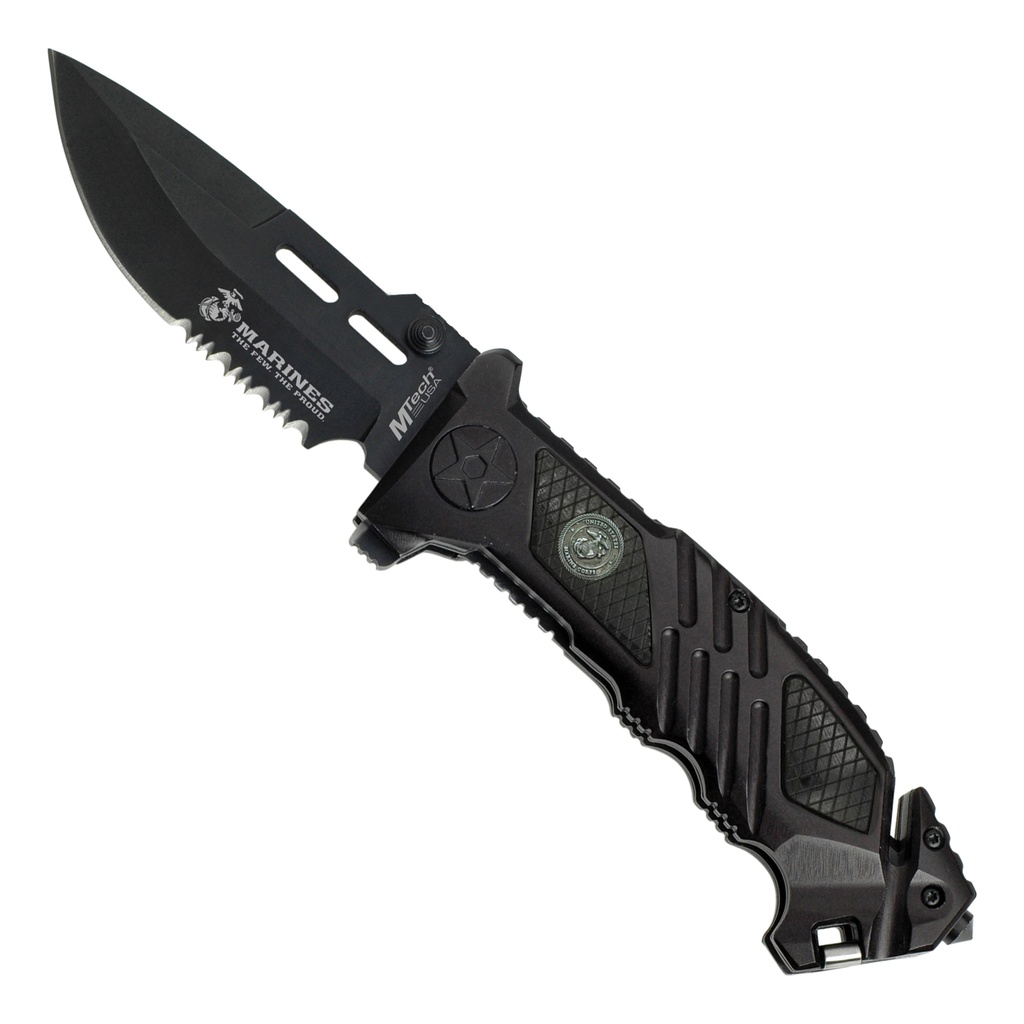
You don’t plan the bad nights—the rollover on a dark county road, the stranger pounding on your window for help. That’s where your assisted opening knife quietly earns its place. The Marine crest rides against your palm, the black Pakkawood warm from carry, the spring snapping the 440 blade to life when seconds get sharp. You feel the seat belt cutter at your fingertips, the glass breaker ready at the tail. You’re not just carrying a tool. You’re the one who shows up steady when everything else breaks.
| Blade Length (inches) | 3.75 |
| Overall Length (inches) | 9 |
| Closed Length (inches) | 5 |
| Weight (oz.) | 7.12 |
| Blade Color | Black |
| Blade Finish | Matte |
| Blade Style | Drop Point |
| Blade Edge | Partial-Serrated |
| Blade Material | 440 Stainless Steel |
| Handle Finish | Anodized |
| Handle Material | Pakkawood |
| Theme | None |
| Safety | Seat belt cutter |
| Pocket Clip | Yes |
| Deployment Method | Spring-assisted |
| Lock Type | Liner lock |
You don’t notice how dark a roadside gets until the taillights disappear. One moment you’re driving home, half-thinking about tomorrow. The next, there’s a car upside down in the ditch, glass spiderwebbed, someone shouting that they can’t get the door open. No sirens yet. Just you, your breath, your heartbeat—and whatever you decided to carry in your pocket that morning.
This is the moment an assisted opening knife stops being gear and becomes the difference between standing there wishing, and actually doing something.
When an assisted opening knife turns you from bystander to first move
You feel your hand close around the black Pakkawood, that familiar contour you’ve already fidgeted with a hundred times in quieter moments. Thumb finds the flipper without looking. The spring takes over, snapping the 3.75-inch matte black drop point into place with a sound that cuts through panic.
There’s no two-handed fumbling, no awkward nail nick. This is why you chose a spring-assisted blade instead of a basic folder: one clean motion, one clear commitment. The partially serrated edge bites straight into the seat belt that wouldn’t release, 440 stainless steel doing what steel is supposed to do—cut, not complain.
The Marine crest on the blade isn’t just decoration in that moment. It’s a quiet reminder of what Semper Fi actually feels like in civilian clothes: step forward, handle it, then go home like it was nothing.
How this assisted opening knife earns your trust before it earns pocket space
There’s a reason some knives end up in a drawer and others live on your hip. This one feels serious before you even flip it open. At 5 inches closed and just over 7 ounces, it has that dense, competent weight that tells you it won’t fold under real pressure—literally or figuratively.
You notice the way the finger grooves line up with your grip, how the textured black Pakkawood doesn’t slip when your hands are sweaty, or wet, or shaking a little after things calm down. The anodized finish on the handle doesn’t scream for attention; it quietly resists the dings and scrapes that come with daily carry.
The small details that signal this knife was built for work
The dual cutout slots on the blade shave a bit of weight and give your fingers extra purchase if you’re gloved. The liner lock settles in behind the tang with a clean, audible click—no mystery about whether it’s fully engaged. The deep-carry pocket clip tucks the profile low and secure, so your assisted opening knife doesn’t advertise itself until you want it in your hand.
And then there are the rescue tools. The seat belt cutter and glass breaker at the tail don’t shout for attention until the exact moment you need them. You run a fingertip over the cutter’s opening once in a while, just to know where it is. The glass breaker is a small, pointed promise at the end of the handle: if there’s a window between you and someone who needs out, that barrier is temporary.
Carrying an assisted opening knife that disappears until it matters
Most days, your life won’t look like a rescue scene. It’ll look like packages, rope, plastic clamshells that refuse to tear. It’ll look like cutting paracord at the range, trimming zip ties on a job, opening drywall wrap in a half-finished room. This is where a reliable assisted opening knife quietly proves itself, one clean cut at a time.
Closed, it rests against your pocket seam, Marine crest medallion turned inward like a private reminder. The deep-carry clip holds it low, out of sight, but never out of reach. You learn exactly how far to pull before your fingers land right where they should—on the flipper tab or thumb stud, depending on what angle your body will allow.
The way it feels in the hand becomes part of your routine
You notice the balance point: just enough blade-heavy that the drop point wants to work, not fight you. The partially serrated edge near the handle makes short work of fibrous material; you don’t baby it because you chose 440 stainless steel knowing it would take the use, take the resharpening, and keep going.
After a few weeks, your hand finds it without your eyes. That’s the real test of everyday carry: not the specs printed on a box, but muscle memory. And this is where an assisted opening knife shines. One-hand, one-motion deployment that feels the same whether you’re in a calm garage or a chaos-lit intersection.
Why this assisted opening knife feels like duty gear even off duty
Maybe you wore the Eagle, Globe, and Anchor once, or maybe you just carry deep respect for the people who did. Either way, the US Marines logo and crest on this blade hit a specific nerve. Not cosplay, not pretend-tactical—a quiet nod to a standard you either lived under or recognize instantly.
The blacked-out matte finish keeps it from looking flashy. This isn’t a mirror-polished showpiece; it’s meant to ride along, get scuffed, and still look ready. The Marine crest medallion set into the handle sits right where your palm can feel it, like a coin you keep in your pocket for reasons that are hard to explain but easy to understand.
In a world full of brightly anodized toys, carrying a serious assisted opening knife with rescue features and military styling says something about how you see yourself. Not paranoid. Not playing soldier. Just quietly prepared to be the calm one when everyone else is losing the thread.
When an assisted opening knife with rescue tools changes the ending
Picture the next time something goes sideways—doesn’t have to be dramatic. Maybe it’s your own vehicle, power dead, belt jammed. Maybe it’s a flooded road and someone’s car half-submerged at the edge. Or maybe it’s just you, middle of nowhere, with a problem that needs cutting, prying, breaking, or freeing.
With this in your pocket, you already know the steps. Hand goes to the same spot. Thumb hits the same flipper. The spring does its job, the liner lock clicks, and you’re moving, not thinking about tools. Your focus stays where it should: on the person or problem in front of you, not on whether your knife will cooperate.
That’s the quiet power of carrying the right assisted opening knife: you stop rehearsing worst-case scenarios in your head because you’ve already answered a simple question—"If it happens, what do I have on me?"
Questions People Ask Before Buying an Assisted Opening Knife
Is an assisted opening knife good for everyday carry or just emergencies?
It’s genuinely both. A good assisted opening knife gives you fast, one-handed deployment for emergency use, but it also works as a daily carry blade for boxes, cord, and general tasks. The key is choosing one like this with a strong lock, practical blade shape, and a pocket clip so it actually gets carried.
Will the spring-assisted mechanism wear out quickly?
On a quality assisted opening knife, the spring is designed for thousands of cycles. You’ll probably dull and resharpen the blade many times before the mechanism shows any fatigue. A quick wipe-down and occasional drop of oil at the pivot will keep it snapping open reliably for years of regular use.
Is it legal to carry an assisted opening knife where I live?
In many places, assisted opening knives are treated differently from fully automatic knives, but laws vary a lot by state, city, and even country. It’s smart to search "assisted opening knife laws" plus your location and check official local statutes so you know exactly what’s allowed in your area before you clip it into your pocket.
How hard is it to sharpen a partially serrated blade?
The plain edge section sharpens like any other knife, while the serrations take a bit more patience and a rod-style sharpener. The trade-off is worth it for many people: serrations on an assisted opening knife stay functional longer on rope, webbing, and belts, even when the rest of the edge is due for a tune-up.
Later that night, when the road is empty again and the adrenaline has burned off, you’ll turn this knife over in your hand under softer light. You’ll see the tiny glass dust still clinging near the breaker, the faint scrape on the black coating where steel met steel, the Marine crest catching a hint of reflection. You’ll slide your assisted opening knife back into your pocket, not as a gadget, but as part of who you are now—the person who doesn’t just watch things happen. The one who shows up ready, without needing to say a word about it.