

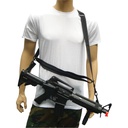
Anchor-Line Control Three Point Rifle Sling - Coyote
You know that moment when you need both hands, but you can’t afford to lose control of your rifle. A three point rifle sling turns that tension into calm. It locks your carbine to your body, keeps the muzzle where you left it, and lets you drop and retrieve the rifle without thinking. The coyote webbing disappears against dust, brush, and concrete so your gear never shouts louder than your skills. This isn’t about looking tactical—it’s about moving like you’ve trained for this.
You’re stepping out of the vehicle and everything starts happening at once. A door sticks. A light goes out. Someone’s shouting for you to help with a casualty, or a kid, or a gate. Your rifle is with you—but right now, it can’t be in your hands. In that split-second, your three point rifle sling decides whether the rifle becomes a problem… or disappears into your movement while staying exactly where you need it.
How a Three Point Rifle Sling Turns Chaos into Control
If you’ve ever tried to juggle a rifle and real life at the same time, you already know why the right three point rifle sling matters. You’re climbing a set of stairs, managing a flashlight, opening a door, or dragging a target off the line. You can’t just set your rifle down and hope for the best. You need it secured to you, not bouncing, not swinging, not muzzling anything you care about.
That’s where this setup quietly earns its place. The sling anchors at three points—rifle, body, and movement—so when you drop the gun, it doesn’t crash down or swing wide. It follows a controlled arc, muzzle oriented where you’ve trained it to be, settling against your chest or side while your hands go do the next thing. When you reach back for it, it’s there, in the same place, at the same angle, ready to come back up without fighting the strap.
Why This Three Point Rifle Sling Stays Put When You Don’t
You’ve probably run gear that looked fine on a table and fell apart once you started moving. This three point rifle sling is built for the opposite: it looks like plain, honest webbing, then proves its worth when you sprint, kneel, or climb.
The webbing feels like that familiar, slightly stiff nylon that breaks in without breaking down. It holds its shape when threaded through swivels and hardware, so you’re not fighting twists every time you kit up. The adjusters grab and hold without slipping, even when you load the sling by dropping your rifle to a hang position. That’s the detail that made the design click: when you let the rifle fall, you can feel the system catch and settle instead of yanking or stretching.
Whether you’re running a fixed stock on an old-duty-style rifle or a modern collapsible stock on your AR, the length adjustment gives you enough range to dial in your fit. Shorten it until the rifle rides high and tight against a plate carrier, or open it up so it hangs comfortably in front of a hoodie and jeans. Once you find that sweet spot, the sling holds that setting day after day.
Carrying a Rifle All Day: Where a Three Point Rifle Sling Changes Everything
There’s a quiet moment where this kind of sling earns your trust. Maybe it’s while you’re on a long walk back from a range berm, gloves off, helmet unbuckled, rifle hanging in front of you. You loosen the strap just enough and feel the weight shift off your shoulders and into the webbing. You realize you’re no longer carrying the rifle; you’re wearing it.
With a three point rifle sling, the rifle stays oriented along your body instead of swinging out like a pendulum. When you bend over a target, check a vehicle tire, or kneel to look under something, you don’t get smacked in the knee or chest by your own gun. The strap layout keeps the rifle close, so your movement doesn’t turn into a wrestling match.
And when things speed up—your buddy yells, a timer beeps, a threat appears—the transition from slung to shouldered feels like a practiced motion rather than a scramble. Your support hand finds the fore-end, your strong hand hits the grip, and the sling guides the rifle along the path you’ve rehearsed a hundred times. Nothing snags, nothing surprises you. It just moves because you do.
Why Coyote Matters When Your Rifle Sling Has to Blend In
The coyote color isn’t an accident or just an aesthetic choice. You’ve seen how black straps scream against tan dirt, how bright hardware flashes in a window reflection. This coyote three point rifle sling lives in the middle ground: it looks at home against desert dust, dried grass, and plywood, but it also disappears over a brown jacket or khaki shirt on a city street.
That matters more than you’d think. When your sling blends into both brush and concrete, your rifle becomes part of your outline instead of a visual anchor. Whether you’re stepping out of a truck onto a gravel lot or leaning against a tree line waiting for your next movement, your gear doesn’t shout before you do.
Even indoors—shoot houses, ranges, or training facilities—the muted coyote tone feels like it belongs. It doesn’t glare in photos or video, and it doesn’t pick up every scuff and stain like lighter colors. Over time, the webbing tells your story in quiet marks and wear patterns instead of loud contrast.
When a Three Point Rifle Sling Beats the Alternatives
You’ve probably asked yourself at least once: single point, two point, or three point rifle sling—what actually works when it’s not just a flat range day? A single point feels fast until you sprint or go hands-on and the muzzle starts swinging. A basic two point rides secure but can fight you on quick transitions. The three point lives in the space between control and speed.
When you’re moving through tight spaces or constantly transitioning between tasks—rifle up, rifle down, hands free, rifle back up—the three point layout keeps the gun closer and more predictable. You trade a tiny bit of simplicity for a whole lot of stability. Once you’ve adjusted it to your body, you’ll notice how natural it feels to go from patrol carry to a ready position without thinking about the strap.
And if this is your first serious sling, this style teaches you something important about managing a long gun with respect. You feel where the muzzle points when you drop it. You feel how much slack you actually need. The sling becomes a quiet coach, nudging you into safer, more controlled habits.
Questions People Ask Before Buying a Three Point Rifle Sling
Is a three point rifle sling good for everyday rifle carry?
If you carry a rifle for more than a quick drill or photo, a three point rifle sling makes everyday movement calmer and safer. It keeps the rifle tight to your body when you walk, climb, or work with both hands, so you’re not constantly grabbing at the gun to keep it from swinging or slipping.
What’s the difference between a three point rifle sling and a two point sling?
A two point sling attaches at two ends of the rifle and works like a simple shoulder strap. A three point rifle sling adds an extra attachment that connects the sling to itself around your body, creating a more controlled, body-hugging carry. That extra contact point helps keep the rifle oriented and ready instead of bouncing loose.
Will this type of sling work with my AR and a collapsible stock?
Yes. A three point rifle sling like this is built to adjust for both fixed and collapsible stocks. As long as your rifle has attachment points or sling swivels at the front and rear, you can route the webbing to fit your setup and then fine-tune the length until the rifle rides where you want it.
Is a three point rifle sling too complicated for training or duty use?
It might look more complex than a basic strap at first glance, but once you set it up and run a few drills, it becomes second nature. The three point rifle sling actually simplifies your decisions in motion—you drop the rifle and it behaves the same way every time, without you needing to babysit it.
End of the day, picture this: you’ve been on your feet for hours. The sun’s dropping. Your shoulders are tired, but your rifle hangs steady against your chest, held there by a three point rifle sling you stopped thinking about three hours ago. Someone calls your name. You let your hands fall, feel the weight settled and secure, then bring the rifle back up in one smooth pull. No fumble, no fight—just you, your training, and a tool that moves like it’s part of you now.