Arachnid Reflex Flip-Ready Butterfly Knife - Red Web Steel
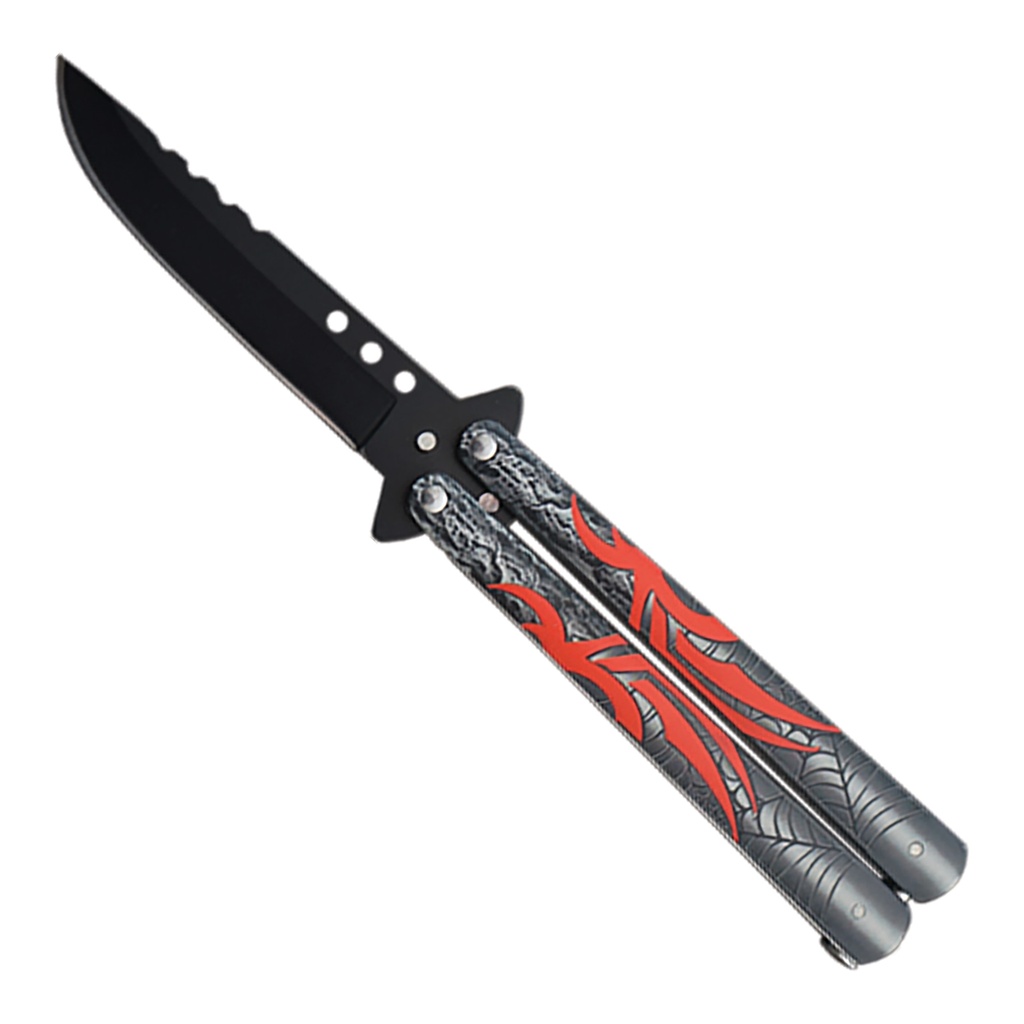
You feel it before you see it—the quiet click, the flash of black, the red spider sliding across your knuckles. This butterfly knife doesn’t sit in your pocket; it lives in your hands, asking to be flipped one more time. The matte black blade, partial serrations, and web-textured handles give you grip, control, and that little hit of adrenaline every time you snap it open. If your everyday carry is as much ritual as readiness, this butterfly knife fits right into your story.
| Blade Color | Black |
| Blade Finish | Matte |
| Blade Style | Clip Point |
| Blade Edge | Partial-Serrated |
| Handle Finish | Matte |
| Theme | Spider |
| Is Trainer | No |
You don’t buy a butterfly knife because you need another blade. You buy it for that moment when the room goes a little quiet, your fingers find their rhythm, and the world shrinks down to steel, motion, and the soft clap of handles meeting home. That first flip of a butterfly knife tells you who you are: steady, deliberate, just dangerous enough to be interesting.
Now imagine that same motion with a red spider sliding across your hand—its legs stretched over silver web-textured handles, a matte black clip-point blade flashing out like a strike. That’s the feel of carrying a butterfly knife that looks as sharp as it moves.
When a Butterfly Knife Turns Fidget Into Focus
If you’ve ever caught yourself flipping a pen, drumming on a desk, or rolling a coin just to keep your hands busy, a butterfly knife takes that same restless energy and gives it purpose. A butterfly knife isn’t just another tool in your pocket; it becomes a kind of moving meditation. Each open-and-close becomes a small test of control.
This butterfly knife leans into that ritual. The dual handles pivot cleanly around the tang, held together by a simple bottom latch that you can feel and hear click into place. The weight is balanced so you don’t fight it into motion—you guide it. The spider graphic isn’t just decoration; it runs across both sides of the handle so that, mid-flip, the design still feels continuous in your palm, like you’re moving one living piece instead of two slabs of metal.
Because it’s a real, live blade—not a trainer—you’re always aware of the edge. That awareness sharpens you. It keeps your focus honest, your timing intentional. Every flip teaches you something about your own control.
Why This Butterfly Knife Stays Ready When You Need It
Of course, you’re not just carrying a butterfly knife for the show. At some point, this has to cut cord, bite into packaging, or handle the little surprises that show up in a day. That’s where the blade earns its space in your pocket.
The matte black clip-point blade gives you a sharp, defined tip that feels precise when you’re scoring cardboard or slicing through zip ties. Just behind the edge, a partial-serrated section near the handle chews through tougher material—rope, plastic straps, that stubborn blister pack that refuses to open. You get the clean slicing of a straight edge with the backup aggression of serrations without having to switch tools.
Look at the spine and you’ll see scallops and round cutouts along the black steel. Those aren’t just there to look tactical; they knock down some weight and give the blade a leaner, quicker feel in motion. Every gram pulled from the spine is a gram you feel in smoother rotations and faster recoveries. In other words, you can flip longer without your hand getting tired, and when you do use the butterfly knife for actual cutting, it still feels nimble instead of clunky.
How This Butterfly Knife Feels in Your Hand and In Your Pocket
Owning a butterfly knife only matters if you actually carry it. That’s where the handle design starts telling a quieter story—one about comfort, grip, and how this thing disappears until you want it.
The silver-gray handles have a matte finish with a web-like texture pressed into the surface. You feel that texture the moment you grip it—just enough bite to stay sure in sweaty hands, but not so rough that it chews up your pockets. The big red spider stretches across both handles, so when it’s closed and riding in your pocket, you get this striking flash of color every time you pull it out. It’s the kind of knife people notice even before you flip it.
Flared tang guards near the pivot give your fingers a natural stopping point when the butterfly knife snaps open. That tiny bump of metal becomes your safety check—it keeps your hand from slipping too far forward when you’re focused on the flip or bearing down on a cut. The standard latch at the bottom does its job simply: closed when you want security, open when it’s time to move. No weird mechanisms, no overthinking it.
The sound and feel of everyday carry
You’ll start to recognize the sounds: the muted clack of handles rotating, the soft click of the latch, the quiet scrape of metal-on-metal as you close it one-handed without looking. That sensory feedback turns carrying a butterfly knife from a novelty into a habit. It slides into your pocket, rides light, and only asks for a little time and attention when you need your hands to do something more than scroll.
When a Butterfly Knife Becomes the Story You Tell
Some blades vanish into the background of your everyday carry. This one doesn’t. The black-and-red contrast, the spider sprawled across the silver handles, the aggressive profile of the clip-point blade—they all broadcast a certain energy. You’re not carrying a gentleman’s folder here. You’re carrying something a little louder, a little bolder.
That doesn’t mean it has to live in a display case. For some people, this butterfly knife becomes their daily carry blade, the one they flick open to cut tape at work, open boxes in the garage, or slice paracord at the campsite. For others, it becomes their flipping blade—the one they practice with in the backyard, show to friends, and use to chase cleaner moves and tighter timing. In either case, it says something about you: you appreciate function, but you’re not afraid of a little drama.
Moments where this knife steps up
Picture this: you’re standing around with friends, waiting for food, talking about nothing. Your hands itch for something to do. The butterfly knife comes out almost without thinking. Flip. Snap. Catch. Someone notices the red spider, asks to see it, wants to try a slow open. Suddenly you’re not just the person with a knife; you’re the person who knows how to handle it.
Questions People Ask Before Buying a Butterfly Knife
Is this butterfly knife practical for everyday carry or just for tricks?
You can absolutely use this butterfly knife for real-world tasks. The clip-point blade with partial serrations handles daily cutting easily, while the butterfly design gives you the option to flip when you want that fidget-factor. It’s both a functional everyday carry blade and a balisong you can actually train with.
Is a butterfly knife like this legal to carry where I live?
Butterfly knife laws change a lot from place to place. Some areas treat a butterfly knife like any folding pocket knife, while others restrict or ban balisongs entirely. Before you carry this knife daily, it’s smart to check your local and state laws or ask a knowledgeable local shop so you know you’re in the clear.
Will this butterfly knife hold up to regular flipping and use?
Butterfly knives live and die on their pivots and handles. The dual-pin pivots, metal handles, and standard latch on this butterfly knife are built for repeated opening and closing. As with any balisong, a little care—tightening hardware and occasional lubrication—will keep it flipping smoothly and cutting cleanly over time.
Is this butterfly knife good for beginners who want to learn?
If you’re careful and respect the live edge, this butterfly knife can work for beginners, but it is not a dull trainer. Many people start with a trainer balisong to build muscle memory, then move to a live-blade butterfly knife like this once they’re comfortable. Either way, slow, controlled practice is the move.
Who You Become the First Time You Flip This Butterfly Knife Open
Picture the first real moment you carry it. You’re alone—garage, bedroom, back porch, wherever you go to clear your head. The butterfly knife is closed in your hand, cool metal pressing into your palm, the red spider tucked between your fingers. You give it that first tentative flip. The blade arcs out, black and smooth, handles rolling around your knuckles before snapping into place against the tang guards.
For a second, you just hold it there. Not as a prop, not as a toy, but as a tool you now control. You feel the texture of the webbed handles, the balance of the blade, the weight of something that could have been just another knife—but isn’t. This butterfly knife has a look that matches the edge you feel on your best days: sharp, focused, a little wild at the edges.
From that moment on, every time you slide this butterfly knife into your pocket, you’re not just carrying a blade. You’re carrying a quiet challenge to yourself—to move with more intention, to stay ready, to let a little of that spider’s patience and precision live in your hands.