Azure Glide Ring-Control Karambit Knife - Stonewash Blue
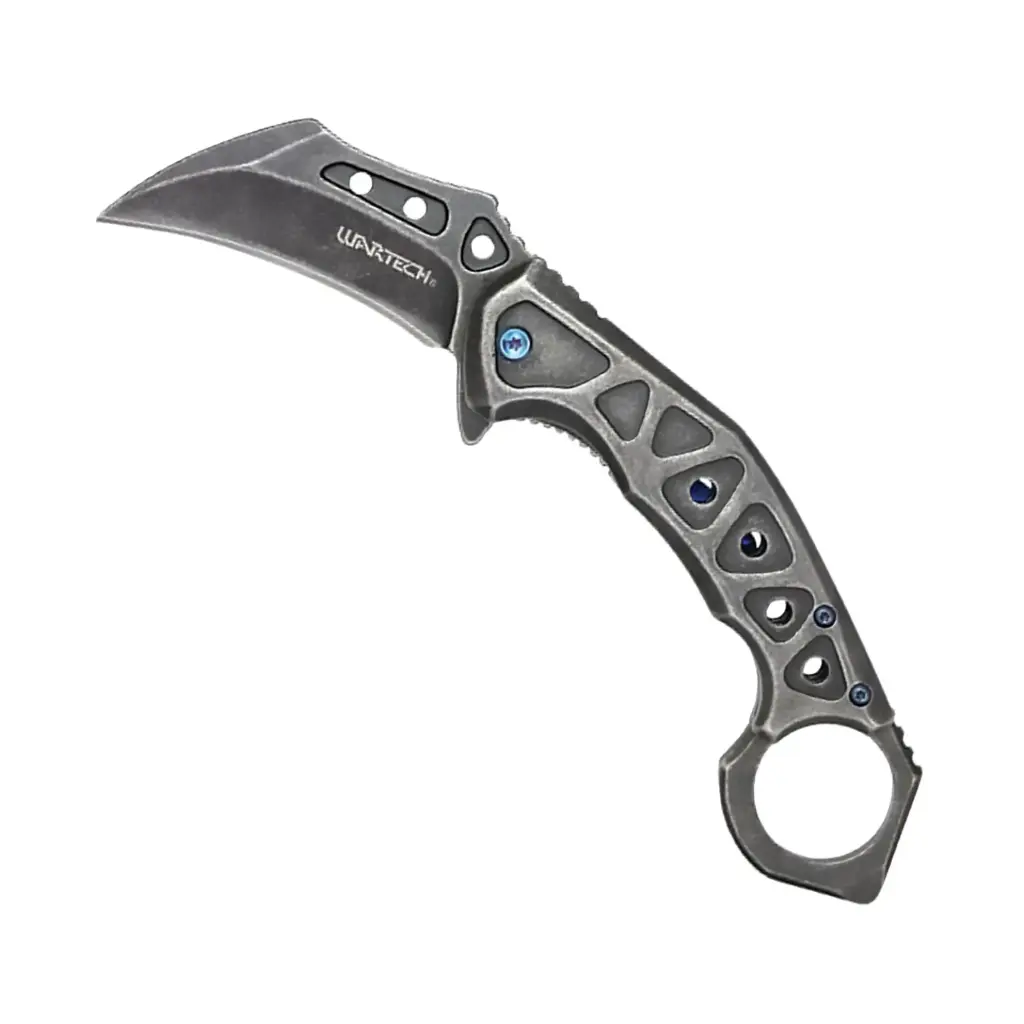
You don’t pull this assisted karambit out to show off. You pull it because your hands already know what to do. The ring hooks your finger, the flipper clicks, and that curved talon blade is just there—stonewashed, sharp, and solid in your grip. Clipped in your pocket, the Azure Glide feels less like a tool you carry and more like a motion you can call on, any time you need control instead of chaos.
| Blade Length (inches) | 2.75 |
| Overall Length (inches) | 7.25 |
| Closed Length (inches) | 4.5 |
| Blade Color | Silver |
| Blade Finish | Stone Washed |
| Blade Style | Talon |
| Blade Edge | Plain |
| Blade Material | 3CR13 Steel |
| Handle Finish | Stonewashed |
| Handle Material | Stainless Steel |
| Theme | Karambit |
| Pocket Clip | Yes |
| Deployment Method | Assisted |
| Lock Type | Liner lock |
You notice it the first time something actually goes wrong. Not on a range, not in a comment thread, but in a parking lot, a stairwell, a dim hallway where your heart rate jumps before your brain catches up. Your hand moves before you think—straight to your pocket, ring already mapped in your mind. That’s when an assisted karambit stops being gear and starts being a habit.
When an Assisted Karambit Knife Becomes Second Nature
Owning an assisted karambit knife isn’t about looking tactical. It’s about what happens when your fingers can find control in the dark. With this one, the ring sits right where your grip expects it. Your index finger slides through, your thumb taps the flipper, and the assist does the rest—snapping that curved talon blade into place with a sound you feel more than hear.
At 7.25 inches open with a 2.75-inch talon, the blade gives you enough reach to cut rope, slice cardboard, or open stubborn plastic without feeling like you’re swinging a sword. The curve does the work. You pull instead of push, and the edge bites smoothly instead of skipping. If you’ve ever struggled with a straight blade in tight spaces, a folding karambit like this shows you what it’s like when the motion finally matches your hand.
Why This Assisted Karambit Knife Feels Like Controlled Motion
There’s a reason this particular piece feels like it wants to move. The whole design is built around flow. The stonewashed 3Cr13 steel curves in a continuous line from tip to finger ring, so when you cut, you’re pulling along a natural arc your wrist already understands. That’s what makes a karambit different—you’re not forcing a straight edge to act curved; you’re using a blade shaped for real pulling cuts.
The assisted opening is tuned for that same flow. The flipper tab is just pronounced enough that you can find it under stress, but not so huge that it prints or snags. One firm press and the spring assist takes over, driving the talon blade out with a clean, confidence-building snap. A liner lock catches it solidly, so once it’s open, it feels like an extension of your hand, not a delicate mechanism you’re afraid to lean on.
The Feel of Stonewash and Steel in Your Palm
The first thing your skin notices isn’t the curve—it’s the texture. That stonewashed steel handle has a worn-in look right out of the box, like something you’ve already carried for years. It doesn’t glare under harsh light, it doesn’t scream for attention, it just looks quietly capable. The skeletonized cutouts keep it from feeling like a brick, and they give your fingers natural indexing points to lock into.
Then there’s the color detail that hooks your eye: blue accent hardware circling the pivot and running down the handle. It’s subtle, but it’s the exact kind of detail EDC people clock instantly. You’re not carrying some generic tactical knife—you’re carrying a piece that looks like someone actually thought about it.
How This Assisted Karambit Knife Fits into Your Everyday Carry
If you’ve ever carried a big, overbuilt tactical piece and left it at home because it was a pain, this is the opposite experience. Closed at 4.5 inches, it sits comfortably in your pocket instead of dominating it. The pocket clip anchors it along the seam, so your hand already knows where to find the ring. No digging. No fumbling. Just a clean, repeatable draw.
In real life, this means you’re cutting zip ties in a garage, trimming paracord at camp, breaking down boxes in the back room, or peeling plastic off a pallet without needing a second tool. The plain-edge talon blade slices instead of tearing. The jimping along the spine and inner grip gives your thumb and palm something to bite into so even when your hands are sweaty or cold, you’re still in control.
Everyday Moments Where the Karambit Shape Earns Its Place
You’ll notice the difference on small jobs first. Pulling through cardboard instead of sawing. Hooking into a stubborn nylon strap and feeling the blade glide through instead of bind. That’s the karambit curve doing work for you. You don’t need to swing hard; you just need to pull with intent.
And then there’s the awareness piece—the quiet, private confidence of knowing you have a folding karambit with ring retention clipped where your hand can find it in one clean motion. You might never need that extra control in a defensive context, but your nervous system relaxes a notch knowing that if you did, your grip would already be there.
When an Assisted Karambit Knife Is the Better Choice
You’ve probably asked yourself at some point: why carry an assisted karambit knife instead of a straight-blade EDC? The answer shows up in two moments—tight spaces and high stakes. In tight spaces, that curved talon edge lets you work close to your body without overextending. You can cut straps, cords, or packaging right against a surface while still keeping your knuckles clear.
In high-stress moments, the ring and curve give you something most standard folding knives don’t: retention and orientation. Once your finger is through that ring, the knife is far less likely to slip or be knocked free. You always know where the edge is pointing, even if you’re not looking directly at it. That’s the quiet advantage you buy when you choose a ring-control karambit as your daily carry knife.
And yet, it still lives comfortably in the EDC world. No exaggerated spikes, no movie-prop excess—just a stonewashed assisted opening karambit that looks like gear, not a costume.
Questions People Ask Before Buying an Assisted Karambit Knife
Is an assisted karambit knife practical for everyday carry?
It is if you actually use your knife. This assisted karambit packs a compact 2.75-inch talon blade into a 4.5-inch closed profile, so it rides like a normal pocket knife. You get the utility of a daily carry blade with the extra control and retention of a ringed karambit when you need it.
Will the blade steel hold up to regular cutting tasks?
The stonewashed 3Cr13 steel on this folding karambit is built for real-world utility—resistant to rust, easy to touch up, and tough enough for daily slicing, box duty, and light outdoor use. You’re not babying a safe queen; you’re carrying something meant to see work and then hit the sharpener without drama.
How fast is the assisted opening in actual use?
Once you’ve practiced the motion a few times, the assisted opening feels almost automatic. Your finger finds the flipper, you apply pressure, and the spring-assist snaps the blade into lockup in a fraction of a second. It becomes a repeatable movement—draw, ring, flip, engage—without you having to muscle it open.
Is a folding karambit comfortable to carry all day?
Despite the aggressive talon profile, this assisted karambit carries surprisingly flat. The skeletonized steel handle and stonewash finish keep weight reasonable, and the pocket clip tucks it along your seam. Once it’s clipped, it disappears until you deliberately reach for it.
Ownership sneaks up on you with this knife. One day it’s just another assisted karambit knife you decided to try; a week later you catch yourself doing that little pocket-check pat and feeling oddly unfinished without it. You feel the cool ring under your fingertip, remember the first time the blade snapped open with that smooth, stonewashed shimmer, and realize this has become your default move. Not because it’s flashy, but because it fits the way you actually live—ready hands, quiet confidence, and a daily carry that finally moves the way you do.