Azure Shogun Ceremonial Jintachi Sword - Blue Gold
You don’t buy a ceremonial samurai sword just to hang it. You choose a Jintachi because you want one object in the room that silently says, “This is who I am.” With this blue-and-gold ceremonial Jintachi sword in your hands—the curve of the carbon steel, the long grip, the weight of history—you feel your posture change. You’re not collecting metal. You’re curating a story, and this is the centerpiece.
You don’t hang this on the wall to fill a blank space. You hang it because a part of you has always been drawn to that quiet, disciplined power of the blade—the kind of presence a ceremonial samurai sword brings just by existing in the room. The first time you lift this ceremonial Jintachi sword from its blue lacquered scabbard, you feel that shift: the room isn’t just decorated anymore. It’s claimed.
When a Ceremonial Jintachi Sword Turns a Room Into a Story
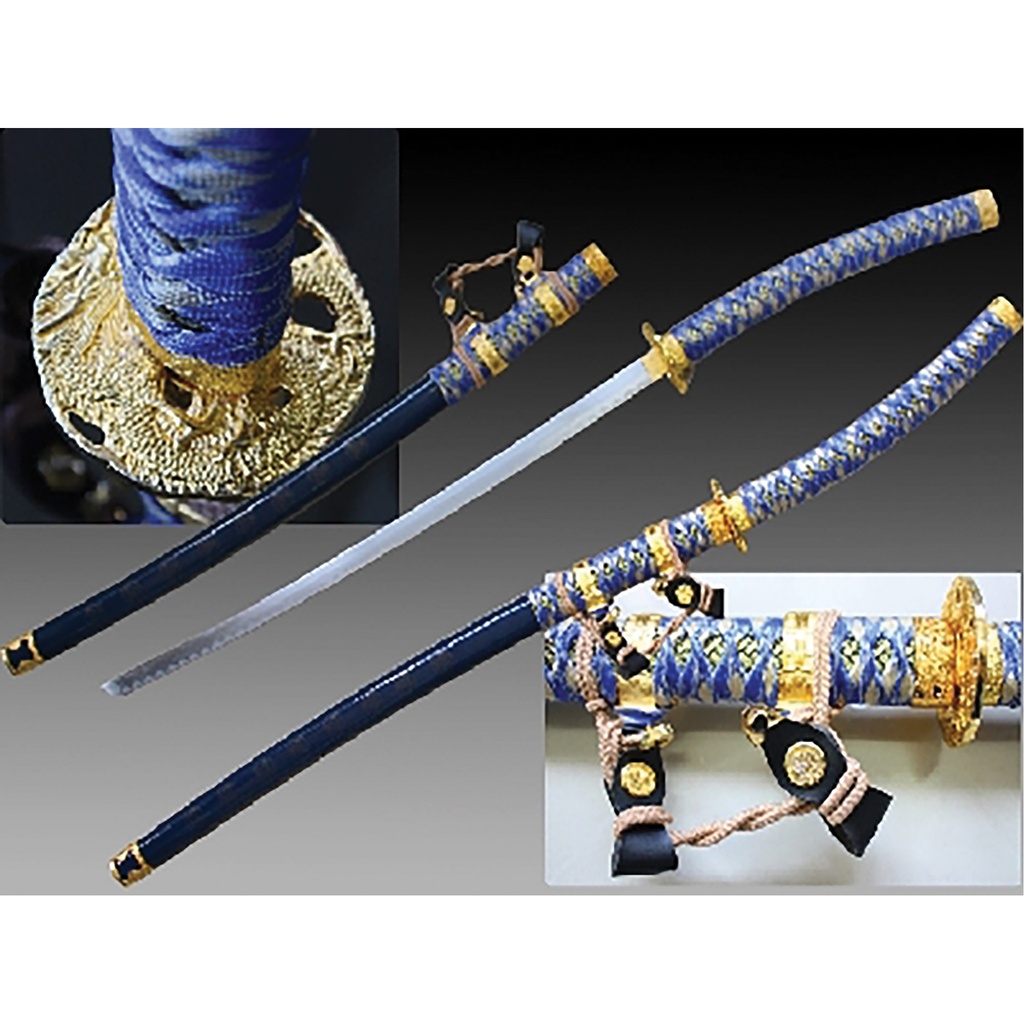
There are swords you stash in a corner, and then there are swords that become the reason people stop mid-sentence when they walk in. This is the second kind. At 43 1/4 inches overall, this ceremonial Jintachi sword doesn’t whisper; it stands long and deliberate, the curve of the blade mirroring the subtle bow of the scabbard. The extra-long handle instantly changes how you move with it—your hands naturally find a two-handed grip, and you feel that classic tachi stance in your body, even if you’ve only ever seen it in films or artwork.
The blue-and-gold palette isn’t loud; it’s intentional. That deep blue wrap against the gold fittings gives you that regal, almost temple-like energy. When you set it on a stand or mount it angled on the wall, the reflection off the carbon steel blade catches just enough light to look like motion held still. You haven’t swung it, but it already feels like an action scene paused on your command.
How This Ceremonial Jintachi Sword Earns Its Place
Collectors know: a prop is light and hollow; a real ceremonial Jintachi sword has presence. The carbon steel blade is where that presence begins. You feel the weight when you draw it, the subtle resistance of steel against scabbard, and your hands register that this isn’t just decor—it’s real metal, real edge, real potential. The single-edged, gently curved blade carries a faint hamon-like effect, giving the impression of traditional craftsmanship without asking you to spend heirloom money.
Look closer at the fittings and you see why this works so well as a display or costume piece. The round tsuba, finished in gold tone, isn’t just a flat disc. It’s cut and formed with patterns that catch shadows and light. The collar and pommel echo that same gold, with raised detail that looks like it belongs in an old family shrine. The long handle is wrapped in blue with a black-and-gold underlayer peeking through the diamonds, giving you that unmistakable Japanese-style grip your fingers instinctively want to line up along.
The design choice that really clicks is the consistency: blue handle, blue scabbard, gold fittings, tan cord. It feels curated, not random. When you hang the sword, the tan braided cord and hardware add a touch of authenticity—you can almost imagine it suspended from a belt or armor, not just resting on a modern wall.
Living With a Ceremonial Jintachi Sword: From Shelf Piece to Centerpiece
Owning a ceremonial Jintachi sword like this changes small things about how you move through your own space. You start curating what sits near it. That messy shelf suddenly feels wrong, so you clear it. You find or build a simple stand. You adjust the angle so the curve of the blade and scabbard align with the lines of the room. Without trying, you’ve created a focal point that tells people something about your taste and your discipline.
If you’re into cosplay or costume work, this is where it really shines. The extra-long handle gives your poses authenticity—two hands on the blue wrap, gold tsuba framed near your knuckles, the blade angled just so. In photos, that deep blue against your outfit becomes a striking accent that looks intentional, not like a random prop grabbed off a rack. You don’t have to explain your character’s background; the sword does half the talking before you open your mouth.
For some owners, this Jintachi becomes a quiet ritual object. Maybe you display it near your desk or in a reading corner. There’s something grounding about glancing up at a ceremonial samurai sword when you need to reset your focus. It’s a subtle reminder: there have always been people who trained, waited, and acted with precision. You’re just putting your own modern version of that on the wall.
Why Choose a Ceremonial Jintachi Sword Instead of Another Samurai Blade?
You could pick up a generic "samurai sword" and call it a day—but you’d know the difference. The reason you’re drawn to a ceremonial Jintachi sword specifically is the way it changes posture and story. The tachi-style mounting, with its slightly downward-curved scabbard and long handle, evokes an older battlefield era. It’s not the same silhouette as the more common katana; it’s a nod to those earlier mounted warriors, formal processions, and ceremonial displays.
That uniqueness matters. When someone asks about your collection, you don’t have to say, “Yeah, this is just another replica.” You can say, “This one’s based on a Jintachi—ceremonial, longer handle, more formal feel.” Suddenly you sound like the person who didn’t just buy a sword. You learned something, you chose something, and you can share that detail like an insider.
And if you’re comparing this to ultra-high-end blades, here’s the honest truth: this isn’t a multi-thousand-dollar, forge-folded historical piece. What you get instead is a visually striking, carbon steel ceremonial samurai sword that delivers the look, the feel, and the story without demanding you baby it like a museum artifact. You can handle it, pose with it, rearrange your decor, and enjoy it.
Questions People Ask Before Buying a Ceremonial Jintachi Sword
Is this ceremonial Jintachi sword only for display, or can I handle it?
You can absolutely handle it. The carbon steel blade, full-length construction, and extra-long handle are built to be held and drawn, not just stared at. Treat it with the same respect you would any real samurai sword, and it becomes a satisfying, interactive display piece.
What makes this different from a regular samurai sword or katana?
This is styled as a ceremonial Jintachi sword, which means a longer handle, tachi-style mounting, and a more formal, regal aesthetic. The curved scabbard, blue-and-gold fittings, and extended grip give it a distinct profile that stands out from standard katana-style replicas.
Will this look too flashy in a normal room?
It depends on how you stage it. The blue and gold palette is bold, but not gaudy. Mounted cleanly on a stand, against a neutral wall, it comes across as intentional and dignified—a single striking line of steel that adds character without overwhelming your space.
Is a ceremonial samurai sword like this hard to maintain?
Basic care is simple. Keep the carbon steel blade clean and dry, wipe off fingerprints after handling, and avoid knocking the fittings against hard surfaces. Occasional light oiling will help preserve the blade, and the lacquer-style scabbard just needs dusting to stay sharp-looking.
Can this Jintachi work for cosplay or stage use?
Yes. The length, extra-long handle, and dramatic curve make this ceremonial samurai sword excellent for costume, photos, and stage presence. Because it is real steel, you’ll just want to follow safety rules and coordinate with event or stage managers regarding prop policies.
The Moment You Claim Your Own Ceremonial Jintachi Sword
Picture the first night it’s in your space. You’ve cleared a spot, set the stand, adjusted the angle. You draw the blade halfway from the blue scabbard and feel the carbon steel slide free, weight shifting into your hands along that long, blue-wrapped grip. For a breath, the room goes quiet. It’s just you, the curve of this ceremonial Jintachi sword, and the story you’ve decided to live with on your wall.
From that point on, it’s not just something you own—it’s something people remember about you. The person with the blue-and-gold samurai sword. The one who doesn’t just decorate, but curates. The one whose space has a spine of steel running right through it.