Dragon Rite Ceremonial Jintachi Sword - Red Gold
You don’t hang this ceremonial katana on your wall to fill space—you claim it like a banner. The first time you draw this red ceremonial sword, you feel the curve of the carbon steel blade steady your grip and your breathing. Gold dragons catch the light; the long, wrapped handle settles into both hands. Suddenly your room doesn’t look decorated. It looks intentional—like a place owned by someone who chooses their legends carefully.
You don’t bring a red ceremonial sword like this into your home by accident. One day you just notice it: the empty stretch of wall, the bland corner, the shelf that says nothing about who lives here. And you realize you’re done buying decor that could belong to anyone. You want a piece that feels like a story you chose on purpose.
The first time you see a ceremonial katana—long, curved, unapologetically red—you’re not thinking about carbon steel or handle length. You’re thinking: that looks like it belongs to someone who stands for something. And quietly, you wonder if that someone might be you.
Why a Red Ceremonial Katana Feels Different the Moment You Hold It
Most swords you see online blur together after a while—generic shapes, forgettable colors, nothing that actually changes how a room feels. This red ceremonial katana doesn’t blur into anything. At 43 1/4 inches overall, with a long, curved carbon steel blade and an extra-long handle, it forces you to slow down when you pick it up. Both hands automatically slide into place on the red-and-black wrap, and for a second, your posture changes before you even think about it.
You notice the balance first. The curve of the single-edged blade draws your eyes forward while the weight of the extended handle anchors you back. This isn’t a tiny wall trinket; it’s a full-length Japanese-style ceremonial sword that feels right when you hold it in a deliberate, two-handed grip. You’re suddenly aware of your breathing, the way your feet settle, how quiet the room goes when the blade clears the red scabbard.
Inside the Details: How This Ceremonial Katana Tells Its Story
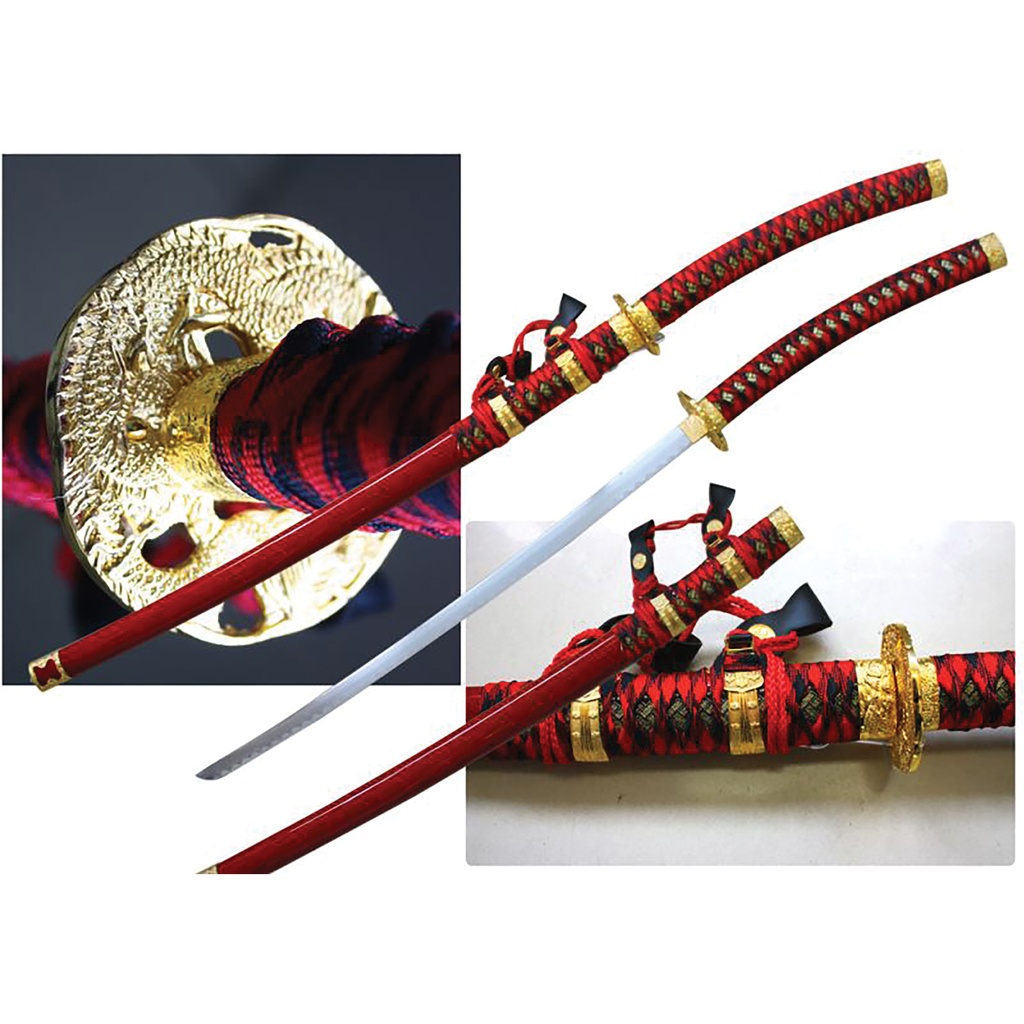
When you look closer, the story gets louder. The polished carbon steel blade catches the light with a clean, silver sheen—no fake weathering, no muddy finish. The red lacquer-style scabbard runs the full length, bold and smooth, broken only by bright gold fittings that look like they were designed to be seen, not hidden in the dark.
Then there’s the tsuba—the round hand guard. It’s not some flat, stamped plate; it’s an ornate, raised dragon motif finished in gold, scaled and textured enough that you can feel it under your thumb. That dragon does something subtle: it turns this from “a red Japanese sword” into your ceremonial katana, the one that means something when you put it on display.
The Moment Your Hand Finds the Wrap
The handle wrap is where it clicks. Red and black cord crisscrosses in a traditional diamond pattern down the extra-long handle, designed so both hands can find their place without looking. When you grip it, you feel those shallow ridges press into your palms—just enough bite to feel secure, never harsh. You understand in a heartbeat why ceremonial blades were made this way: not just to be seen at a distance, but to feel composed and controlled when held.
Red, Gold, and the Drama of Being Seen
That red scabbard and gold hardware aren’t quiet. They’re deliberate. When this ceremonial katana hangs on a wall, leans on a stand, or rests above a desk, the eye goes straight to it. Red for power and presence, gold for status, black accents to ground it so it doesn’t tip into costume territory. You don’t need to explain it to guests. They’ll ask on their own.
Living With a Ceremonial Katana: How It Changes Your Space
Owning a red ceremonial sword like this isn’t about having “a sword collection.” It’s about what happens to the spaces you live in every day. That blank wall behind your desk? Now it’s a focal point. The entertainment center that looks like everyone else’s? Add this blade on a stand, and suddenly the TV isn’t the loudest thing in the room.
You start to notice the small rituals. The way you pause before drawing the blade from the scabbard because you like the sound of steel leaving wood-lined lacquer. The habit of straightening the sageo cord, the red-and-black tying on the scabbard, before guests arrive. The quiet pride when someone stops mid-conversation and says, “Okay, that sword—what’s the story?”
In that moment, this isn’t just a Japanese ceremonial sword hanging in your home. It’s a conversation you chose to start. Maybe it ties back to your love of samurai history, your training background, your favorite anime, or just your belief that objects should feel intentional, not random. Whatever your reason, the blade gives that story a physical shape.
When a Red Ceremonial Katana Becomes the Gift They Never Forget
There’s another side to this: the moment you give it away. A sword is never a neutral gift, especially a bold red ceremonial katana with dragon-etched gold hardware. You don’t hand this to someone casually. You give it to mark something—graduation, a promotion, a black belt, a new home, a chapter closing and another one opening.
You watch them take the scabbard in both hands, feeling the weight. You watch their eyes run from the extra-long handle to the bright gold tsuba, then back to you with that silent Are you serious? look. Then they draw the blade, hear that first soft whisper of carbon steel sliding free, and you can see it land: this isn’t decor. This is recognition. This says, "I see what you’ve done, and it deserves ceremony."
Questions People Ask Before Buying a Ceremonial Katana
Is a red ceremonial katana like this just for display, or can it be used?
This red ceremonial sword uses a real carbon steel blade with a full-length, curved edge, so it feels authentic in hand. That said, it’s designed as a ceremonial and display katana—ideal for drawing, posing, and presence—rather than as a hard-use cutting tool or training weapon.
How big is this ceremonial sword compared to a standard katana?
At 43 1/4 inches overall, this ceremonial katana is a full-length Japanese-style sword with an extra-long handle. That extended grip gives it a more dramatic, formal profile than many shorter replicas, and it feels naturally two-handed, which adds to its ceremonial presence on a wall or stand.
Will the red and gold finish look cheap up close?
In person, the red lacquer-style scabbard, gold dragon tsuba, and matching fittings create a bold, coordinated look rather than a plastic costume vibe. The polished carbon steel blade and traditional wrap help it read as a ceremonial display sword—striking and theatrical, but still respectful of Japanese samurai aesthetics.
Is a ceremonial katana like this hard to display safely?
It’s straightforward to live with if you treat it like the real sword it is. Keep it in the red scabbard when not in use, mount it on a wall rack or horizontal stand, and make sure it’s out of the easy reach of kids. Most people find that setting it in one visible, stable spot turns it into the room’s natural anchor.
Who You Become the First Time You Draw This Ceremonial Katana
Picture your space as it looks right now. Then picture this: you reach for the red scabbard, fingers brushing the gold fittings, and ease the blade from its sheath. Light runs the length of the carbon steel as the last inch clears, and your grip settles into the red-and-black wrap like it’s been waiting there for you. In that quiet second, you’re no longer someone who just owns things. You’re someone who chooses symbols—and this ceremonial katana is the one that finally matches the story you’ve been telling yourself all along.