Beacon Edge Full-Tang Survival Knife - Orange Rubber
You know that moment when the trail gets quiet, light dips, and you realize you’re farther out than planned? That’s when a survival knife stops being gear and becomes insurance. This full-tang survival knife gives you a bright orange grip you can’t lose in the brush, a black clip-point blade with serrations and sawback teeth that actually bite, and a sheath that keeps it where your hand expects it. You’re not hoping it’ll hold up—you’re counting on it.
| Blade Color | Black |
| Blade Finish | Matte |
| Blade Style | Clip Point |
| Blade Edge | Serrated |
| Blade Material | Steel |
| Handle Finish | Matte |
| Handle Material | Rubber |
| Theme | None |
| Tang Type | Full Tang |
| Carry Method | Sheath Carry |
| Sheath/Holster | Sheath |
The sky goes from gray to charcoal faster than you expected. The map said another mile. Your legs say you’ve already done it. Brush closes in, temperature drops, and that comfortable margin between “prepared” and “pushing it” starts to shrink. Your pack feels heavier, but your hand goes straight to one thing you know you can trust: the full-tang survival knife riding your hip, that blaze of orange handle exactly where you left it.
Why a Survival Knife Becomes the Tool You Reach For First
When you carry a survival knife, you’re not just hauling steel—you’re carrying the quiet promise that if things get weird, you’re not helpless. This isn’t a delicate pocket blade you loan out to open snack bags. It’s the knife you grab when a branch needs to become a stake, when wet cordage needs cutting, when something has to give and you’re the one responsible for making it happen.
A full-tang survival knife like this one runs its steel straight from the tip of that matte black clip-point blade through the entire orange rubber handle. You feel that continuity the first time you baton it through a knotty piece of wood. There’s no flex, no question about where the force is going. Every swing, every push cut, every twist is backed by a single solid spine.
And you notice how it changes your posture. Instead of working around flimsy gear, you start assuming your blade will take the hit. You stop babying it and start using it like a real survival tool.
How a Full-Tang Survival Knife Holds Up When Conditions Don’t
You don’t think about construction when the sun’s out and everything’s going to plan. You think about it later—the first time you’re cold, hungry, and counting on your survival knife to do more than pose for photos. That’s when the full-tang build and rubber grip stop being buzzwords and start being the reason you’re getting things done.
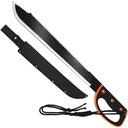
The matte black clip-point blade gives you a strong tip for controlled piercing and detail work, while the sharpened edge runs long enough to slice through stubborn rope, webbing, or sap-laden branches without needing three passes. Along the spine, the aggressive sawback teeth aren’t decoration—you can lean into them to notch poles, hack through smaller limbs, or score wood for easier breaking when you don’t want to burn energy swinging.
The orange and black rubber handle locks into your palm when your hands are slick, cold, or gloved. That enclosed guard and full hand loop keep your fingers from sliding forward when you’re driving the survival knife into something that doesn’t want to move. You don’t need to think about grip safety; the design makes the decision for you.
This is where design choices start to matter in your story. Matte finish means minimal reflections when you’re working at dawn or trying not to draw attention. The lanyard cord at the base means you can loop it to your wrist while sawing or working over water, so a slip doesn’t turn into losing your blade completely.
Carrying a Survival Knife You Can Find Fast and Use Hard
If you’ve ever set gear down “just for a second” and spent fifteen minutes hunting for it among dead leaves and underbrush, you already know why the orange handle on this survival knife matters. High visibility isn’t an aesthetic choice; it’s the difference between continuing the job and backtracking through fading light looking for the one tool you really need.
Belt carry with the included sheath becomes second nature. Slide it onto your hip before heading out, and before long your hand starts to drift there whenever you need to cut, pry, or notch. The sheath keeps the survival knife secure against your side when you’re ducking under branches or scrambling over deadfall, but the opening is forgiving enough that you can draw it cleanly without fumbling—even with light gloves on.
In camp, the survival knife becomes the default: shaving tinder, trimming tent lines, splitting kindling small enough for a stubborn fire, slicing food when you don’t feel like unpacking a whole kitchen. You stop wondering if you’re "abusing" it and start judging everything else by whether it holds up as well.
When a Full-Tang Survival Knife Quietly Changes How You Move Outdoors
There are moments when a survival knife is just comfortable overkill—and you like it that way. A quick day hike that stretches to sunset. A roadside breakdown in the rain where you’re cutting zip ties, clearing brush, or rigging a temporary fix on the fly. An unexpected storm front that forces you to throw up shelter fast before everything around you is soaked.
In those in-between moments—the ones that never make it onto social feeds—you’ll feel the quiet confidence of having a full-tang survival knife as part of your kit. You stop mentally rehearsing worst-case scenarios and start thinking in steps: cut this, notch that, saw here, reinforce there. The knife isn’t the star of the story; it’s the reason the story stays boring instead of turning dramatic.
And when someone with you says, "I wish we had something sharp," you already know where your hand is going. Not to show off. Just to get it done.
Questions People Ask Before Buying a Full-Tang Survival Knife
“What makes a full-tang survival knife better than a basic fixed blade?”
With a full-tang survival knife, the steel runs the entire length of the handle, which means the blade and grip are one continuous piece. For you, that translates into strength when batoning, prying, or chopping—less chance of the handle separating or failing when you’re leaning into the work. It’s about confidence that your main tool won’t tap out before you do.
“Can I use this survival knife for everyday camp tasks, not just emergencies?”
Yes—and that’s where it really earns its place. A solid survival knife pulls double duty as your daily camp blade: processing firewood, cutting paracord, prepping simple meals, even light clearing around camp. You get used to having one tool that covers a lot of ground, instead of juggling a dozen fragile gadgets.
“Is this kind of survival knife practical to carry, or is it too much?”
If you’re only opening packages at home, a big survival knife might be overkill. But if you hike, camp, hunt, or like knowing you can handle minor emergencies yourself, carrying a full-tang survival knife on your belt quickly feels natural. The sheath keeps it out of the way until you need it, and the bright orange handle makes it easy to spot and grab fast.
“How well does the sawback on a survival knife actually work?”
Sawbacks on a survival knife are about controlled notching and cutting, not replacing a dedicated saw. On this blade, the teeth are aggressive enough to bite into branches and green wood when you’re shaping poles, making traps, or building shelter. It’s a backup capability that saves you time and effort when carrying a full saw isn’t realistic.
Later, you’ll remember small flashes instead of specs: the way the orange handle of your full-tang survival knife glowed against wet leaves when you set it down; the steady bite of the serrations as you cut stubborn rope with cold, numb fingers; the sound of the sawback working through a branch while the rest of the world went quiet. You’ll remember how it felt to reach for your belt and know that when plans shifted, you didn’t have to. That’s what owning a survival knife like this really gives you—less drama, more control, and the calm confidence of someone who came ready and left on their own terms.