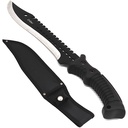
Blackout Sawback Field-Ready Tactical Fixed Blade - Matte Black
You’re deep in it when the easy options run out—wet cord, stubborn branches, gear that has to be cut free now. That’s when a tactical fixed blade stops being just another knife and becomes the one tool you trust. The sawback bites into wood, the partial serrations tear through webbing, and that matte black rubber grip stays locked in even when your hands don’t. On your belt, it feels less like gear and more like backup you don’t have to question.
| Blade Color | Black |
| Blade Finish | Matte |
| Blade Style | Clip Point |
| Blade Edge | Partial-Serrated |
| Handle Finish | Matte |
| Theme | None |
| Sheath/Holster | Sheath |
When a Tactical Knife Becomes the Quiet Backup You Rely On
You don’t notice the tactical knife on your belt the first hour you’re out. You notice it in the tenth, when the temperature drops, your hands are tired, and something finally goes wrong. The strap that won’t budge. The branch blocking the trail. The tarp that has to be notched and rigged before the light disappears. In that moment, you’re not thinking about brand names—you’re thinking, “Will my blade actually do this?”
That’s where a field-ready tactical knife like this earns its place. Not in the pretty photos, but in the small, ugly jobs you wish you didn’t have to do—and the way it quietly handles them without drama.
How a Tactical Knife Changes the Way You Move Through the Field
If you’ve ever carried a knife that felt more like a suggestion than a solution, you know the difference the first time you pick up a real tactical knife. The weight settles into your palm, not too heavy, not toy-light. The full-tang steel runs straight through the handle, so when you drive the blade into something stubborn, you feel one solid piece of intent, not a rattle of parts.
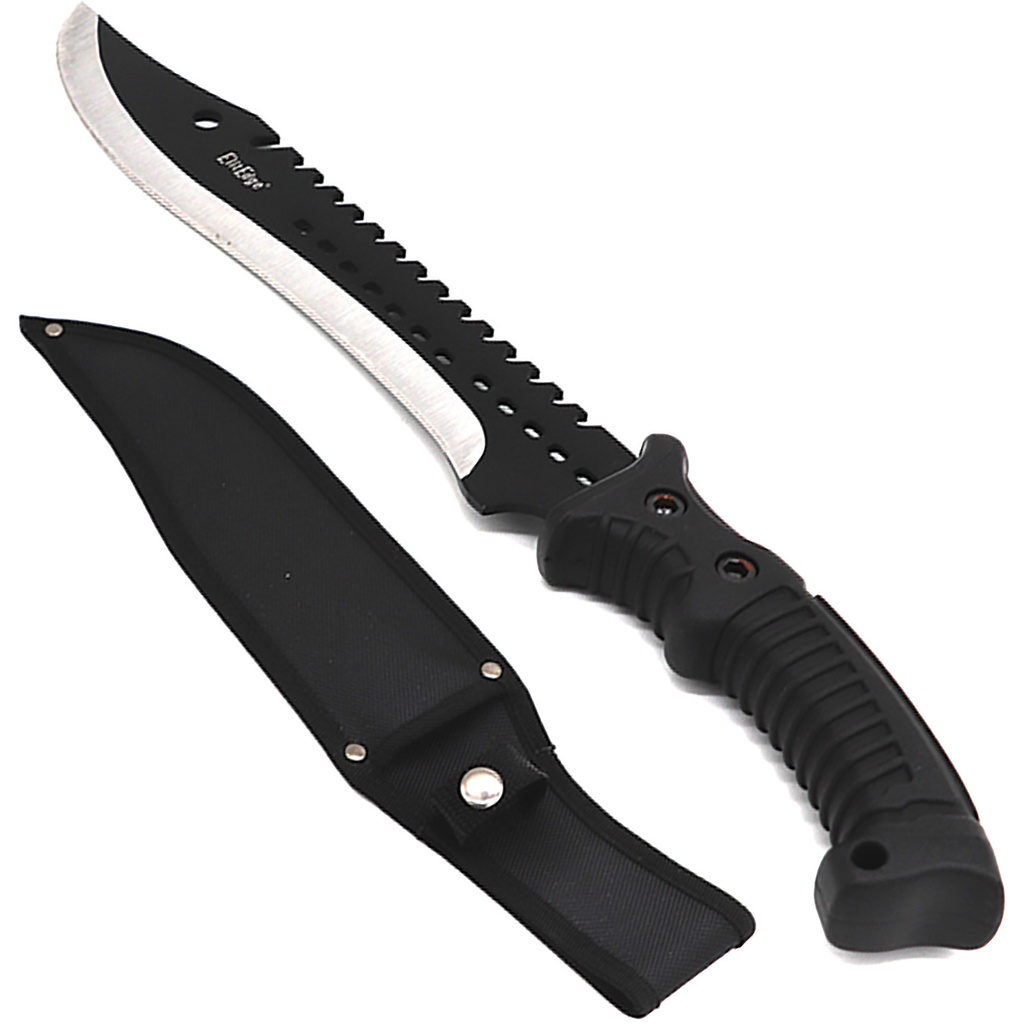
The clip point tip gives you control where you need it most—starting a precise puncture in tough material, opening packaging without shredding what’s inside, or making that first clean pierce in dense plastic or leather. Then the partial serrations near the handle take over, ripping through rope, paracord, and webbing when a smooth edge would just skate. You’re not babying the cut; you’re getting it done.
Run your thumb gently along the spine and you feel the sawback teeth: aggressive enough to chew into small branches and notches, controlled enough that you can guide them without slipping. That sawback isn’t decoration; it’s the difference between carving out a quick tent stake or pot hanger and giving up because you don’t have the right tool.
The Build That Makes This Tactical Knife Field-Ready, Not Just Tactical-Looking
There’s a reason this doesn’t shine. The matte black finish on the blade eats reflections instead of throwing them back. That matters more than you think: no accidental flash when you’re trying to stay low-key, no glare when the sun hits your hand at the wrong angle. It feels like seriousness, and when you’re tired and moving fast, seriousness is a kind of safety.
The blade steel runs full tang through the handle, ending in a flat pommel with a lanyard hole. That flat butt cap gives you options—light hammering, tapping in tent pegs, or delivering controlled impact when you don’t want to risk the edge. The lanyard hole lets you secure the knife to your wrist or rig it to your gear, so losing it takes real effort.
What you notice first, though, is the grip. The black rubber handle is sculpted with deep finger grooves that tell your hand exactly where to go. That’s not just comfort; it’s orientation. In the dark, in gloves, with cold or wet fingers, you know instantly which way the blade is facing. The texture bites just enough, so sweat, rain, or mud don’t turn your knife into a liability.
Two visible fasteners pin the handle to the tang, another small signal that this was built to work, not just pose. You’re not wondering if the scales will twist free the first time you put real pressure on the blade. You grab, you cut, it holds.
Carrying a Tactical Knife That Actually Fits Into Your Daily Reality
Plenty of knives look ready for the apocalypse and then fight you every time you try to carry them. This one shows up when you need it and stays out of the way when you don’t. The black sheath rides on your belt with a loop that doesn’t flop around and a snap that closes with that quiet, satisfying click you can feel more than hear.
Belt carry matters more than most people admit. When your tactical knife sits at the right angle and doesn’t dig into your hip or catch every time you bend, you stop thinking about it. That mental quiet is worth more than an extra feature or two. You’re free to focus on the trail, the task, the moment—not on adjusting your gear for the hundredth time.
Picture it on a long day: cutting cord for a tarp shelter, trimming small branches for kindling, notching a stick to hang your cook pot over the fire. The sawback gives you the rough shaping, the smooth edge handles the finer slices, and the serrations chew through the jobs you don’t want to waste patience on. Same tool, three distinct roles, all in one motion you’ve repeated enough times that it feels like muscle memory.
When a Tactical Knife Becomes the Difference Between Struggling and Solving
There’s always that one moment that sticks with you. Maybe it’s the time you had to cut a stuck strap in the rain with half-frozen fingers. Maybe it’s the hike where your cheap blade folded on you and turned a simple task into a risky mess. When you carry a solid tactical knife, you’re buying your way out of that feeling.
In the field, seconds stretch. Cutting someone out of tangled gear, clearing a small branch that could twist an ankle, punching a drainage hole in a tarp before a storm dumps everything on you—these aren’t dramatic movie scenes, they’re the small pivots between a trip that goes sideways and one that stays under control.
This knife leans into those pivots. The clip point reaches precisely where you need it. The serrations don’t ask you to be gentle. The sawback spine lets you improvise—quick notches for line, rough cuts in green wood, anything that needs more bite than elegance. You’re not wondering if your blade can handle it; you’re already doing it.
Questions People Ask Before Buying a Tactical Knife
Will this tactical knife hold up to real outdoor use?
Yes—this is a full-tang, fixed blade tactical knife with a rubberized grip and a durable matte black finish, built to be used hard, not babied. The solid steel running through the handle and the included belt sheath make it a dependable daily carry option for field, camp, or range days.
Is a fixed blade tactical knife better than a folding knife for survival?
For rough survival tasks, a fixed blade tactical knife usually wins. There’s no hinge to fail, and you get a stronger platform for prying, batoning, or heavy cutting. A folder is great for pocket convenience; a full-tang tactical knife like this is what you want when you know you’ll be pushing your gear.
Can I carry this tactical knife every day?
If your local laws allow fixed blade carry, this tactical knife makes solid everyday field gear. The belt sheath keeps it secure and accessible, and the blackout finish stays low profile. It’s more at home on a belt, pack, or range rig than in an office, but if your daily life includes the outdoors, it fits.
How sharp is the sawback on this tactical knife?
The sawback is designed for utility, not decoration. The spine teeth are aggressive enough to cut notches in branches, start cuts in tough material, and help with camp tasks where a traditional edge isn’t ideal. It won’t replace a full saw, but in the field it often means you don’t need one.
Picture your next trip out. The air cools, shadows stretch, and the easy part of the day is over. Your hand drops to your belt, finds the sheath, and the tactical knife slides free in one clean motion. Matte black steel, sawback spine, serrated edge—all there, all familiar. No second-guessing, no hoping you brought the right tool. In that moment, with this tactical knife in your hand, you’re not just someone carrying gear. You’re the person everyone turns to when things need cutting, fixing, or quietly handled—and you know your blade is already up to it.