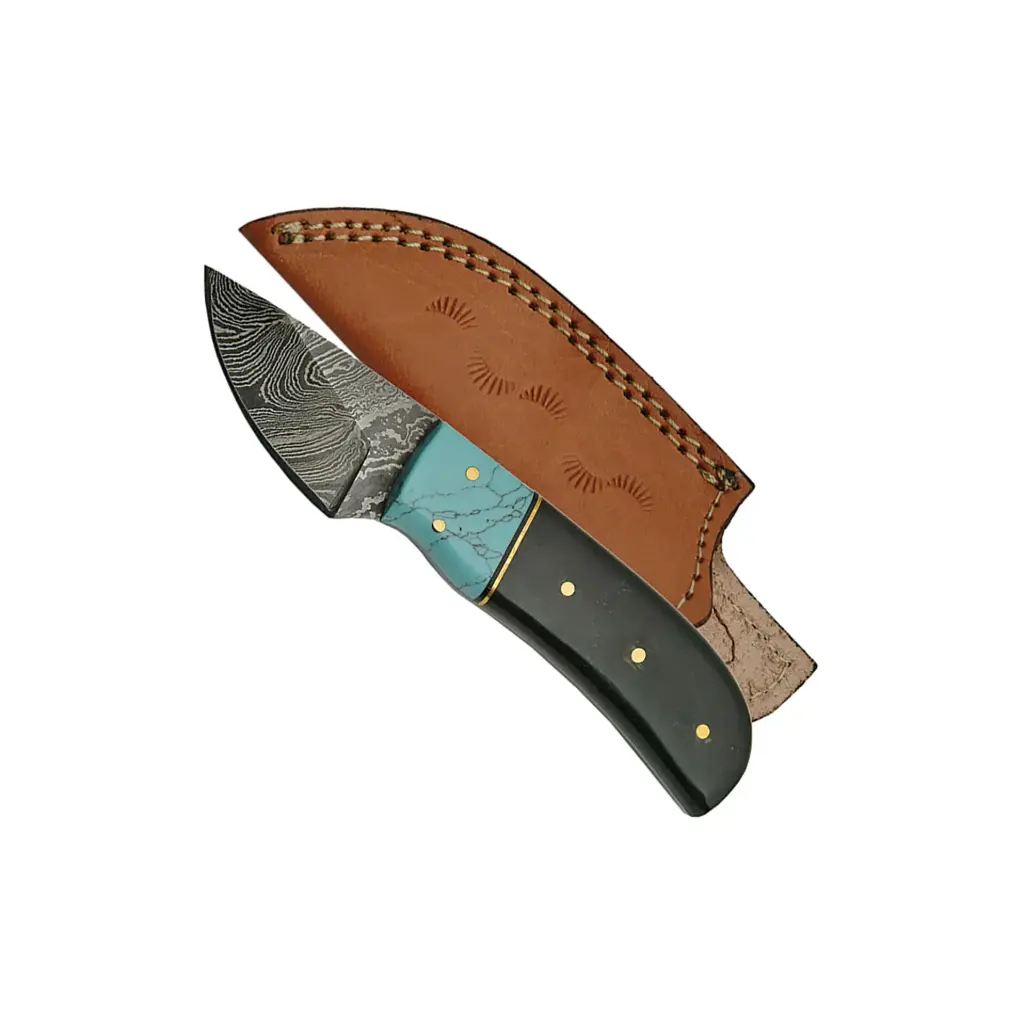
Canyon Vein Damascus Skinner Knife - Horn & Turquoise
You know that moment on the ridge when the light drops and you’re dressing game by feel as much as sight? That’s where a Damascus skinner knife earns its place. This compact full-tang blade slides into hide cleanly, horn and turquoise locking into your grip like it was shaped for your hand alone. The leather sheath rides quiet on your belt, always there, never in the way. You don’t just carry a tool—you carry a piece of the country you love.
| Blade Length (inches) | 2 |
| Overall Length (inches) | 5.5 |
| Blade Color | Silver |
| Blade Finish | Patterned |
| Blade Style | Drop Point |
| Blade Edge | Plain |
| Blade Material | Damascus |
| Handle Finish | Polished |
| Handle Material | Horn |
| Theme | Damascus |
| Handle Length (inches) | 3.5 |
| Tang Type | Full Tang |
| Carry Method | Sheath |
| Sheath/Holster | Leather |
You’re on the last ridge of the evening, hands already cold, breath hanging in the air. The work has to be clean, quick, and respectful. This is the moment you find out whether the knife on your belt is just another blade or the Damascus skinner knife you’ll reach for every season from now on.
When a Damascus Skinner Knife Turns Work Into Rhythm
Field work has a rhythm when your gear doesn’t fight you. With a compact Damascus skinner knife in your hand, that 2-inch drop point doesn’t feel small—it feels precise. The full-tang spine runs steady through your palm, and suddenly you’re not wrestling with hide and angles. You’re just moving, confident, sure. The cutting edge glides through skin instead of tearing, so you spend less time correcting mistakes and more time doing the job right the first time.
This is what layered Damascus steel really means for you: not buzzwords, but a blade that bites cleanly, then keeps biting. The rippled pattern you see isn’t decoration; it’s your visual reminder that this edge was built to handle real field use instead of folding the second you hit gristle or bone. You feel it the first time you draw that line along the hide—the cut goes where your hand intends, not where the blade decides.
How a Damascus Skinner Knife Disappears on Your Belt, Then Delivers
Out in the field, every ounce on your belt has to earn its ride. At 5.5 inches overall, this fixed blade skinner is the kind of daily field companion you forget is there—until you reach back and it’s exactly where you want it. The leather sheath hugs close, riding quiet against your side instead of swinging or catching as you climb over deadfall or step into the truck.
Full-tang construction means the steel runs from tip to butt, so when your fingers tighten around the handle, you’re holding one solid piece, not a blade pinned to hope. That matters when your hands are slick or tired and you’re working by instinct. The drop point profile gives you control at the tip for careful opening cuts, while the belly brings the slicing power when it’s time to pull long, clean passes.
The Feel of Horn and Turquoise in a Damascus Skinner Knife
There’s a moment before the first cut when you just hold the knife and your hand makes up its mind. Polished horn warms quickly against your skin, smoothing into your grip. The turquoise inlay isn’t just there to look good—it breaks up the handle visually and physically, giving your fingers a natural reference point, a subtle index that tells you exactly how the blade is oriented without needing to look.
Horn has a way of feeling alive, especially when it’s contoured to follow the curve of your fingers. Paired with the cool, veined turquoise and brass spacers, the handle becomes something you can recognize by touch in the dark bottom of a pack or in a pile of gear. This isn’t plastic that feels the same as every other knife you’ve owned. It’s a combination of materials that quietly says you chose this piece, you didn’t just grab it off a rack.
The Small Knife That Handles Big Jobs
At first glance, a 2-inch blade sounds almost too compact—until you’re on the third animal of the season and your wrist isn’t screaming at you. A compact fixed-blade skinner forces the work closer to your hand, which translates into control. You’re not overreaching, not trying to steer a big camp knife through tight angles. You’re guiding a short, obedient edge that goes exactly where you nudge it.
That’s the hidden advantage of carrying a small Damascus hunting knife like this one: you don’t waste energy wrestling steel. You move slow, steady, and accurate, which is how hides stay intact and meat stays clean.
Carrying a Damascus Skinner Knife in Real Life
Think about your usual day in the field or in camp—the constant on-off with gloves, the bending, crouching, climbing into trucks and stands. A lot of knives feel like anchors by midday. This one rides in its leather sheath like a secret between you and your belt. You reach down, thumb the top of the sheath, and the handle is already in your hand, horn and turquoise lined up the way you like it.
For everyday carry around property, in the shop, or on the trail, a compact fixed blade can be easier to live with than a bulky folding knife. No moving parts, no grit creeping into a pivot, no lock to fail at the worst time. Just draw, cut, and slide it back home into leather. Whether you’re breaking down feed bags, trimming cord, or dressing game, it’s the same simple motion, over and over, until it’s just part of how you move.
The Quiet Flex of a Damascus Everyday Carry Blade
You know how some gear quietly tells people you know what you’re doing? The Damascus waves on this blade and the flash of turquoise at the handle do that without shouting. Around other hunters or knife people, it reads as a deliberate choice: a compact, purpose-built carry knife that balances beauty with work. Around non-knife folks, it just looks like a handsome, well-kept tool that belongs on your belt.
When a Damascus Skinner Knife Becomes “Your Knife”
There’s a difference between owning a knife and having a knife that stories stick to. This is the one that shows up in memory—the first deer your kid helps you dress, the freezing morning when everything went wrong but the edge didn’t fail, the night you used it more on rope, tarps, and stubborn packaging than on hide.
Because the blade is Damascus, it carries those faint, topographic lines that age with you. Over seasons, the pattern darkens slightly, the horn picks up its own subtle shine where your fingers always land, the leather sheath softens and shapes to your hip. A generic stainless skinner stays anonymous. This one becomes recognizable—your family could pick it out of a pile without hesitating.
Questions People Ask Before Buying a Damascus Skinner Knife
Is a small Damascus skinner knife actually big enough for real hunting?
If you’re used to oversized hunting blades, a compact Damascus skinner knife can surprise you. That 2-inch drop point is more than enough for dressing deer, small game, or hogs when you use clean technique. The shorter blade keeps the work close to your hand, which gives you more precision and less accidental punctures.
Will a Damascus skinner hold an edge with regular field use?
Damascus steel is known for combining toughness with solid edge retention. In real use, that means your Damascus skinner knife keeps cutting cleanly through hide and light bone contact without constant trips to the sharpener. A few passes on a stone or strop brings the edge right back when you finally need it.
Is a fixed-blade skinner harder to carry than a folding hunting knife?
A compact fixed blade like this actually carries easier than many folding hunting knives. At 5.5 inches overall, it rides low-profile in its leather sheath on your belt, with no bulk in your pocket and no moving parts to worry about. Draw and re-sheath are one smooth motion, even with gloves on.
Can I use a Damascus skinner knife as an everyday carry blade?
If your daily life includes property work, shop time, or regular outdoor miles, this compact Damascus skinner knife makes a capable everyday carry blade. It handles rope, boxes, cord, and light camp chores easily, while still being ready for serious field work when the season turns.
Picture your next season opener. The air’s colder than you planned for, and you’re working fast but careful. Your hand wraps around horn warmed by your grip, turquoise pressing lightly against your fingers as the Damascus edge slips into hide with that first, clean line. The knife doesn’t draw attention to itself; it just does exactly what you ask, every time. By the time you slide it back into its leather sheath, that compact Damascus skinner knife isn’t “a new blade” anymore—it’s part of how you hunt, how you work, how you carry yourself in the field.