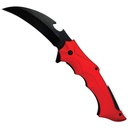
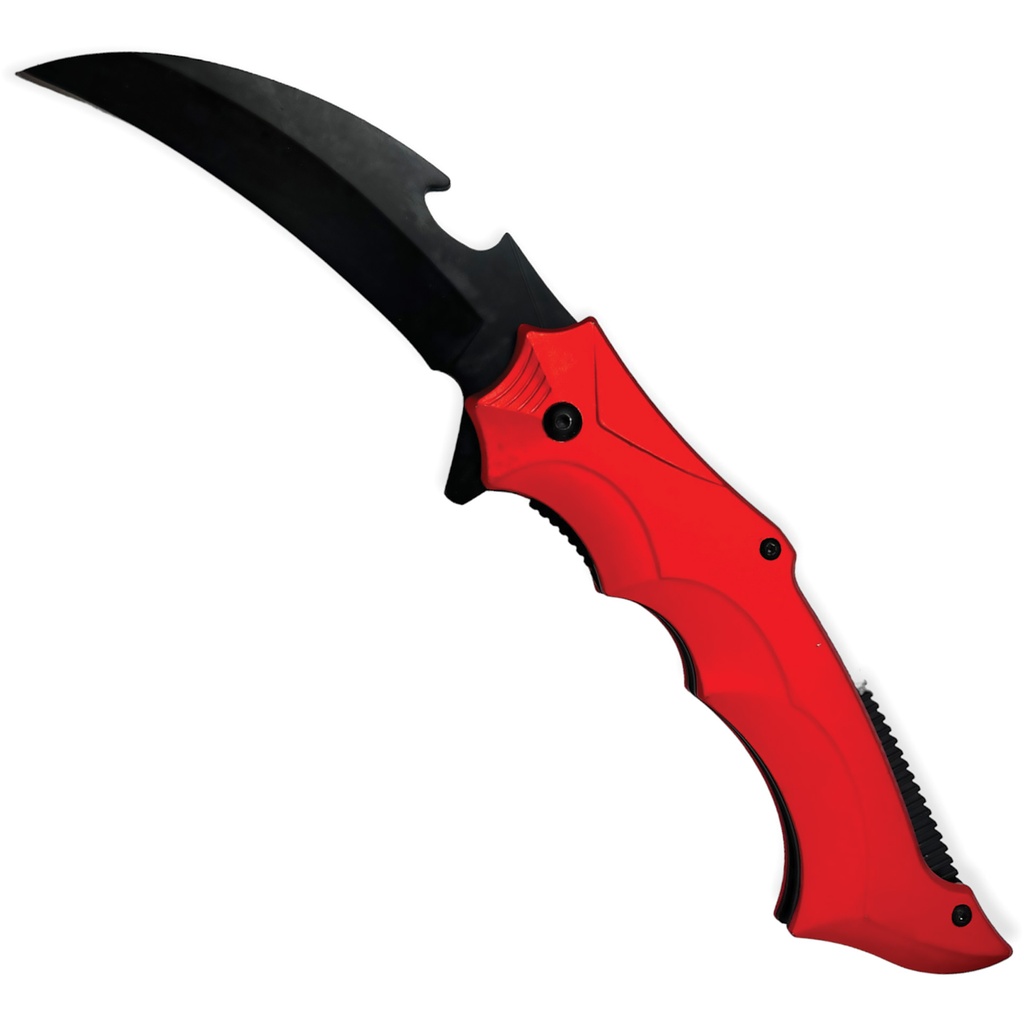
Crimson Talon Rapid-Deploy Karambit Knife - Red Handle
You don’t carry a spring-assisted karambit knife just to have a blade—you carry it so your hands never hesitate. One push on the flipper and that black talon snaps into place, locking behind your grip like it’s wired to your reflexes. The red handle fills your palm, the ring anchors your hold, and suddenly you’re the person who’s ready when everyone else is still thinking about what to do.
| Blade Color | Black |
| Blade Finish | Matte |
| Blade Style | Talon |
| Blade Edge | Plain |
| Handle Finish | Matte |
| Theme | Karambit |
| Pocket Clip | Yes |
| Deployment Method | Spring-assisted |
| Lock Type | Liner lock |
You’re walking to your car and something just feels off. That tiny prickle at the back of your neck, the one you’ve learned not to ignore. Your hand doesn’t fumble for a light or keys or an app—you already know exactly where your spring-assisted karambit knife sits, clipped in the same spot every single day.
Your fingers close around that red handle like they’ve done it a hundred times. One practiced motion, one press on the flipper, and the black talon blade arcs out, locked and ready. In that split second, you’re not scrambling. You’re in control.
How a Spring-Assisted Karambit Knife Changes What You Do in a Split Second
When stress spikes, your fine motor skills drop. You know this. That’s why a spring-assisted karambit knife matters—it replaces fumbling with muscle memory. The flipper is right where your index finger expects it, and the assist mechanism does the rest, snapping the talon blade into place with a decisive, satisfying click.
This isn’t about flashy tricks. It’s about a curved, talon-style blade that naturally follows the line of your hand, giving you controlled, powerful cuts even when your heart rate is up. The finger ring locks in your grip, so you’re not worried about slipping, twisting, or losing control if your hands are wet, gloved, or shaking with adrenaline.
Because the blade is compact and folding, this isn’t some oversized combat fantasy piece you leave at home. It rides quietly in your pocket as a daily carry companion, always in the same place, always ready to open the same way—fast, repeatable, instinctive.
Why This Spring-Assisted Karambit Knife Feels So Locked-In in Your Hand
The first time you pick this up, what hits you isn’t just how it looks—it’s how it seats into your hand. The bright red handle isn’t just for show; its curves follow your fingers, letting you instinctively find your place without looking. Each groove tells your hand, "You belong here."
The liner lock engages behind the black matte blade with a firm, audible assurance. You feel it more than you think about it. That’s the whole point: your focus stays on what’s in front of you, not on whether your knife is going to fold when you lean into a cut.
Jimping along the spine and exposed liner gives your thumb and palm somewhere to bite in. When you pull through rope, cardboard, or stubborn plastic, nothing squirms or wriggles free. You’re not fighting the knife; the knife is backing you up. The matte finish on both blade and handle keeps glare down and grip predictable, so even under bright lights or sweaty palms, you stay in command.
The Red-Black Contrast You Can Read at a Glance
There’s also something quietly practical about that crimson handle against the black blade. Drop it in a dark room or at the bottom of a bag, and your eyes find the red first. It’s bold, aggressive, sure—but it’s also easy to spot when you actually need it.
Carrying a Spring-Assisted Karambit Knife in Real Life, Not Just in Theory
Owning a tactical-looking knife is one thing. Actually carrying it, every day, is another. You know the difference. If a blade feels bulky, awkward, or like it’s trying too hard, it ends up living in a drawer instead of on your pocket.
This spring-assisted karambit knife was built with a different reality in mind: jeans, joggers, work pants, maybe a jacket when it’s cold. The pocket clip keeps the knife riding low enough to stay discreet, but high enough that you can get a clean draw without digging for it. The ring peeks just enough to give your fingers a natural hook-in point.
In day-to-day life, you’ll reach for it more often than you expect. Breaking down boxes after a delivery. Cutting paracord on a camping trip. Opening heavy plastic packaging that laughs at cheap blades. Every time, that same simple sequence repeats—clip, draw, flipper, snap. The motion becomes part of your daily rhythm, not some special-occasion move.
From EDC Task Blade to Quiet Confidence
The more you use it, the less you think of it as “a weapon” and the more it becomes a tool of readiness. You’re the person who always seems prepared: the friend who already has a sharp blade when nobody else does, the neighbor who can cut a strap or free a stuck line without making a production out of it.
When a Spring-Assisted Karambit Knife Is the Right Move vs. a Regular Pocket Knife
You’ve probably owned a standard pocket knife. Straight blade, maybe a thumb stud, maybe a basic liner lock. It works. But a spring-assisted karambit knife changes the equation in three ways: deployment speed, grip security, and cutting mechanics.
The assist gives you near-automatic speed without crossing into full-auto territory. The curvature of the talon blade pulls material into the cut instead of pushing it away, which means more control on pull cuts—exactly what you actually use in tight spots and real-world defensive situations.
Then there’s the grip. That finger ring doesn’t just look tactical; it keeps the knife anchored to you. Even if your hand opens under stress, the ring keeps the handle from dropping away. That security is the kind of thing you don’t fully appreciate until you’ve trained with both styles and feel how much harder it is to lose this knife once it’s in your hand.
So you’re not choosing this just because it looks aggressive. You’re choosing it because it changes how you interact with a blade—more control, more retention, more natural motion for both utility cuts and, if you ever needed it, self-defense.
Questions People Ask Before Buying a Spring-Assisted Karambit Knife
Is a spring-assisted karambit knife practical for everyday carry or just tactical show?
It’s more practical than it looks. The curved blade excels at everyday pull cuts—rope, straps, cardboard—while the assisted opening makes one-handed use simple. The pocket clip and compact profile keep it EDC-friendly so it doesn’t feel like you’re carrying a giant tactical brick.
Is a spring-assisted karambit knife legal to carry where I live?
Laws vary a lot by state, city, and even country. Many places treat spring-assisted knives differently than automatics, but karambit-style blades can draw extra attention. Before you carry this daily, check your local knife and concealed carry laws so you know exactly where you stand.
Will the assist and liner lock on this kind of knife hold up to real use?
Spring-assisted mechanisms are built for repeated deployment, and the liner lock is a proven design used on countless working knives. As long as you don’t abuse it as a pry bar or hammer, it’ll handle normal EDC cutting tasks and training use just fine.
Is a spring-assisted karambit knife good for self-defense compared to other carry knives?
Many people choose a spring-assisted karambit knife specifically for defensive carry because of the rapid deployment and secure ring grip. But a tool is only as effective as the person using it—training and understanding your local laws matter just as much as the blade you choose.
Later that night, you empty your pockets onto the dresser—the same quiet ritual you do every day. Keys. Wallet. Phone. And that flash of red and black, your spring-assisted karambit knife, folding back into itself with a soft, controlled click. You don’t feel like someone who’s looking for trouble. You feel like someone who’s already decided how they’ll handle it if it ever shows up. That’s the difference you carry now—small enough to clip in your pocket, big enough to change how you move through the world.