Crusader Oath Medieval One Hand Sword - Black & Silver
You don’t hang a crusader’s blade on the wall just to look at it—you reach for it. With this medieval one hand sword in your grip, the weight, the carbon steel, the cruciform hilt all answer a quiet question: do you move like someone trained, or someone pretending? The black wrap bites into your palm, the silver cross on the pommel meets your eye, and suddenly you’re not holding décor. You’re holding a story you chose to step into.
You never meant to stay on the sidelines. That’s why you’re here—staring at a blade that looks like it was stolen from a knight stepping out of a church doorway into cold morning air. You can almost feel the weight of a medieval one hand sword settling into your grip, steady and certain, and you wonder: if you owned it, would you move like someone who knows what they’re doing—or like someone just playing dress-up?
When a Medieval One Hand Sword Stops Being Just a Prop
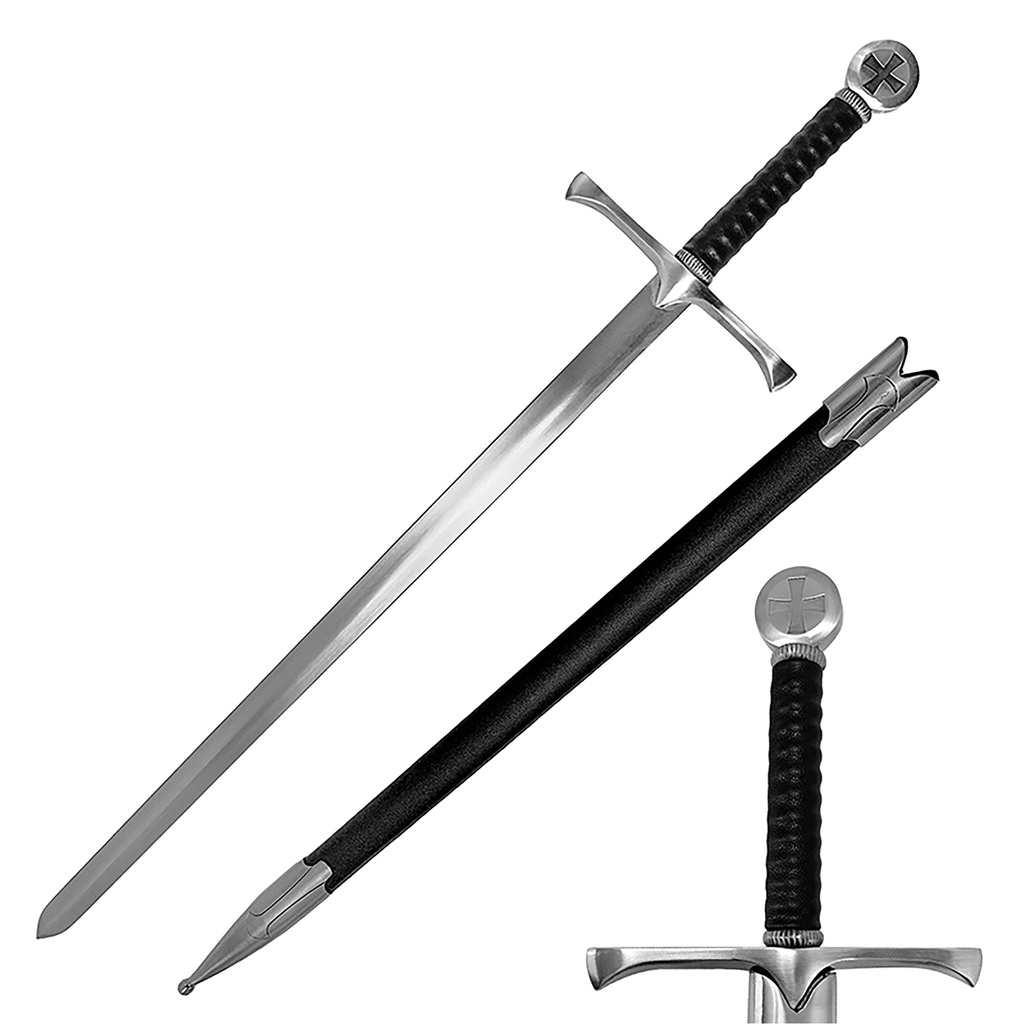
This isn’t a plastic stage toy or a fantasy wall-hanger with impossible curves. In your hand, a true medieval one hand sword should feel like a decision. At 42 1/4 inches overall, this carbon steel blade fills your reach without owning your body—long enough to feel like a knight’s weapon, balanced enough that you can still cut, thrust, and recover without fighting the weight.
You notice it first in the way the blade tracks. That straight, double-edged profile with a central ridge doesn’t just look historically honest; it lets you align your cuts without thinking. The sword helps your wrist find the line, the way a well-made training tool quietly teaches your body. You don’t have to baby it, and you don’t have to pretend. You just pick it up, and your stance changes.
Why This Medieval One Hand Sword Feels Knightly, Not Cartoonish
Most people spot the cross on the pommel and think “crusader.” You feel something slightly different: discipline. The clean disc pommel with the engraved cross, the straight cruciform guard, the black wrapped grip—nothing is overdone. No spikes, no skulls, no etched flames. Just the restrained black-and-silver geometry of a knight who took vows before he took the field.
The carbon steel blade has that honest, polished sheen that catches light without screaming for attention. You see the faint line of the ridge down the center, the subtle taper toward the point that tells you this isn’t just a chopping bar of metal—it’s built to thrust as well as cut. The black wrap on the handle isn’t smooth; it has texture under your fingers so your grip doesn’t wander when sweat, rain, or stage lighting gets involved.
Even the scabbard stays in character: black with silver metal fittings at throat and chape, the kind of look that makes sense slung from a belt over a gambeson or hanging by the doorway of your modern apartment. You get the full medieval story without sacrificing the quiet, grounded realism collectors and reenactors respect.
Carrying a Medieval One Hand Sword Into Your Real Life
Owning a medieval one hand sword like this doesn’t mean you’re suddenly living in armor. It means your hobbies and your space start to line up with who you say you are.
The way it lives on your wall
Picture it mounted horizontally above your desk or vertically by the door. The black scabbard and silver accents sit against the wall like a line of punctuation—simple, final. Guests notice. Some will joke. The ones who get it will step closer, eyes on the cross pommel, and you’ll see that flicker of recognition: this isn’t a toy.
The way it moves in your hand
Maybe you practice historical European martial arts, or maybe you just want to move like someone who could. The one-hand grip lets you work basic cuts and guards while keeping your off-hand free—shield, buckler, cape, or nothing at all. The balance lets you drill without gasping for air after a few passes. You feel the blade respond when you adjust your wrist angle, and that feedback quietly makes you better.
When a Real Blade Changes Your Reenactment or Training
If you step onto a field with other reenactors, you already know: the moment you draw, everyone sees whether your sword belongs. A medieval one hand sword with a straight crusader aesthetic and a carbon steel blade tells a different story than a fantasy piece with serrations and neon accents. It says you cared enough to choose something that could plausibly have been carried by a 12th–13th century knight.
For stage work or choreography, the length and form factor give you options. One-handed cuts, shield-side footwork, half-swording techniques for close work—the geometry supports all of it. You’re not wrestling a wall-sword; you’re directing a tool. And because there’s a scabbard, you get the full moment: draw, engage, recover, resheathe. The rhythm of that sequence has a way of anchoring you in character, even if the “stage” is just your backyard at sunset.
Questions People Ask Before Buying a Medieval One Hand Sword
Is a medieval one hand sword like this good for actual training?
If your training includes handling real steel, this medieval one hand sword gives you the weight, reach, and balance you need to understand how a knightly blade moves. It’s not a foam simulator, and you should respect it as a live blade, but for solo drills, flow work, and understanding mechanics, it’s a solid, honest tool.
Can I use this medieval sword for reenactment or stage combat?
Many reenactors and stage performers choose a medieval one hand sword with this kind of cruciform design because it looks right from ten feet away and in photos. Actual use will depend on your group’s safety rules, edge preferences, and local regulations, so you’ll want to confirm whether live edges are allowed or if you need to blunt or modify the blade.
What makes this different from a generic decorative sword?
You feel the difference the first time you swing it. A true medieval one hand sword is built around handling, not just looks. The carbon steel blade, the disc pommel that helps counterbalance the length, and the textured grip all exist so you can actually move with it—cut, guard, and recover—without fighting awkward weight distribution.
How This Medieval One Hand Sword Fits the Story You’re Writing
Maybe you’ve collected knives and smaller blades for years and you’re ready to step into something that carries more presence. Maybe you’ve been borrowing practice weapons at class and you’re tired of your movement depending on whatever’s left in the rack. Or maybe you just want one piece in your home that quietly says: I respect history, and I don’t do half measures.
A medieval one hand sword like this doesn’t scream for attention; it waits. Hung on a wall, resting in a stand, or resting across your lap while you wipe it down, it becomes part of your ritual. You might run your thumb along the ridge of the blade, trace the engraved cross on the pommel, feel the bite of the black wrap under your fingers. In that small, private moment, you’re not just someone who “likes knights.” You’re someone who chose a weapon that could have belonged to one.
So picture your next quiet evening. The room is dim, screen glow fading. You stand, cross the space, and your hand closes around the grip of your medieval one hand sword. The blade slides free of the black scabbard with a muted whisper, silver catching the last of the light. Your spine straightens just a little. You test the weight, the line of the edge, the way the point settles where you look. In that moment, you’re not escaping into fantasy—you’re aligning with a part of yourself that values discipline, history, and readiness. And this time, the story in your head has a real blade to match.