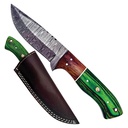
Forest Vein Damascus Field Hunter Knife - Green Wood
You feel it before you see it—the quiet weight of a Damascus hunting knife that actually wants to work. The patterned steel, the green wood shaped to your grip, the leather creak as you draw. This fixed blade doesn’t shout; it settles in. At the truck tailgate, at the first clean pass through hide, you realize you’re not fighting the knife. It moves the way you do. Out here, this is the field hunter that feels like it’s always been yours.
| Blade Length (inches) | 4.5 |
| Overall Length (inches) | 9 |
| Weight (oz.) | 12 |
| Blade Color | Silver |
| Blade Finish | Patterned |
| Blade Style | Clip Point |
| Blade Edge | Plain |
| Blade Material | Damascus Steel |
| Handle Finish | Polished |
| Handle Material | Wood |
| Theme | Damascus |
| Handle Length (inches) | 4.5 |
| Tang Type | Full |
| Carry Method | Sheath |
| Sheath/Holster | Leather |
You’re standing at the edge of the tree line, last light sliding off the ridge. The air has that cold, metal taste it only gets in late season. Your hand drops to your belt—not to check, just to feel. The leather sheath is where it always is, the familiar curve of a Damascus hunting knife resting inside. Before you even draw it, you already know what it’s going to feel like in your hand, and what’s about to get done.
Why This Damascus Hunting Knife Feels Like It Was Made For Your Hands
There’s a moment, right after a clean shot, when everything goes quiet. No bragging, no stories yet—just work. That’s when a Damascus hunting knife either earns its place on your belt or ends up in a drawer back home. This one was built for that quiet, focused stretch where your hands know what to do and you need a blade that simply keeps up.
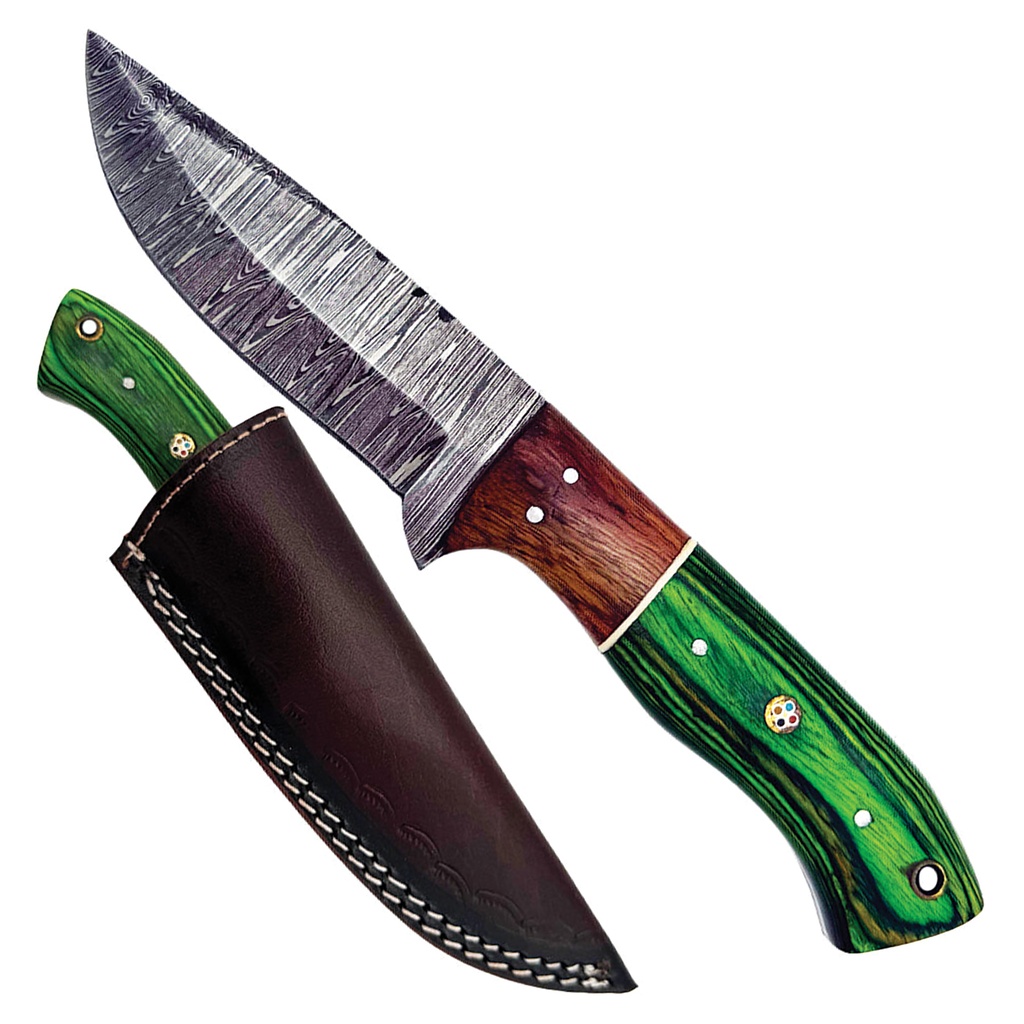
The 4.5-inch clip point gives you that sweet spot between reach and control. Long enough to open up the job without sawing, short enough that your wrist doesn’t fight you when you’re working close. The Damascus steel isn’t just for looks; those layered lines hide a spine that stays stiff under pressure while the edge bites clean. You feel it on the first pass—no tearing, no hesitation, just a smooth glide that lets you guide instead of muscle.
And when your fingers are cold, slick, or gloved, the ergonomics matter more than any spec list. The handle is carved with a finger groove that catches your hand right where you expect it. You’re not thinking about grip; you’re thinking about the animal in front of you, the job at hand, the respect in how you finish what you started. The Damascus hunting knife just becomes part of the motion.
Damascus Hunting Knife Steel That Looks Like Art, Works Like A Tool
There’s a reason this blade catches your eye before you even pick it up. The Damascus pattern runs the length of the 4.5-inch clip point like river veins—light and dark waves frozen in steel. But once it’s in your hand, the design stops being decoration and starts making sense as a working Damascus hunting knife.
Damascus steel isn’t about being precious; it’s about layered performance. The core strength gives you a solid spine that won’t flex when you twist or pry lightly, while the layered structure helps the edge stay true through repeated cuts. In the field, that means you’re not heading back to camp every fifteen minutes to touch up a dull edge. You can break down an animal, trim camp cordage, shave tinder, and still run your thumb lightly across an edge that feels ready for more.
You notice the details when you clean it later. The full-tang construction runs all the way through the handle—no hidden weak points, no mystery joints. Multiple pins, including a mosaic pin, lock the green wood scales to the tang, not just for show but for real-world durability. You can see exactly where steel meets wood, and that honesty in the build gives you quiet confidence every time you bear down.
Carry A Damascus Hunting Knife That Belongs In The Woods
There’s something about that polished green wood handle against dark leather that just belongs against flannel, wool, and worn denim. This isn’t a tactical showpiece that looks out of place in the timber. It’s a Damascus hunting knife that feels like part of the landscape from the moment you slip it on your belt.
The green and brown tones in the wood look like moss and tree bark layered together. When you grip it, your fingers settle into smooth contours that have just enough swell to fill your palm without feeling bulky. At 9 inches overall and about 12 ounces, the weight tells you it’s there, but never drags. Walking ridge lines, climbing into a stand, or moving through underbrush, it rides in its leather sheath without clanking, rattling, or snagging.
The sheath itself matters more than you think. Thick, stitched dark brown leather hugs the blade, with a belt loop that keeps it anchored behind your hip where it won’t catch on brush. There’s a little sound the first time you draw it each day—the soft creak of leather followed by the quiet slide of patterned steel—that becomes part of your ritual. Over time, the sheath darkens, picks up scars and bends that match your days outside. It starts to tell your story as much as the knife does.
The Small Field Details You Only Notice Later
The lanyard hole at the butt seems like a small thing until you’re dressing game on a steep hill and want a loop through your wrist. The polished finish wipes clean easily when you’re back at the truck. And that mosaic pin? It’s the one detail that makes you smile every time you set the knife down on a tailgate or log, the quiet hint that someone cared enough to make this more than a disposable tool.
When A Damascus Hunting Knife Becomes Your Daily Field Companion
Not every day outside is a full hunt. Some days it’s camp chores, clearing a small branch from a trail, cutting cord, opening feed bags, or shaving curls off a log to coax a stubborn fire into life. This is where a reliable Damascus hunting knife quietly earns its keep as part of your everyday outdoor carry.
You draw it without thinking when a buddy asks, “Anybody got a real knife?” You split kindling on a cold morning, using that full-tang spine against a baton of wood, and feel how the force travels straight through the handle without any strange flex. You featherstick, carve, trim, and notch, and by the time you’re back home rinsing the blade under warm water, you’ve forgotten it was ever a “new” knife. It just feels like part of your kit.
There’s a certain confidence in knowing that the blade on your belt isn’t a maybe. It will cut when you need it to, hold an edge through real use, and ride comfortably in leather without demanding attention. In a world of flashy folders and gimmicks, a straightforward fixed-blade Damascus hunting knife like this is a quiet way of saying: you don’t need noise to be ready.
How It Changes The Way You Buy Knives
Once you’ve carried a solid fixed blade in the field, the way you look at knives shifts. You stop chasing the newest thing and start asking one question: will I trust this when it matters? A full-tang Damascus blade, a shaped green wood handle, and a real leather sheath answer that question without a sales pitch.
Questions People Ask Before Buying a Damascus Hunting Knife
Will this Damascus hunting knife actually hold up to real field use?
Yes—this isn’t a display piece. The Damascus blade is full-tang, 4.5 inches long, and built for real hunting and camp work. The layered steel construction gives you strength along the spine and an edge that holds up through skinning, dressing, and daily outdoor tasks without constant sharpening.
Is a Damascus hunting knife hard to maintain or sharpen?
Maintenance is straightforward. Wipe it clean and dry after use, especially after field dressing. A basic stone or guided system will bring the edge back easily. Damascus steel likes a light coat of oil if it’s going to sit for a while, just like any good field blade you plan to keep for years.
Is a fixed-blade Damascus hunting knife comfortable to carry every day?
If you’re used to folders, the first day may feel different, but the leather belt sheath makes daily carry simple. The 9-inch overall length and balanced weight ride close to your side, and the natural materials blend in with outdoor clothing so it feels like part of your regular kit, not an extra burden.
What makes this different from a basic fixed blade I can buy anywhere?
You notice the difference in the quiet moments. The Damascus pattern that feels personal, the green wood handle that fits your palm instead of fighting it, the mosaic pin and full-tang build that speak to someone actually caring how this tool lives on your belt. It’s a working Damascus hunting knife with a story you grow into every season.
Later, back at the truck, the sky gone completely black, you slide the knife back into its leather sheath and close the tailgate. Your hands smell like earth, steel, and wood. The patterned blade flashes once in the dome light before disappearing, and you feel that small, steady satisfaction of knowing your gear did exactly what you asked. Tomorrow, when you thread your belt through that loop again, it won’t feel like grabbing a tool. It’ll feel like picking up the part of you that only really wakes up when a Damascus hunting knife rides at your side and the tree line is calling.