Frontier Lineage Heritage Hunting Knife - Natural Stag
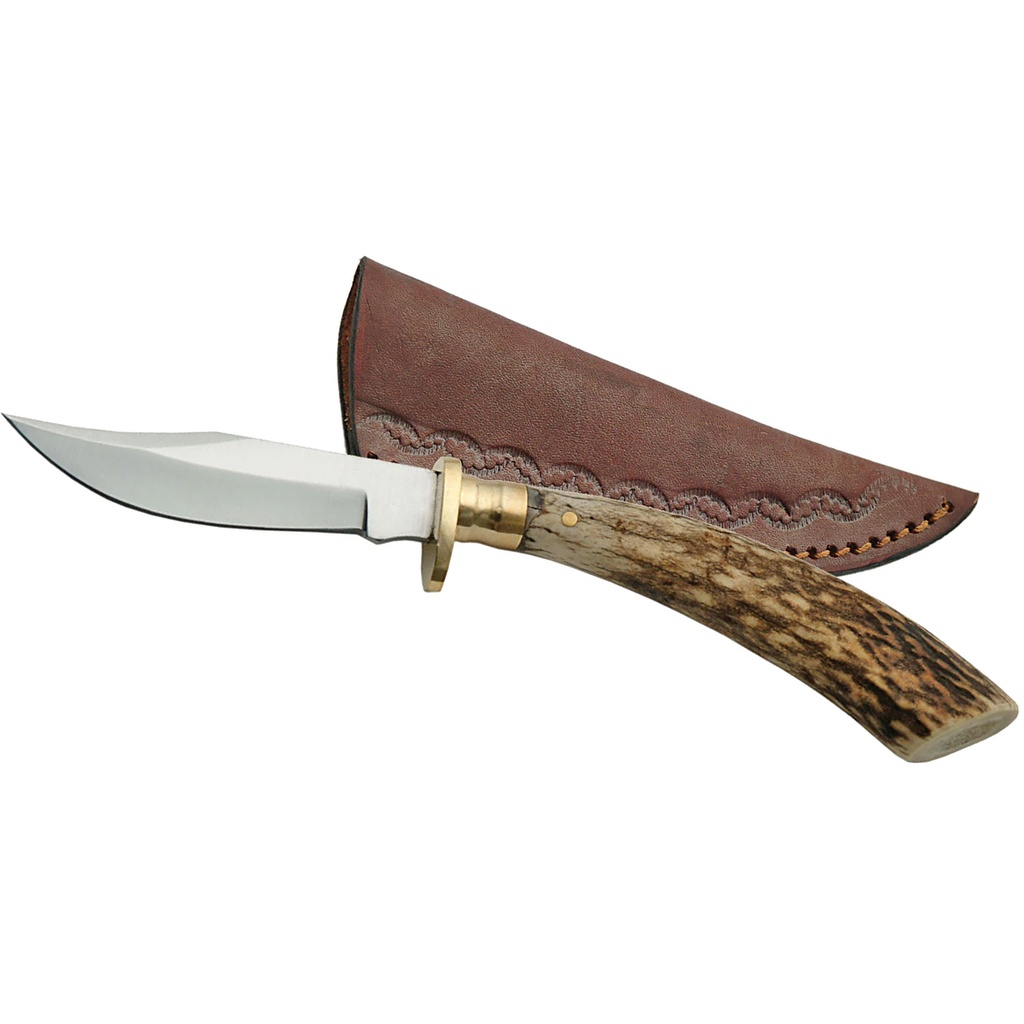
You don’t carry a hunting knife for looks. You carry it because when the light is fading and the work starts, you need a fixed blade hunting knife that just does its job. This one disappears into your palm, stag warm against your hand, leather creaking at your belt. The 7.5-inch clip point bites clean, glides true, and wipes down easy. You walk back to camp not thinking about the knife at all—only how quietly it let you handle what mattered.
| Blade Length (inches) | 7.5 |
| Overall Length (inches) | 7.5 |
| Blade Color | Silver |
| Blade Finish | Satin |
| Blade Style | Clip Point |
| Blade Edge | Plain |
| Blade Material | Steel |
| Handle Finish | Natural |
| Handle Material | Stag |
| Theme | None |
| Tang Type | Full Tang |
| Pommel/Butt Cap | Stag |
| Carry Method | Belt Carry |
| Sheath/Holster | Sheath |
The night you realize your fixed blade hunting knife matters more than you thought
The first time it really hits you isn’t in a catalog or on a screen. It’s when you’re standing over a buck at last light, hands already cold, and you realize the knife on your belt is either going to make this clean… or turn it into a fight. That’s when a fixed blade hunting knife stops being just gear and becomes part of how you move through the woods.
With this one, you feel it the second your fingers close around the natural stag. It doesn’t feel new. It feels like it’s been riding your belt for years, like something that should have a story behind it already. The brass guard catches the last of the daylight, the 7.5-inch clip point reflects a thin line of sky, and you know, before you even cut, that this is going to glide instead of struggle.
How a fixed blade hunting knife changes the way you work in the field
Out here, you don’t want to think about technique every second. You want your hands to know what to do. A good fixed blade hunting knife turns the whole process—opening, dressing, quartering—into muscle memory instead of trial and error.
The clip point blade gives you that fine control at the tip, so you can start your first cut without punching through anything you don’t mean to. The belly of the blade does the long work, sliding through hide and tissue instead of sawing. Because it’s a full-tang hunting knife, you feel the strength run straight from blade through stag handle into your wrist. When you twist, bear down, or leverage against bone, nothing flexes, nothing argues back. It just does what you ask.
This is where design matters: the 7.5-inch satin-finish blade is long enough to handle big game cleanly, but not so oversized that you feel clumsy on small tasks. You could feather sticks by the fire with the same knife you used in the field an hour before. That balance—between reach and control—is what separates a real fixed blade hunting knife from something that only looks the part.
The heritage you feel every time you grip that stag handle
There’s a reason natural stag has been riding on hunters’ hips for generations. It isn’t just tradition—it’s feel. When your palm wraps around this handle, the texture catches your skin just enough to stay put, even when your hands are slick or numb. It’s not rubbery, not plasticky, just that solid, warm, bone-like certainty.
The brass guard does more than look good in photos. When you’re pushing into a cut and your hand is tired, it’s the quiet line between control and a slip. You don’t have to think about it; your index finger finds the same spot every time, and the guard stops you from creeping forward onto the edge.
Look closely and you notice the pinned construction locking the stag to the full tang. That’s not decoration—that’s a promise that this hunting knife is one solid piece of work, not a pretty shell wrapped around a question mark. The pommel stays stag as well, so when you choke back for more power or tap something into place, you don’t feel cold metal striking your hand.
How this fixed blade hunting knife actually carries in your real life
A knife can be perfect on paper and still stay home if it rides wrong. You know that feeling—belt digging, sheath flopping, handle catching on your jacket every time you move. A fixed blade hunting knife only becomes your daily field companion when it disappears until you need it.
The fitted brown leather sheath on this one does exactly that. It hugs the blade with a welted edge, protecting the stitching so it doesn’t blow out the first time you re-sheath in a hurry. The scalloped stitching isn’t just pretty; you feel that slight contour when you grab it in the dark, so you know instinctively which side the edge is on before you draw.
Belt carry feels natural—no swing, no slap against your leg as you climb over deadfall or step into a truck. It rides close, the stag handle resting where your hand naturally falls. You’re not wrestling with snaps or noisy plastic; leather gives a quiet creak, then the hunting knife is in your hand and you’re working before you’ve even really noticed the motion.
The small moments that make it your knife, not just a knife
It’s the way the blade catches firelight when you’re trimming kindling. The way the stag warms up under your palm after a cold start. The way you find yourself running your thumb along the brass guard while you talk around the campfire, half-listening, half-lost in your own thoughts.
And later, when someone new joins the camp and their eyes land on your belt, you see the little nod. They recognize a real fixed blade hunting knife when they see one. You don’t have to explain a thing.
When a traditional fixed blade hunting knife beats anything modern and tactical
Maybe you’ve tried carrying a folding knife into the field because it felt more compact or "everyday carry" friendly. It worked—until it didn’t. Until you hit a job where you needed more reach, more strength, more confidence. That’s where a traditional fixed blade hunting knife quietly proves why it’s still around.
No moving parts to clog with fat, hair, or dirt. No lock to fail when you’re twisting through a stubborn joint. Just a solid, full-tang blade that rinses clean and dries back to that soft satin finish. In moments when things get hectic—a rushed field dress before the temperature climbs, or a late-night chore by lantern—simple wins.
This isn’t a mall-ninja fantasy piece. There’s no blacked-out blade, no exaggerated sawback, nothing trying to shout at you. It doesn’t need to. The story lives in how it performs when the work shows up unannounced. It’s a hunting knife meant to be used, scarred, sharpened, and eventually handed across a table with a story attached.
The feel of readiness on your belt
There’s a certain calm that comes from knowing the tool you’re carrying can do more than you’ll ask of it. You feel that weight at your side walking into the woods before dawn. Not heavy, just present. You touch the stag once, like checking a pocket, and that’s enough. You’re set.
Questions people ask before buying a fixed blade hunting knife
Is a 7.5-inch fixed blade hunting knife too big for everyday field use?
For most hunters, a 7.5-inch fixed blade hunting knife hits a sweet spot. It’s long enough to handle full field dressing and camp chores, but still manageable for finer work. If you’re used to pocket knives, it will feel bigger at first, but in the field that extra reach quickly feels natural.
How does a fixed blade hunting knife compare to a folding knife for hunting?
A fixed blade hunting knife trades pocket convenience for strength and reliability. There’s no joint or lock to worry about when you’re twisting through joints or bearing down. It’s easier to clean after dressing game, and it gives you more confidence on demanding cuts. Many people still carry a smaller folder, but the fixed blade does the real hunting work.
Will the stag handle on this hunting knife hold up in real weather?
Natural stag has been used on hunting knives for generations because it handles weather and hard use well. It won’t feel rubbery when it’s wet or icy, and the texture actually improves grip. As with any quality hunting knife, a quick wipe-down and dry sheath after use will keep it looking and feeling right for years.
Is a fixed blade hunting knife comfortable to carry all day?
Comfort comes down to weight, sheath design, and how you wear it. This knife rides in a fitted leather belt sheath that keeps it close to your side with minimal flop or swing. If you already carry a belt tool or sidearm, adding a fixed blade hunting knife like this usually feels natural within a day or two of wear.
The moment this fixed blade hunting knife quietly becomes part of who you are
Fast-forward a season. You’re back in the same stretch of woods, different weather, different tracks, same leather sheath riding on your belt. Your hand finds the stag handle without looking. You don’t wonder if the blade is sharp—you remember the last time you took a stone to it by the truck, working in slow, even strokes.
You kneel, make that first opening cut, and the fixed blade hunting knife glides in like it’s done this a hundred times. No hesitation, no fight, no drama. The story is about the hunt, the camp, the company, not the tool. And that’s when you realize: this isn’t just a knife you bought. It’s the one that will show up in your stories years from now, remembered simply as "the knife I always carried."