Guide’s Legacy Compact Skinning Knife - Natural Stag
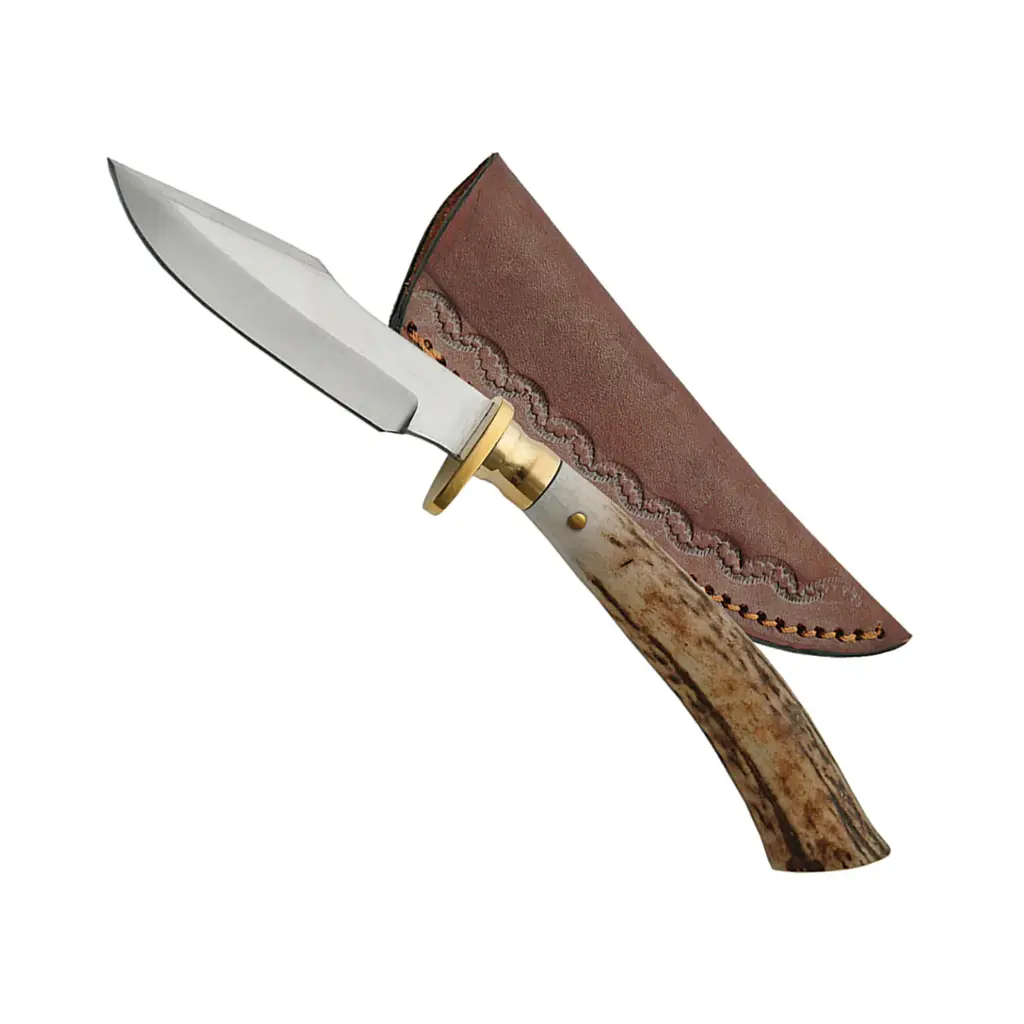
You remember your first clean skin—no hacking, no wrestling, just calm, steady pulls. That’s the feeling a compact skinning knife like this brings back. The natural stag fills your palm with real texture, the brass guard stops your fingers without you thinking about it, and the short drop point just follows your hand. You’re not fighting your gear; you’re honoring the animal. This is the knife that lives on your belt and quietly becomes part of your hunting stories.
| Blade Length (inches) | 3.5 |
| Overall Length (inches) | 7.5 |
| Blade Color | Silver |
| Blade Finish | Matte |
| Blade Style | Drop Point |
| Blade Edge | Plain |
| Blade Material | Steel |
| Handle Finish | Natural |
| Handle Material | Stag |
| Theme | None |
| Handle Length (inches) | 4.0 |
| Tang Type | Full Tang |
| Pommel/Butt Cap | Stag |
| Carry Method | Belt Carry |
| Sheath/Holster | Sheath |
You’re in the field, knees in the leaves, the air still holding that mix of sweat, cold, and adrenaline. The rush of the shot has faded, and now it’s down to what comes next—how you treat the animal, how clean you work, how much you trust your hands. This is where a compact skinning knife either becomes part of your rhythm… or reminds you why you should’ve chosen better.
Why a Compact Skinning Knife Changes the Moment in Front of You
When you reach for a compact skinning knife, you’re not looking for drama. You’re looking for control. A 3.5-inch drop point doesn’t try to do everything—it just does the one thing you need most in this moment: it tracks exactly where your hand intends to go. No extra length to snag on hide, no awkward balance that forces you to fight the blade instead of guiding it.
With a 7.5-inch overall length, this fixed blade sits naturally in your hand. That shorter profile means when you’re making those first careful nicks along the legs or ring-cutting around the head, you’re moving with precision, not guessing where the tip is. The full tang running through the stag handle gives you that reassuring weight—enough to feel solid, never clumsy. You’re not just cutting; you’re making clean, confident decisions in tight spaces where a bigger knife would get in your way.
A Compact Skinning Knife That Feels Like It Grew from the Field
There’s a reason the handle is natural stag and not some anonymous plastic. When you pick it up, it doesn’t feel like gear fresh from a blister pack. It feels like something that could’ve already spent seasons on someone else’s belt. The antler’s natural curve settles into your palm—the slight swell, the texture under your fingers, the way it gives you grip even when your hands are slick or cold.
The brass guard sitting between that stag and the matte-finished steel isn’t decoration; it’s a quiet boundary. When you’re pulling through hide or sliding along the belly line, you’re not babysitting your fingers. The guard catches you before you ever get close to the edge, so your focus stays on the animal, not on the risk.
Look closely and you’ll notice the pinning through the handle, the full tang visible at the stag’s edges, and the smooth transition of the brass bolster into the blade. Those details are why the knife feels like one continuous line from pommel to tip. You don’t think about those choices in the moment; you just feel a knife that doesn’t twist, flex, or surprise you when you bear down.
Carrying a Compact Skinning Knife That’s Actually Ready When You Are
There’s a particular comfort in knowing your compact skinning knife is exactly where you left it—on your belt, inside a leather sheath that’s earned its own creases and scuffs. The fitted brown sheath on this one rides close, not bouncing or printing. You thread it onto your belt in the dark at camp, and by mid-season you’ll be doing it without even looking.
The scalloped stitching isn’t a flex; it’s a nod to the same traditional mindset that put stag and brass on the handle. The leather shapes itself around the blade over time, and that snug fit means when you squat, climb, or kneel, you’re not catching the sheath on brush or feeling the knife shift. You go to draw, thumb pushing the handle clear, and it comes free with that quiet, familiar resistance.
The Feel in Hand When It Matters
On your first pull through hide, the matte silver blade doesn’t flash or glare in the sun. It just bites in and follows through. A plain-edge drop point doesn’t complicate things: no serrations to catch on hair, no wild recurve to change the angle mid-cut. You’ll notice how the spine stays straight before dropping at the tip, giving you a clear sense of where the point is without needing to see it. In low light or under a headlamp, that matters more than you think.
When a Compact Skinning Knife Becomes Part of Your Ritual
There’s the practical side—edge holding, control, steel that doesn’t chip at the first bone contact. Then there’s the part you don’t talk about much: the ritual. The animal on the ground, the quiet between you and whoever’s with you, the unspoken agreement that this doesn’t get rushed or disrespected.
A compact skinning knife like this fits into that space cleanly. It’s big enough to take you from first cut to final pull without swapping tools every few minutes, yet small enough that you can choke up your grip and work around joints with surgeon-level control. You aren’t waving around a oversized blade to prove anything—you’re using something that looks and feels like it belongs in that moment.
The Detail That Makes It Yours
Every piece of stag looks different. The grain, the color variations, the subtle curve in the handle—those aren’t printed patterns. Over time, the natural antler will pick up tiny marks from the field: a faint scratch from a rock, a darkening where your thumb always rests. The brass will take on a soft patina. It stops being "a" knife and starts being "your" knife—the one your kid recognizes on your belt from across the yard.
Why Choose a Compact Skinning Knife Over a General Hunting Blade?
You probably already have a big hunting knife somewhere in your kit. Maybe it rides in the truck, maybe it only comes out for camp chores or breaking down bigger cuts. But for skinning—real, detailed, no-tear work—a dedicated compact skinning knife changes how much effort you burn and how clean your hides come off.
A shorter drop point lets you work closer to the hide without punching through meat. That matters when you care about saving the cape, about minimizing waste, about not turning a good harvest into a mess just because your blade was too long or too clumsy. The compact profile also reduces hand fatigue; you’re not muscling a heavy blade around for half an hour. Instead, your hand and the knife move as one, especially when that full-tang stag handle fills your grip just right.
And when the work is done? A fixed, compact hunting and skinning knife is easier to clean quickly and thoroughly. No pivot, no liners hiding gunk—just warm water, a cloth, a quick dry, and back into the leather.
Questions People Ask Before Buying a Compact Skinning Knife
Is a compact skinning knife big enough for deer and larger game?
Yes. A well-designed compact skinning knife with a 3.5-inch drop point is actually ideal for deer-sized game and even elk. You’re not hacking; you’re making controlled cuts along hide and joints, and the shorter blade gives you better precision without sacrificing capability.
Can I use a compact skinning knife as my everyday carry blade?
You can, especially if you’re comfortable belt-carrying a fixed blade. While this is built as a hunting and skinning knife, its size makes it handy for camp chores, light utility work, and daily tasks around the property. Just keep in mind local laws about fixed blades and open carry.
How do I care for a stag handle and leather sheath in the long run?
Treat your stag-handled compact skinning knife like any trusted field tool. Wipe the handle dry after wet or bloody work, and avoid soaking it. The leather sheath will benefit from occasional conditioning to prevent cracking. Over time, both will develop a patina that tells the story of where you’ve been.
Is a compact skinning knife better than a folding hunting knife?
For dedicated skinning, many hunters prefer a fixed, compact skinning knife. There’s no joint to flex, no pivot to clog with fat and hair, and full-tang construction tends to feel more secure under pressure. Folders are versatile, but when you’re on your knees over an animal, the simplicity of a fixed blade often wins.
Picture this: you drop your pack on the tailgate at dusk, that quiet satisfaction already settling in. You slide the leather sheath from your belt, thumb the stag handle, and draw your compact skinning knife with a motion your hand already knows. The first touch of steel to hide feels steady, deliberate, almost calm. This isn’t just another tool you grabbed off a shelf. It’s the knife that shows you treat the animal—and the work—with respect. And before long, it’s the one your stories keep circling back to, hanging from your belt in every memory worth keeping.