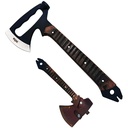
Hammerback Fieldsmith Tactical Camp Hatchet - Black & Wood
You know that moment at camp when everyone looks around for “something” to pound stakes, chop kindling, or yank a bent nail—and their eyes land on you? That’s where a tactical hatchet earns its ride. The black powder-coated head bites clean, the hammerback hits square, and the nail puller turns headaches into quick fixes. Leather on your belt, warm wood in your grip, you’re no longer the one asking for tools. You’re the one who quietly has exactly what the day needs—a tactical hatchet that just works.
The first time the wind shifts on a wet morning and someone’s tent stake lets go, you notice who reaches for their gear and who just stands there, shrugging. If you’ve ever felt that tug—wanting to be the person who simply steps forward and fixes it—you already understand why a tactical hatchet finds a permanent place in your kit.
This isn’t about owning another tool. It’s about that quiet, steady feeling you get when you know you’ve got the right one.
How a Tactical Hatchet Changes Your Camp Story
Think about the jobs that keep repeating themselves every time you’re out: stubborn stakes in hard ground, knotty rounds that won’t split, nails left half-buried in a weathered pallet you’re turning into a camp table. A tactical hatchet turns those little friction points into simple, almost automatic tasks.
With a compact, full-size tactical hatchet in your hand, you’re not hunting for a rock, borrowing a hammer, or babying a cheap camp axe. The black powder-coated head shrugs off moisture and grit, while the curved cutting edge gives you a clean bite when you’re chopping kindling or trimming branches. On the flip side, the hammerback isn’t a gimmick—it’s a real striking face that lets you drive stakes, tap in hardware, and close stubborn lids with control instead of guesswork.
What this means for you is simple: camp setup stops being a chore and starts feeling like a rhythm. You walk into a new site, unclip your tactical hatchet, and everything that used to slow the group down now runs through your hands.
Why This Tactical Hatchet Feels Trustworthy in Your Hand
There’s a specific moment when a tool either earns your trust or quietly loses it—usually the first time you swing with intent. A tactical hatchet that flexes, rattles, or feels top-heavy never makes it past that moment. This one is built to get through it without a single doubt.
The full-tang steel construction runs from the edge of the black head all the way through the handle, so when you strike, the force stays on a solid spine instead of relying on a press-fit or hollow core. Over that steel, reinforced wood scales give you warmth and a sure grip, with deep longitudinal grooves that lock into your palm even when your hands are cold, wet, or gloved.
Field use reveals the small things: how the balance point sits just forward of your grip so the tactical hatchet wants to swing true, not twist. How the powder-coated head resists rust after a wet weekend. How that satin edge, once you’ve honed it to your preference, keeps its bite through real chopping, not just showroom posing.
Owning this kind of tactical hatchet means not wondering whether your tool will hold up. You’ll feel it in the clean thunk of steel into wood, in the absence of vibration, in the way you stop checking the handle between hits.
From Trail to Tailgate: How You Actually Use a Tactical Hatchet
On paper, a tactical hatchet looks like a list of functions: chopping, hammering, nail pulling, prying. In your hands, it becomes a rhythm of small wins across an entire weekend.
The sound of camp getting built
Imagine the first evening at a new site. The light’s dropping fast. You’ve got canvas to stretch, a tarp that needs tension, and wood that’s still a bit green. Your tactical hatchet comes off your belt in one motion. The hammerback taps in stakes with a solid, muffled crack against hard soil. Turn your wrist, and that curved edge snaps kindling to size, the powder-coated head sliding through fibers while the exposed silver edge does the real cutting. You’re not fighting the tool; you’re just moving with it.
The quiet fixes nobody sees coming
The nail puller at the base looks like a small detail until you run into that one bent nail holding together a pallet, a crate, or a makeshift bench. Instead of walking away or wrestling with multi-tools not meant for the job, you hook, lever, and the metal gives. In that moment, your tactical hatchet isn’t just for chopping wood—it’s your pry bar, your problem-solver, your way of saying, "We’ve got this" without making a speech.
Back at the tailgate, the leather sheath slides on and off easily, snap closures keeping the edge covered without a fight. The brown leather and black-steel head against the warm wood handle don’t just look good; they tell anyone watching that you care about gear that works and ages well.
When a Tactical Hatchet Beats a Bigger Axe or a Tiny Multi-Tool
If you’ve ever packed a full-size axe and barely used it, or relied on a small multi-tool and pushed it way past what it was built for, you’ve already discovered the gap a tactical hatchet quietly fills.
Compared to a full axe, a tactical hatchet gives you control in tight spaces: around guy lines, under low branches, near the vehicle. You can choke up on the handle through the head cutout for detail work, then slide back down for more power when you need it. It rides lighter, packs easier, and actually comes out of its sheath more often because it’s not a burden.
Compared to tiny camp gadgets, a real tactical hatchet offers something they simply can’t: confidence. When you need to split a stubborn log, drive a steel stake into rocky ground, or pry something that doesn’t want to move, this isn’t a compromise tool. It’s built for those hits and those levers.
What that means for you is fewer "I wish I’d brought…" moments and more "Glad I’ve got this" ones. Your kit feels tighter, more intentional. You carry one tactical hatchet instead of three half-solutions.
Questions People Ask Before Buying a Tactical Hatchet
Is a tactical hatchet actually useful for everyday camping, or is it overkill?
A good tactical hatchet ends up being the most-used tool in camp, not overkill. You’ll reach for it to chop kindling, drive tent stakes with the hammerback, pull nails, and do light prying. If you camp, overland, or work around property, a tactical hatchet usually replaces a separate axe, hammer, and pry tool.
How do I carry a tactical hatchet safely without it getting in the way?
This style of tactical hatchet rides in a fitted leather sheath with secure snaps, so the cutting edge and hammerback stay covered. You can loop it on a belt, lash it to a pack, or tuck it along a vehicle panel. The compact profile and full-tang handle make it easy to stow without bulky handles catching on gear.
Will a tactical hatchet like this hold up to real hard use?
Full-tang steel construction, a black powder-coated head, and reinforced wood handle scales are all signals that this tactical hatchet is built for real work. As long as you keep the edge maintained and don’t use it for abuse like striking hardened steel with the blade, it’s designed to handle chopping, hammering, nail pulling, and prying in normal field use.
Is a tactical hatchet better than a folding camp saw or knife?
They solve different problems. A saw excels at clean cuts in larger wood, while a knife handles fine work. A tactical hatchet gives you impact power and leverage—splitting, driving, prying, and rough shaping. Most experienced campers like having a knife and a tactical hatchet together; the combination covers almost all field tasks without needing a full axe.
The Moment This Tactical Hatchet Becomes Part of Who You Are
Picture your next trip: damp air, coffee steaming, campsite half-built. Someone mutters about a bent stake, a stubborn board, or wood that just won’t split. Before the frustration spreads, you’re already moving. Leather in your hand, black steel flashing for a second before it goes to work, your tactical hatchet answers the problem without a word.
After a few trips, nobody has to ask who brought the tools. They know. You’re the one who plans ahead, who carries gear that doesn’t just look the part but earns its keep. And every time your hand closes around that grooved wood handle, your tactical hatchet reminds you: you didn’t come out here to get stuck. You came out ready.