Harbor Beacon Long‑Range Emergency Strobe Light - Red
You don’t plan to be stranded on a shoulder in the dark, but you do plan how visible you’ll be when it happens. A long‑range emergency strobe light changes that sick feeling in your gut into calm, because you know drivers can see you from miles out. One solid clip to a jacket, cone, or roof rack and that hard, red pulse starts doing the talking for you—loudly, clearly, and long after your nerves settle.
You don’t notice how dark a roadside really is until you’re standing in it. Engine off, traffic hissing past, that thin strip of gravel between you and a passing truck suddenly feels very small. In that moment, you’re not thinking about gadgets—you’re thinking one thing: “They need to see me.” That’s the exact moment a long-range emergency strobe light earns its place in your kit.
When a Long-Range Emergency Strobe Light Turns Panic Into a Plan
Picture this: hazard lights clicking weakly, your phone flashlight already dimming, and every pair of headlights feels like a coin toss. With a long-range emergency strobe light, the decision tree gets a lot simpler. Slide the switch up, clip it high on your jacket, backpack, or roadside cone, and suddenly you’ve got a hard, rhythmic red pulse cutting through the dark. It’s not just light—it’s a visible statement to every driver: “I’m here. Adjust now.”
This isn’t a gentle glow. At 60–70 flashes per minute, that emergency strobe hits the eye over and over again in a way your four-way flashers simply can’t match. Up to three miles out, someone can register that signal and start shifting lanes or slowing long before they’re on top of you. That extra distance? That’s your breathing room. That’s your heartbeat coming back down.
Why This Long-Range Emergency Strobe Light Stays Noticeable When Everything Else Fades
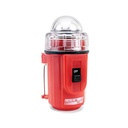
Ever notice how some lights look bright in your hand but vanish the second you step back? The difference here is purpose-built visibility. The clear dome and ribbed lens aren’t there to look technical—they spread that red strobe out wide so it throws a clear, unmistakable signal in 360 degrees. You’re not just lit from one angle; you’re broadcasting in every direction at once.
The bold red body isn’t cosmetic either. When the light is off, that high-visibility red still reads as safety gear in daylight—on your dash, in the trunk, in a work bag. When it’s on, the red pulse taps into what every driver’s brain has been trained to recognize from years of sirens, brake lights, and emergency vehicles. You’re not begging for attention; you’re using a visual language people already take seriously.
Built for the Long Night, Not the Quick Test in the Garage
You’ve probably had gear that seemed bright… for about 20 minutes. Then it sagged into a dull, useless glow. This long-range emergency strobe light runs up to 60 hours on a single D battery. That matters when the problem isn’t over in an hour—when you’re waiting on a tow that keeps getting delayed, or you’re marking a downed vehicle overnight on a back road.
One big, common D cell is easier to find than some exotic battery you’ll forget to restock. And when you do need to change it, the body is straightforward plastic and hardware—no tiny screws, no puzzle-box engineering. Just tools that work when your hands are cold and your patience is gone.
How a Long-Range Emergency Strobe Light Actually Fits Into Your Life
Most safety gear fails not because it’s bad, but because it’s annoying. Too bulky to carry, too fiddly to mount, too complicated to explain to someone else in a rush. This long-range emergency strobe light leans hard in the other direction: a single sliding on/off switch, a sturdy metal clip, and a form factor that disappears until you need it.
You clip it on a work vest during night shifts so passing traffic has no excuse. You snap it onto a bike rack or backpack for dusk commutes. You mount it on a roadside cone if you’re stuck changing a tire, pushing the glow farther into the lane to give yourself a safety buffer. The vertical orientation rides close to your body without swinging, and that simple switch can be found even with gloves on.
Everyday Carry for Emergencies You Hope Never Happen
If you’re the type who keeps jumper cables, a first aid kit, or a multi-tool close by, a long-range emergency strobe light fits the same mindset. It’s not glamorous gear. It’s the quiet backup that sits in your trunk, your go-bag, or your work truck until the one day it becomes the most important thing you own for about an hour.
You don’t rave about it. You just know it’s there. And that knowing changes how you feel when things suddenly go sideways.
When a Long-Range Emergency Strobe Light Makes the Difference You Never See on the News
Here’s the thing about safety: when it works, nothing dramatic happens. No near-miss compilation, no horror story, no viral video. The car behind you sees your emergency strobe light three miles out, shifts over calmly, and you never even realize how close it could have been. That’s the kind of “boring” you actually want.
This is where specs quietly matter. Three miles of visibility isn’t marketing puff—it’s the kind of margin that gives a drowsy truck driver or a distracted commuter time to react. A 60–70 flashes-per-minute rate isn’t arbitrary; it’s tuned to be jarring enough to cut through rain, fog, or low light without being a chaotic mess. The metal clip isn’t decorative; it’s what keeps the light attached when wind, movement, or vibration try to shake everything loose.
Questions People Ask Before Buying a Long-Range Emergency Strobe Light
Will a long-range emergency strobe light really be seen from three miles away?
In clear conditions, yes—a true long-range emergency strobe light is designed specifically so drivers can pick up that flashing red signal up to three miles out. Weather, terrain, and curves in the road can affect that, but you’re still dramatically more visible than with hazard lights alone.
Is a long-range emergency strobe light legal to use on my vehicle?
In most places, using an emergency strobe light to mark a broken-down vehicle or roadside hazard is allowed, but blue and some red combinations can be restricted to official vehicles. This style of red long-range emergency strobe light is generally fine for visibility and roadside safety, but it’s smart to check your local laws if you plan to use it while driving, not just while stopped.
How long will the battery last if I leave the emergency strobe on all night?
With a single D battery, this strobe is built to run up to about 60 hours, so an overnight breakdown or all-night worksite won’t drain it. That long runtime means you can turn it on and leave it doing its job without constantly checking your watch or worrying it’ll die before help arrives.
Can I use a long-range emergency strobe light for hiking, boating, or camping?
Absolutely. A compact long-range emergency strobe light clips easily to a pack, PFD, or tent line so rescuers or your own group can find you in the dark. The flashing pattern is easier to spot than a steady flashlight beam, especially across water or open terrain.
The Moment You’re Glad You Packed a Long-Range Emergency Strobe Light
Fast forward to the night it matters. You’re pulled over on a narrow shoulder, or guiding friends into a remote campsite in the dark, or marking a stuck vehicle on a gravel road miles from town. You reach down, feel the familiar shape of that long-range emergency strobe light, and flip the switch without thinking twice.
The first red flash hits the dark like a heartbeat. Then another. Then another. You clip it high, step back, and watch that steady pulse claim space for you—three miles of warning wrapped into one simple, relentless signal. You feel your shoulders drop a little. You’re not just hoping people see you anymore. You made sure they will. And that quiet confidence is the real reason this light earns its spot in your everyday emergency kit.