Heritage Curve Trail-Chop Kukri Knife - Wood Handle
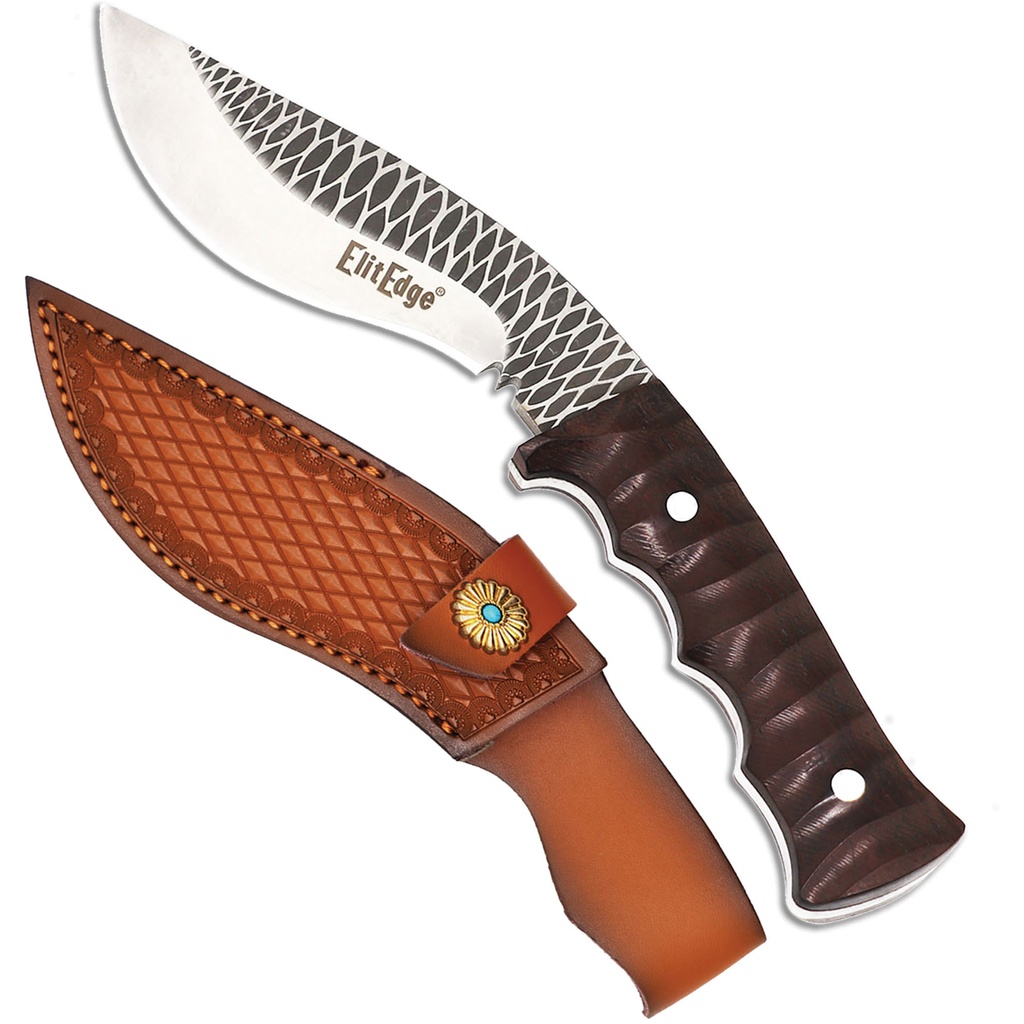
You’re halfway down the trail when camp sneaks up on you sooner than planned. This compact kukri knife steps up where a pocket blade falls short—splitting kindling, chopping, slicing dinner on a log. The curved 4-inch blade bites deeper than its size suggests, while the full-tang build and finger-grooved wood handle lock in your grip. The basketweave leather sheath rides your belt like it’s been there for years. You don’t baby this knife. You just reach for it, and it quietly proves you prepared right.
| Blade Length (inches) | 4 |
| Overall Length (inches) | 8.75 |
| Weight (oz.) | 7.91 |
| Blade Color | Silver |
| Blade Finish | Satin |
| Blade Style | Kukri |
| Blade Edge | Plain |
| Blade Material | Stainless Steel |
| Handle Finish | Polished |
| Handle Material | Wood |
| Theme | Kukri |
| Handle Length (inches) | 4.75 |
| Tang Type | Full Tang |
| Spine Thickness (inches) | 0.197 |
| Pommel/Butt Cap | Exposed tang |
| Carry Method | Belt Loop |
| Sheath/Holster | Leather Sheath |
You’re a few miles from the trailhead when the light starts to thin. Not quite dark, but that gray in-between where every decision matters just a little more. You find a spot off the path—a flat patch of earth, a couple of dead limbs nearby, enough space to breathe. This is where your day shifts from moving to making. And this is where having a compact kukri knife on your belt stops being theory and turns into the reason everything feels easy instead of improvised.
How a Compact Kukri Knife Changes the Trail for You
If you’ve ever tried to prep camp with a tiny pocket blade, you know the feeling: too much sawing, not enough cutting. With a compact kukri knife, the curve and forward weight of the blade do the work your wrist usually has to fake. That 4-inch satin kukri blade doesn’t look huge on paper, but when it bites into a branch, it feels like a much larger tool.
You swing once to clear a low snag on the path instead of hacking five times. You choke up on the belly of the blade to slice cord or feather tinder without changing tools. The compact size keeps it nimble; the kukri profile gives you that satisfying, almost shocking "oh, that went through" power. You’re no longer coaxing your gear to keep up—you’re just moving from task to task, and the knife keeps saying, "Yeah, I’ve got that."
Why This Compact Kukri Knife Feels Like an Inherited Tool
There’s something about real wood and leather that changes how you treat a knife. Stainless steel might keep the edge, but wood and leather keep the story. When you wrap your hand around the finger-grooved wood handle, it doesn’t feel generic—it feels like someone thought about how fingers actually rest when you’re chopping, slicing, and pushing through tougher cuts.
The full-tang stainless steel core runs straight through the handle and out the back as an exposed tang. You can see the metal all the way around, so you never wonder if this compact kukri knife will hold up when you baton through a knotty piece of wood or twist the blade free from a stubborn cut. The 0.197-inch thick spine gives you that quiet, reassuring weight: substantial enough that you trust it, not so heavy that it turns into a burden on your hip.
Even the blade finish—the simple satin silver, with a textured pattern near the spine—feels more like a field tool than an ornament. It’s the kind of finish that looks good the first day and looks better once it’s earned a few scuffs clearing brush and prepping stakes.
The Small Details That Change How You Use It
Run your thumb along the carved handle and you’ll feel where the contours guide your grip. Those grooves aren’t decoration; they keep your hand planted when the blade’s forward curve starts to really dig in. Two lanyard or fastening holes in the handle mean you can tie in a safety cord, hang it in camp, or lash it if you ever need a more improvised tool setup. Little details, but they add up to something you reach for without thinking.
Carrying a Compact Kukri Knife Without Feeling Overloaded
There’s a fine line between being prepared and feeling like you’ve strapped on half a toolbox. A compact kukri knife edges right up to that line and then quietly steps back. At 8.75 inches overall and just under eight ounces, it rides on your belt in that sweet spot: present, but not nagging. You feel it when you put it on, and then it fades until you need it.
The basketweave leather sheath is what makes that possible. It isn’t just a token sleeve; it’s thick, shaped to the blade, and patterned with that old-school tooled weave that looks like something you’d see in a passed-down kit. The floral concho on the snap is one of those small touches that doesn’t change performance but absolutely changes how you feel clipping it to your belt. It makes the whole setup feel intentional, not thrown together.
On the Trail, at Camp, and Back Home
On the move, the compact kukri knife sits close to your hip through the belt loop carry—no flopping, no clatter. In camp, drawing and resheathing it becomes part of your rhythm. Clear a stubborn root from under your tent corner, cut paracord to length, slice vegetables on a cutting board improvised from a flat rock. Back home, it doesn’t vanish into a drawer. It hangs on a nail in the garage, sits on a workbench, or rides again when you’re trimming back low limbs along a fence line.
When a Compact Kukri Knife Outperforms a Regular Fixed Blade
You could carry a straight fixed blade and get by. But the moment you put that first chopping stroke into a limb with this compact kukri knife, you feel the difference. The pronounced belly and curved tip change how force transfers from your hand into the cut. Instead of babying a straight blade through tough fibers, you let the forward curve pull in and bite.
For batoning smaller logs, the thick spine and full-tang build spread impact across the knife instead of concentrating stress on a hinge or weak point. For food prep, the curve lets you rock cut instead of just push cut, turning a campsite log into something that almost feels like a kitchen board. And when you’re just doing everyday tasks—opening bags of feed, trimming garden stakes, carving a quick tent peg—you realize you’re getting the utility of a larger chopper without the bulk.
This is where the identity shift happens. You’re not the person hoping their little knife will manage. You’re the one quietly over-equipped in the best way—without looking like you’re trying to play survivalist on a simple hike.
Questions People Ask Before Buying a Compact Kukri Knife
Is a compact kukri knife actually useful for everyday carry or just camping?
A compact kukri knife earns its keep far beyond the campsite. The size makes it realistic for trail, truck, and yard use, while the kukri curve adds chopping and heavy-cutting ability you won’t get from a standard small fixed blade. If you want one belt knife that handles brush, camp chores, and odd jobs at home, this hits that cross-section.
Will this compact kukri knife feel too heavy or bulky on my belt?
At under eight ounces and under nine inches overall, it’s surprisingly manageable. The leather sheath keeps it tight to your belt, so you’re not dealing with a swinging, oversized rig. You’ll notice it’s there when you first put it on, and then, like any good everyday tool, it fades into the background until you need it.
How tough is the blade for real trail and camp work?
The full-tang stainless steel construction, almost 0.2-inch spine thickness, and solid kukri geometry make this compact kukri knife more than a casual accessory. It’s built to take batoning, limb trimming, light chopping, and day-to-day cutting without feeling fragile. You’re not signing up for a display piece—you’re getting something meant to get dirty.
Is this compact kukri knife practical if I’m used to a straight fixed blade?
If you’re coming from a straight blade, the kukri curve takes about five minutes to feel natural—and then it’s hard to go back. You’ll notice faster, cleaner cuts when you chop, and more control when you carve or slice near the belly. Most people find they rely on fewer strokes to get the same work done.
Later that night, the fire’s burned down to coals and your gear is scattered in that satisfying, organized chaos of a day well used. You slide the compact kukri knife back into its basketweave leather sheath and feel the weight settle on your hip. It doesn’t feel like a new purchase anymore. It feels like something that belongs with you—on trails, in the yard, in the back of the truck. The next time you step off pavement, you won’t wonder if you brought enough blade. You’ll feel the curve at your side and know you did.