High-Stakes Four-Ace Throwing Cards - Stainless Steel
You don’t pull these out to blend in. You pull them when you want your throwing cards to feel like a high-stakes bet that always goes your way. True-size stainless steel aces leave your hand flat and fast, edges whispering through the air before they bite. The nylon sheath on your belt feels like a secret only you remember. And when that first card hits and sticks, nobody in the room sees playing cards anymore—they see you in complete control.
You’ve felt it before—that tiny flicker when people realize you didn’t just bring another trick. You brought something they haven’t seen, but won’t forget. The first time a stainless steel ace leaves your hand, you feel the weight, hear that quiet hiss through the air, and then the soft, certain thunk when it lands and stays. In that moment, it isn’t about the target. It’s about the way every eye in the room shifts toward you.
How High-Stakes Throwing Cards Turn A Simple Throw Into A Story
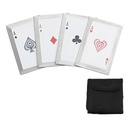
Anyone can pull out a basic throwing star. You’re reaching for high-stakes throwing cards because you want the moment to mean more. These are true-size playing cards styled as the four aces—the symbols everyone recognizes before their brain even catches up. But the edges aren’t ink. They’re sharpened stainless steel that carry real weight when you throw.
That means when you send one of these high-stakes throwing cards downrange, people see an ace of spades flying through the air and landing like a blade. Your brain gets to enjoy the casino illusion; your hands get the confidence of solid steel. You feel that balance right away: flat, rectangular, easy to grip along the brushed border, easy to release in a straight line.
This is where the design clicks. A normal throwing star makes sense to your muscles. A metal playing card hits your imagination too. You’re not just practicing accuracy—you’re dealing out your own kind of drama, one throw at a time.
Why Stainless Steel High-Stakes Throwing Cards Feel So Sure In Your Hand
You know the difference between a toy and a tool the second it hits your palm. These throwing cards are cut from stainless steel, giving each ace a weight that feels intentional instead of gimmicky. The edges are sharpened along the perimeter so any clean, flat throw has a real chance to bite and stay.
The faces stay true to what your eyes expect: white card fronts, bold suit symbols, black for spades and clubs, red for hearts and diamonds. Around that artwork runs a brushed steel border that does two things for you: it frames the card so your grip finds the edge without thinking, and it reminds you these aren’t props. They’re metal.
When you throw, that flat profile cuts the air without wobbling like cheap novelty blades tend to do. The steel isn’t trying to be delicate—it’s trying to be consistent. And if you’ve ever had a blade glance off because the balance was off, you know how much that reliability matters. You stop wondering what the card will do and start focusing on what you are doing.
Carrying High-Stakes Throwing Cards In Real Life
Gear only matters if you actually carry it. That’s where the black nylon sheath quietly becomes part of your daily rhythm. It holds all four aces together—spades, hearts, clubs, diamonds—in a tight stack that slides onto your belt, into a bag, or into a gear drawer without rattling around.
The snap-close flap gives you that simple, tactile moment when you decide you’re going to throw. You feel the nylon texture under your thumb, hear the pop of the snap, and then you’re holding cold steel and painted suits. There’s no fumbling with packaging or loose blades. Your high-stakes throwing cards are either secured, or they’re in your hand. Nothing in between.
Out at the range, hanging in the backyard, or behind the counter doing a quick demo, you’re always pulling the same four aces. That repetition builds muscle memory. Your fingers learn the corners, your wrist learns the release, and pretty soon you’re not thinking about how to throw—just where you want that card to land.
When High-Stakes Throwing Cards Change How People See You
There’s a reason these feel different from a standard set of throwing stars. Throwing stars say you bought gear. High-stakes throwing cards say you chose a story. You lay out the four aces on a table—spades, hearts, diamonds, clubs—and everyone assumes they’re just cards until you tilt one and the light catches the edge.
The first throw is always the same. Someone leans in, maybe smirks, expecting a party trick. You step to your line, feel the stainless steel press lightly into your fingers, and send the card downrange in one smooth motion. When it bites and stays, the smirk disappears. Now the questions start. "What are those? How do they fly so straight?"
That’s the quiet advantage you’ve built in. Your throwing cards aren’t just a way to hit a target; they’re a way to reset expectations. You’re the one who shows up with something they haven’t seen, but instantly understand. You’re not waving around a weapon—you’re dealing aces with intent.
Choosing High-Stakes Throwing Cards Vs Regular Throwing Stars
It’s natural to compare these to a traditional throwing star. Stars give you multiple points; these give you a continuous sharpened edge. With high-stakes throwing cards, your throw becomes about alignment and follow-through. You’re using that true-size card face as a visual guide, sending the broadside of the card forward in a clean, straight path.
If you’ve ever asked yourself which is better—a throwing star or metal throwing card—the real question is: what kind of thrower do you want to be seen as? Stars blend into the usual tactical lineup. Stainless steel aces stand out because they connect instantly with gambling, risk, and control. You’re not just practicing stick-or-miss; you’re practicing presence.
For training, it’s easy to track progress: same shape, same weight, four times over. You get to dial in consistency without switching between different blade profiles. Over time, that pays off in confidence. You stop wondering if today will be a "good" throwing day, because your hands know exactly what a good throw feels like with these cards.
Questions People Ask Before Buying High-Stakes Throwing Cards
Are metal throwing cards actually good for beginners?
If you’re willing to practice, yes. High-stakes throwing cards give you a large, flat target surface and a consistent stainless steel weight, which helps you learn a clean release. They’re sharper and more serious than plastic props, so you treat them with respect from day one—exactly how real throwing tools should be used.
Do these high-stakes throwing cards really stick into targets?
Used correctly, they can. The sharpened stainless steel edges around each true-size ace are designed to bite into suitable targets when thrown flat and with enough rotation or speed. Softer wood backstops and dedicated throwing targets give you the best chance to see that satisfying, full-edge stick on impact.
How easy is it to carry and store a set of throwing cards?
The included black nylon sheath makes it simple. It keeps all four high-stakes throwing cards stacked together, covered, and ready, whether they’re on your belt, in a bag, or in a gear drawer. You don’t have loose blades sliding around, and you always know exactly where your four aces are when you want to train or show off a throw.
Are high-stakes throwing cards just novelty items?
They look like a novelty at first glance because they mimic real aces, but the stainless steel build and sharpened edges make them real throwing tools. The difference is that they carry a built-in story. You’re not choosing between function and flair—you’re choosing a way to train skill while also owning something you can’t wait to show people.
Picture this: the sun’s low, the backyard’s quiet, and you’ve got a simple target hanging at the far end. You snap open the nylon sheath, slide out the four stainless steel aces, and feel that cool weight in your hand. One breath in, one smooth throw, and your first high-stakes throwing card lands flush with a solid, reassuring thud. In that moment, you’re not just someone who bought throwing gear—you’re the one who deals their own odds, one steel-backed ace at a time.