Legacy Grain Damascus Butterfly Knife - Wood Inlay
You don’t pick up this Damascus butterfly knife to show off. You pick it up because the first flip feels like you’ve done this before. The rippled blade catches light; the wood inlays feel warm against your fingers as the handles roll and lock. Suddenly practice doesn’t feel like practice—it feels like ritual. Day by day, your timing sharpens, your catches smooth out, and this doesn’t sit in a case. It lives in your hand, quietly turning daily minutes into something you’re proud of.
| Blade Length (inches) | 3.875 |
| Overall Length (inches) | 9.125 |
| Closed Length (inches) | 5.25 |
| Weight (oz.) | 5.06 |
| Blade Color | Silver |
| Blade Finish | Damascus |
| Blade Style | Drop Point |
| Blade Edge | Plain |
| Blade Material | Damascus Steel |
| Handle Material | Stainless steel, wood |
| Theme | Damascus |
| Latch Type | T-latch |
| Is Trainer | No |
You remember the first time you saw a butterfly knife flip cleanly—no stutter, no fumble, just steel and rhythm. A part of you wanted that feeling, but not with some loud, tactical-looking toy. You wanted something that looked like it could have come out of a wooden drawer in your grandfather’s workshop. That’s the moment this Damascus butterfly knife steps into your story.
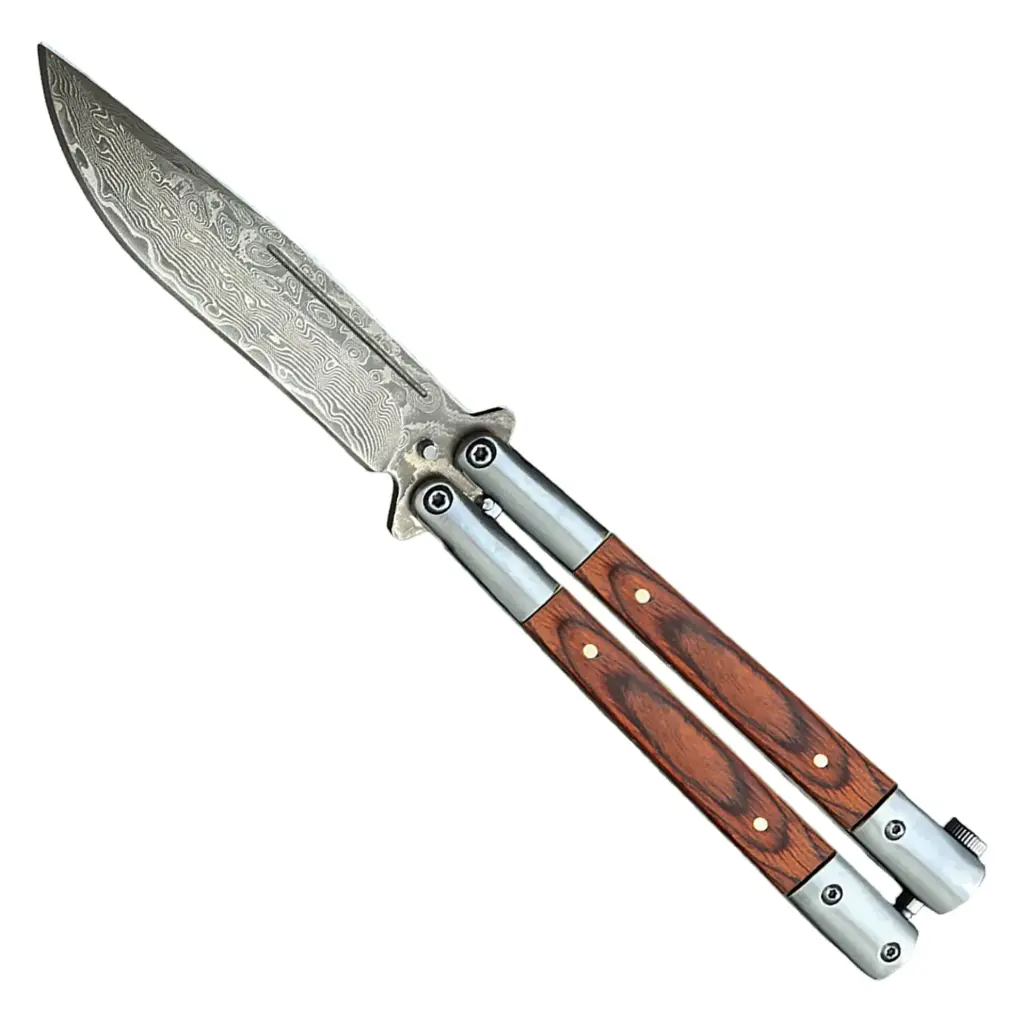
In your hand, it doesn’t feel like a prop. The blade’s Damascus pattern ripples under the light, and the wood inlays in the handles feel warm, almost familiar. Before you’ve done a single trick, your fingers already understand why this belongs in your everyday carry rotation, even if it spends most of its life in quiet, focused practice sessions.
How a Damascus butterfly knife turns practice into a ritual
Owning a Damascus butterfly knife isn’t about having another sharp object. It’s about having a tool that makes you want to come back to the motion. At 9.125 inches open and 5.25 inches closed, this balisong lands in that sweet spot where you can flip confidently without feeling like you’re wrestling a showpiece. The 3.875-inch drop point blade in Damascus steel carries just enough forward weight that each swing feels intentional, but not so much that your wrists fatigue after a few minutes.
As you work through basic openings—standard, behind-the-back, a simple roll—you notice something subtle: the balance makes you look better than you are. The 5.06-ounce weight gives the knife presence, so your hand doesn’t have to over-correct. The stainless bolsters lend solidity; the wood inlays soften the feel so the handles don’t bite. You’re not fighting the knife. You’re learning with it.
The sound and feel that keep you hooked
There’s a specific sound when a good butterfly knife closes—a muted, confident click as the T-latch meets the tang. That tiny moment of feedback becomes your metronome. The Damascus blade’s fuller trims weight and adds a visual line that your eye follows as you move, helping you track the edge without overthinking. This is how repetition turns into rhythm.
Why this Damascus butterfly knife feels naturally at home in your hand
When you pick up a Damascus butterfly knife, you want it to feel like it was made for real use, not just photos. Here, the materials and dimensions work quietly in your favor. The Damascus steel blade brings more than just pattern—it brings the sense that this isn’t disposable. The drop point profile makes everyday cuts—opening packages, trimming cord, cutting tape—feel straightforward, not precious.
The handles tell a different part of the story. Polished stainless frames give structure, while reddish wood inlays add warmth and grip where it matters. The brass pins stand out just enough to catch your eye, a small, human detail that makes the whole butterfly knife feel crafted instead of stamped. Torx screw pivots hold the whole thing together, and you can dial them in to match your style: tighter when you’re learning, looser when you’re chasing fluid, fast flows.
Dialing in your own balance
You’ll notice the difference the first time you tweak the pivots. A quarter turn shifts the behavior of the entire balisong. Tighten it, and the Damascus butterfly knife feels controlled, almost deliberate—great for learning safe openings and closing sequences. Ease it off, and the handles start to float around the blade, giving that effortless, flowing motion you’ve watched in videos. Either way, you’re in charge of how it moves.
Carrying a Damascus butterfly knife without feeling like you’re showing off
Not everyone wants their everyday carry to scream “tactical.” This Damascus butterfly knife reads differently. The patterned steel and wood inlays lean more heirloom than hardcore, more workshop than weapons cache. Slip it into a pocket or a bag, and you know you’re carrying something distinctive, but it doesn’t shout for attention.
When you do take it out—maybe at home, maybe at a friend’s place—it becomes a conversation piece without you having to sell it. Someone notices the Damascus pattern; someone else comments on the wood grain. You flip it open once, hear the soft clack of the handles, and suddenly people aren’t just looking at the knife—they’re watching your hands. That’s the quiet confidence this kind of everyday carry blade gives you.
From desk display to daily habit
You might start by leaving it on your desk or shelf, Damascus blade closed, wood handles catching stray light. It looks good just existing there. But over time, it stops being decor. It becomes the thing you pick up while a video buffers, while a file loads, while coffee brews. A few minutes here and there turn into smoother flips, cleaner catches, and a small daily ritual that belongs entirely to you.
When a Damascus butterfly knife beats a regular pocket knife
You could carry a simple folder and call it a day. But a Damascus butterfly knife adds something a standard pocket knife rarely does: a sense of practice, performance, and presence. With a balisong, the two-handle design forms a natural guard when open, giving you a secure grip and clear awareness of where the edge is at all times.
Then there’s individuality. Each Damascus blade carries a unique pattern—swirls, waves, lines that no other knife duplicates exactly. You’re not just carrying a tool pulled from a bin; you’re carrying a piece that looks singular. When you compare it to a plain stainless EDC folder, you can feel the difference in story. One is a tool that disappears when it’s not needed. The other is a tool that invites you to use it, train with it, and talk about it.
And functionally, you’re not compromising much. The plain-edge drop point can handle normal everyday tasks, and the T-latch locks the handles with a reassuring bite when the work is done. When someone asks what makes this carry knife different, you don’t have to stretch: Damascus steel, warm wood, stainless bolsters, serviceable pivots, and a feel that makes you want to get better every time you flip it.
Questions people ask before buying a Damascus butterfly knife
Is a Damascus butterfly knife good for everyday carry?
It can be, as long as it fits how you live and you respect local laws. This Damascus butterfly knife offers a versatile drop point blade and a balanced 5.06-ounce build, so it feels natural in hand for light daily cutting and regular flipping practice. Always check whether carrying a balisong is legal where you live before making it part of your EDC.
How does a Damascus butterfly knife compare to a regular balisong?
Functionally, they work the same: two handles rotate around a central blade and lock with a latch. The difference with a Damascus butterfly knife is in the experience. The patterned steel adds visual depth and a sense of craftsmanship, while the wood inlays and stainless bolsters give it a classier, heritage look than most standard balisongs. You get the same flipping mechanics with a much stronger identity.
Can I actually train with this, or is it just for display?
You can absolutely train with it, as long as you respect the live edge. This isn’t a trainer blade, but the balanced weight, T-latch, and adjustable torx pivots make it a solid choice for learning and refining skills. Many owners start slow with basic openings, then loosen the pivots and build toward smoother, more advanced flips as their confidence grows.
Will the Damascus pattern fade with use?
The Damascus pattern is part of the steel itself, not a surface print, so normal use and careful maintenance won’t make it vanish. Wiping the blade after cutting, avoiding harsh abrasives, and keeping a light coat of oil on the edge will help your Damascus butterfly knife keep its character for the long haul.
Owning the moment your Damascus butterfly knife finally feels like an extension of you
Picture this: you’re standing in your usual spot—maybe at the kitchen counter, maybe on the back porch, maybe by your desk. The air is familiar, the light is nothing special. You pick up your Damascus butterfly knife, the wood inlays pressing lightly into your fingers. Without thinking, you start an opening you used to fumble. This time, the handles swing cleanly, the blade arcs, and the T-latch closes with that soft, certain click.
In that small moment, you’re not just someone who owns a knife. You’re someone who put in quiet reps, who chose a tool with history in its steel and warmth in its handles, and turned idle minutes into skill. The Damascus pattern on your blade isn’t just decoration now—it’s part of a story you’ve been writing with every flip. That’s what carrying a Damascus butterfly knife really gives you: not just a piece of gear, but a daily proof that your hands can learn new rhythms and make them your own.