Legion Shade Roman Dagger Knife - Black Scabbard
You don’t pick up this Roman dagger knife just to hang it—you pick it up to feel history sit in your palm. The double-edged blade balances clean and straight, the black grip locks into your hand, the scabbard rides at your side. You feel the quiet weight of a different era, but the confidence is yours, right now, every time you draw and hear steel leave leather.
| Blade Length (inches) | 8 |
| Overall Length (inches) | 13 |
| Blade Color | Silver |
| Blade Finish | Satin |
| Blade Style | Dagger |
| Blade Edge | Plain |
| Blade Material | Steel |
| Handle Finish | Matte |
| Handle Material | Metal |
| Theme | Medieval |
| Handle Length (inches) | 5 |
| Pommel/Butt Cap | Metal pommel |
| Carry Method | Sheath carry |
| Sheath/Holster | Scabbard |
You don’t grab this off a shelf and forget it in a drawer. You slide the Roman dagger knife from its scabbard, feel the weight settle into your palm, and for a moment the room goes quiet. It’s just you, a double-edged blade, and that strange rush that comes when something in your hand feels like it could have belonged to someone centuries ago—and somehow still fits you.
When a Roman dagger knife turns your wall piece into a story
Maybe you’ve had replicas before—plastic-heavy, chrome-shiny, good from six feet away and disappointing up close. This time you want something different. When a visitor sees this Roman dagger knife resting in its scabbard, they don’t just think “cool display.” They lean in. They ask to hold it. And when they do, the first thing they notice is that this feels like a weapon, not a toy.
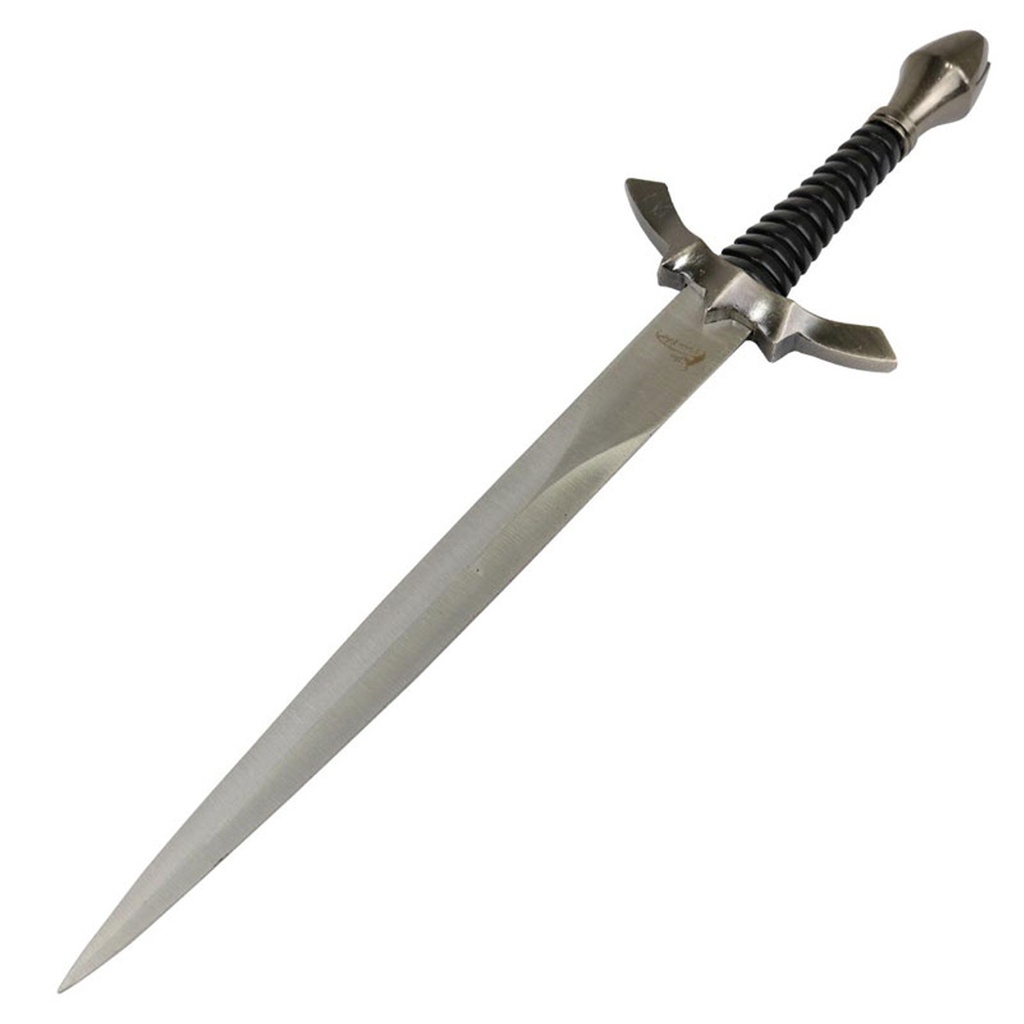
The 13-inch overall length fills the hand and the eye the way a real medieval sidearm should. An 8-inch double-edged blade runs straight and true, a central ridge catching the light. The satin steel doesn’t scream for attention; it just looks like it belongs in a soldier’s kit. That subtle authenticity is what quietly tells your brain, “this one’s different.”
Why this Roman dagger knife feels "right" the moment you draw it
There’s a reason this doesn’t feel like cheap decor. The fixed blade is steel from tip to tang, carried into a solid metal crossguard and pommel that do more than look medieval—they change how the dagger balances in your hand. That black ribbed handle isn’t an accident either. The minute your fingers wrap around it, you feel those ridges bite just enough to lock your grip without chewing up your skin.
At 5 inches, the handle gives your whole hand room to settle in, whether you’re holding it in a classic forward grip or reversing it for practice drills. You’re not fighting for space. You’re not pinching at the guard. You just close your hand and suddenly your wrist, arm, and blade all line up. That alignment is what makes a historical dagger feel believable in motion, not just on a stand.
Owning a Roman dagger knife when you care about more than a photo
You might picture this Roman dagger knife mounted on a wall plaque, or resting on a bookshelf next to worn paperbacks and a few well-chosen collectibles. But the real satisfaction comes from the moments when you actually draw it from the scabbard, hear that soft scrape of steel, and feel the point hang steady in front of you.
Because it’s a fixed blade with a plain double edge, nothing rattles, flips, or folds. You don’t baby it. You simply slide it free, practice a guard position, maybe run through a simple drill you watched from a historical fencing video, then sheath it again. The scabbard keeps it contained, controlled, and ready to display, but the ritual of draw-and-sheath is what makes it feel like yours instead of just another fantasy dagger gathering dust.
When a medieval historical dagger becomes part of your space
Think about where this lands in your world. Maybe it hangs near your gaming setup, a Roman dagger knife that echoes the worlds you step into on screen. Maybe it stands by the bookshelf where your copy of Marcus Aurelius or your favorite fantasy series lives. Wherever it ends up, it doesn’t just fill empty space—it anchors it.
The silver blade and fittings play against the black handle and scabbard like armor against leather. In a dim room, the blade catches stray light just enough to draw the eye; in daylight, that satin finish looks clean, not gaudy. You can leave it sheathed when kids or guests are around, but you know that with one smooth pull you can bring the full medieval profile into view. That mix of display and draw-ability is where this historical dagger quietly shines.
Roman dagger knife vs. generic fantasy blade: what actually changes for you?
If you’ve ever handled a bargain-bin fantasy knife, you know the feeling—too light, too hollow, edges that look mean but feel like tin. You set it down, you stop thinking about it. With a Roman dagger knife built on a straightforward, historical shape, the experience shifts completely.
Instead of wild serrations and impossible curves, you get a long, straight double edge that looks like it belongs in a legionary’s belt. Instead of plastic that flexes, you feel steel and metal fittings that carry real weight. The plain edges mean this isn’t trying to pretend it’s a survival tool—it’s honest about what it is: a specialized weapon form inspired by medieval and Roman design, made for training, display, and that satisfying weight of history in your hand.
Steel, grip, and scabbard: the small choices you actually notice
Run your thumb gently along the flat of the blade and you feel cool, smooth steel with a satin sheen instead of mirror-flash chrome. Close your hand around the handle and the ribbing lines up under your fingers the same way, every time, so your grip becomes muscle memory. Guide the blade back home into the scabbard and you feel a small, controlled resistance before it seats—enough to know it’s secure, not so much that you have to fight it.
From collection piece to handling ritual
Over time, owning this medieval dagger stops being about having “a dagger” and starts being about the tiny habits around it. Maybe you wipe the blade after a handling session, adjust its angle on the wall, or draw it before a movie or game you’ve been waiting to watch. Those rituals are where the historical vibe stops being decoration and starts being part of how you experience your own space.
Questions people ask before buying a Roman dagger knife
Is this Roman dagger knife just for display, or can I actually handle it?
You can absolutely handle it. The Roman dagger knife is a full-size fixed blade with an 8-inch steel double edge and a solid 5-inch grip, so it feels like a real weapon in the hand. It’s not a utility tool, but it’s built to be drawn, held, and trained with, not just looked at.
Is a Roman dagger knife legal to own or display at home?
In most places, owning a historical or medieval-style dagger at home is legal, and a Roman dagger knife like this is typically treated as a collectible. Carry laws vary a lot by state, city, and country, especially for double-edged blades, so you’ll want to check your local regulations before wearing or transporting it in public.
How big is this compared to a regular knife?
This Roman dagger knife is larger than most everyday carry blades. At 13 inches overall with an 8-inch double-edged blade, it feels closer to a short sword than a pocket knife. If you’re used to small folders, the difference in reach, presence, and weight will be immediately noticeable.
Can I use this Roman dagger knife for everyday tasks?
Technically, you could cut with it, but that’s not where it shines. A Roman dagger knife is a specialized, double-edged weapon form with a straight medieval profile, better suited to collection, cosplay, training, or decor than opening boxes. You’ll get more satisfaction treating it as a historical piece than a daily beater.
Picture this: the room is quiet, the day’s done, and you reach for the scabbard hanging on your wall. Your hand finds the grip, the Roman dagger knife slides free, and the blade lines up with your arm like you’ve done this a hundred times already. The steel catches a stripe of light, the weight settles into your palm, and for a moment you’re not just someone who likes medieval gear—you’re the kind of person whose space, and whose presence, carries a little edge of history with it.