Shadow Parry Elegant Rapier Sword - Black Wire-Wrapped
You don’t pick up this rapier sword to swing wildly—you reach for it when you want control. The first time you draw this elegant rapier sword, the slim silver blade and black wire-wrapped grip change how you stand, how you move, how you’re seen. The balance pulls your wrist into that natural duelist line, whether you’re stepping onto a stage, into a cosplay hall, or in front of your display wall. You’re not holding a prop. You’re inhabiting a role.
You don’t just want a sword on your wall—or at your side—you want that moment when the room goes quiet for half a second as you draw. Not because you’re trying to impress anyone, but because the line of the blade, the curve of the guard, and the way your hand settles on the grip all say the same thing: this person came prepared.
That’s what happens the first time you pick up a dueling-style rapier sword like this. Before you know its length in inches, you know how it changes the way you stand.
How a Rapier Sword Changes the Way You Enter a Room
A heavy broadsword makes you feel like a battering ram. A rapier sword does something different—it lengthens you. The long, narrow silver blade pulls your focus forward, like your attention is now measured in steel instead of steps.
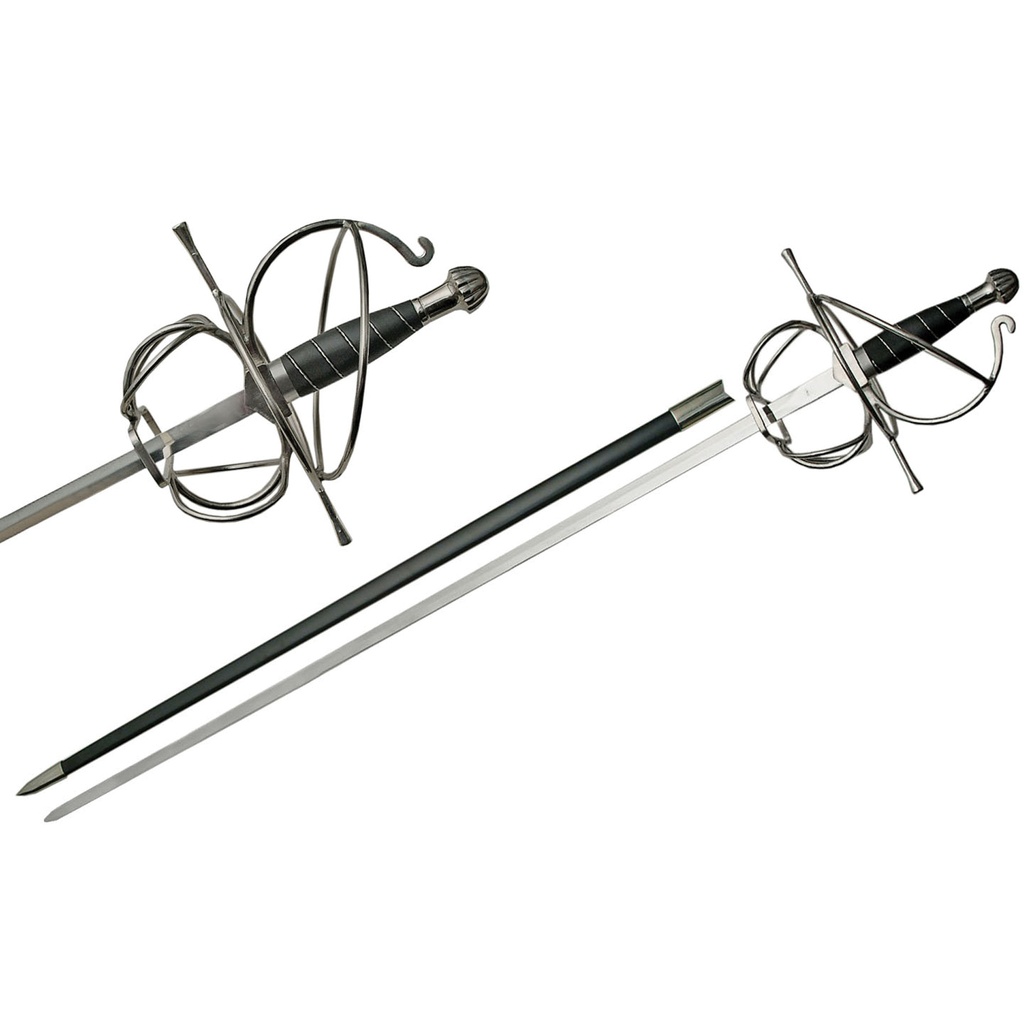
When your fingers close around the black wire-wrapped grip, you notice two things immediately. First, the texture—fine metal winding under your palm, firm without biting, giving you that confident, precise hold. Second, the guard: a swept hilt of polished silver-colored bars wrapping around your knuckles. You see it in your peripheral vision, framing your hand like armor and jewelry at the same time.
This isn’t the kind of rapier sword you drag into imaginary chaos. It’s the one you bring into rehearsed moments: stepping onto a stage, walking into a Renaissance faire, or finishing a display wall you’ve been curating piece by piece. It makes you move with intention, because it looks like it belongs to someone who already knows exactly what they’re doing.
Why This Rapier Sword Feels So Balanced in Your Hand
There’s a reason you can tell cheap wall-hangers from the instant you touch them: they feel dead. The blade pulls weirdly, the hilt rattles, or the whole thing feels like painted tin. This rapier sword lands differently.
The blade is long, slim, and straight—a classic thrusting profile with a bright, polished finish that catches light without shouting. It’s unsharpened or only lightly edged, which is what you want for costuming, stage work, or safe practice choreography. You can move freely without the constant fear that one misstep will turn a rehearsal into a hospital visit.
The swept hilt isn’t just decoration. Those curved bars of polished metal create a cage around your hand, giving you real protection in stage combat and a very real sense of security when you’re practicing lunges in front of a mirror. The fluted cone pommel at the back isn’t random either—it acts as a counterweight, so the balance point pulls closer to your hand instead of feeling like a steel fishing pole.
The First Time You Test the Line
You’ll probably do what everyone does: take a fencing stance you half-remember from movies, extend the blade, and watch how straight that line runs from your shoulder through your knuckles and out to the tip. That’s where the design clicks. The wire-wrapped grip keeps your fingers locked comfortably, the guard keeps your confidence high, and the blade stays obedient, not wobbly.
Carrying, Drawing, and Displaying Your Rapier Sword in Real Life
Owning a rapier sword isn’t just about the blade—it’s about how it fits into your actual life. This isn’t a short knife you tuck into a pocket; it’s a statement piece that becomes part of your movement, your costume, or your room.
The included black scabbard matters more than it first seems. Slide the blade home and you get that soft, controlled resistance—the sound and feel that tell you this isn’t just a bare-metal wall stick. The slim, dark scabbard with silver throat and tip keeps the whole profile clean and refined, whether you’re wearing it on a belt at a Renaissance faire or mounting it on hooks above a shelf of leather-bound books and collected props.
In costume, it changes everything. Your walk gets a slight, deliberate sway as the scabbard tracks your stride. Your hand finds the hilt without looking, fingers slipping over the wire wrap and under the sweep of the guard like you’ve done this a thousand times. Even if it’s your first faire or your first stage play, you don’t feel like a beginner. You feel like a duelist between scenes.
Onstage, Backstage, or Center Wall at Home
Onstage, the bright blade reads clearly under lights, while the black grip and scabbard fade just enough to keep focus where it needs to be: the line of your attacks, the clash, the final pose. Backstage, it leans against a folding chair or rests on a rack, and you catch yourself glancing at it because it simply looks like it belongs there.
At home, mounted with the scabbard or displayed bare, it doesn’t scream for attention; it rewards people who notice details—the sweep of the guard, the rhythm of the wire, that slender, almost needle-like silhouette.
When a Rapier Sword Is Better Than a Broadsword
If you’re already deep into swords, you know the debate: heavy cutting blades versus elegant thrusting weapons. This is where a rapier sword quietly wins in a lot of real-world situations.
For cosplay and costume events, a rapier’s narrow profile means it’s easier to navigate crowds, doorways, and narrow vendor aisles. You’re less likely to bump chairs and people, and more likely to keep that smooth, composed presence you actually want. For stage work, the thrusting shape and unsharpened edge give fight choreographers more control and more safety, while still looking deadly from the audience’s point of view.
Even as a display piece, a slender dueling blade often fits better into modern spaces. It can hang above a desk, alongside framed art, or near a bookshelf without visually overwhelming everything. It says sophistication instead of “garage arsenal.”
Questions People Ask Before Buying a Rapier Sword
Is this rapier sword sharp enough to be dangerous?
This rapier sword uses an unsharpened or only lightly edged blade, designed for display, costume, and stage use. You still treat it with respect—its point and weight are real—but it’s intentionally not built as a live cutting weapon, which makes it far more practical for events and indoor practice.
Can I actually use this rapier sword for stage combat?
Yes, this style of rapier is well-suited to choreographed stage combat, cosplay, and rehearsal when used responsibly. The slim thrusting blade, protective swept hilt, and wire-wrapped grip give you control, while the non-live edge reduces risk. As always, follow your troupe’s safety rules and practice with a partner who knows their marks.
Is a rapier sword like this okay to carry at events or in public?
Legality depends heavily on where you live. Many places allow carrying a sheathed rapier sword at fairs, cons, or events, especially as part of a costume, while others have stricter rules. Check your local laws and event policies first, then transport it in its black scabbard and keep it sheathed until you’re in an appropriate space.
How does a rapier sword compare to a katana or fantasy sword for display?
A rapier brings a different energy. Where katanas and big fantasy blades lean toward power and drama, a dueling-style rapier leans toward precision and elegance. If you want your display to look curated and refined rather than chaotic and oversized, this kind of blade often fits the room—and your identity—as a collector who knows restraint.
Stepping Into the Role With Your Rapier Sword
Picture this: the house lights dim, or the sun starts to drop behind the faire tents, or you’re alone in your room after a long day. You reach for the black scabbard, feel the cool metal of the throat under your thumb, and draw. The polished blade slides free with that quiet, satisfying sound you’ll never get tired of.
Your fingers find the black wire-wrapped grip. The swept hilt frames your hand in silver. You extend your arm and the tip of the rapier sword hangs perfectly in line with your focus. In that instant, you’re not just someone who bought a sword. You’re the duelist, the fencer, the character people remember—the one who looks like they’ve always belonged behind that blade.