Old-World Milano Heritage OTF Knife - Wood Handle
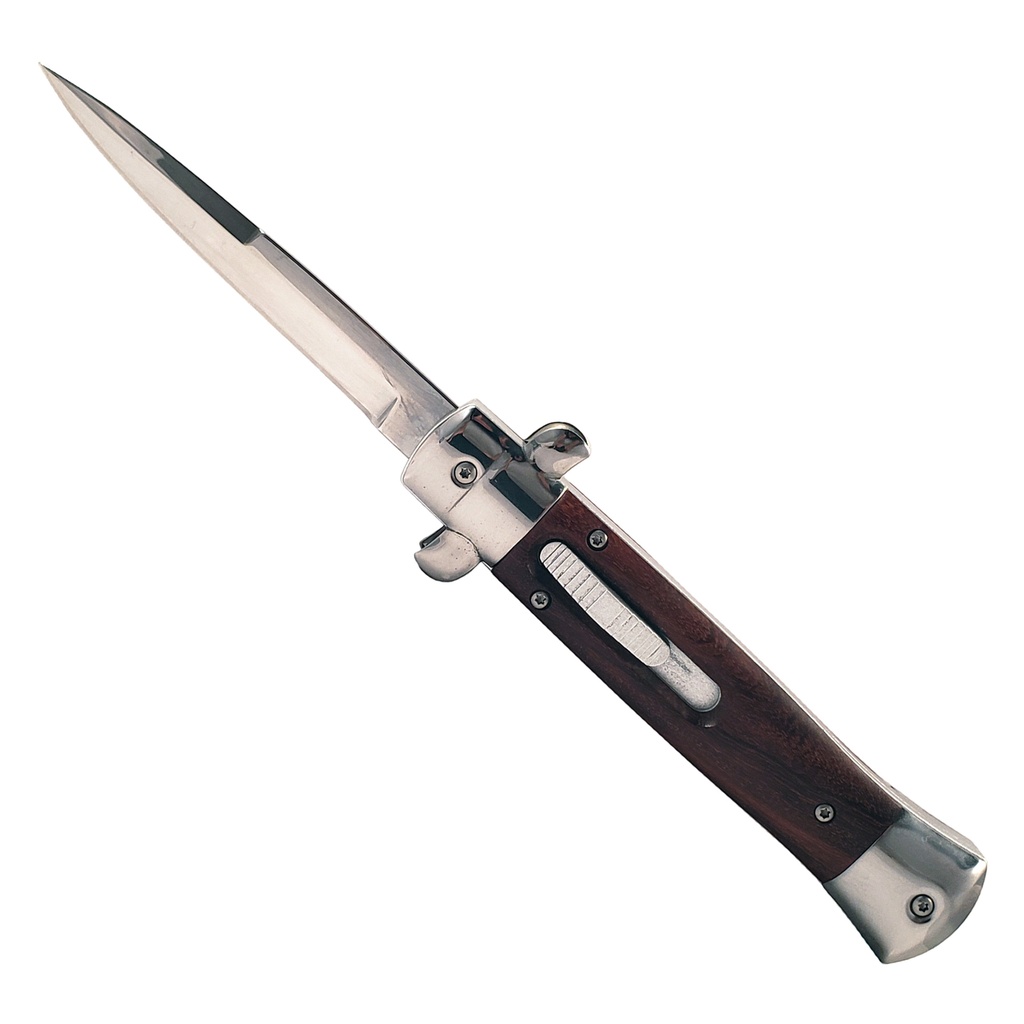
You don’t carry an OTF knife like this just to cut things—you carry it to remember who you are when you don’t rush. One thumb on the switch and that long Milano blade snaps out in a clean line of polished steel and warm wood. It feels like something your grandfather might have carried, but with the automatic snap you crave now. In your pocket, it’s quiet heritage. In your hand, it’s confidence that looks as good as it feels.
| Blade Length (inches) | 3.5 |
| Overall Length (inches) | 9 |
| Closed Length (inches) | 5.125 |
| Weight (oz.) | 6.9 |
| Blade Color | Silver |
| Blade Finish | Polished |
| Blade Style | Dagger |
| Blade Edge | Plain |
| Blade Material | Steel |
| Handle Finish | Polished |
| Handle Material | Wood |
| Button Type | Switch |
| Theme | Stiletto |
| Double/Single Action | Single |
| Pocket Clip | Yes |
You notice it first when you set your keys, wallet, and knife down at the end of the day. The keys clink, the wallet thuds, but the moment the wood and steel of your OTF knife touch the table, the whole scene shifts. It doesn’t feel like gear anymore. It feels like an heirloom you somehow get to carry early.
Why This OTF Knife Feels Like Old-World Milano in Your Pocket
There’s a reason this doesn’t feel like every other OTF knife you’ve handled. The first time you thumb the sliding switch and that long, narrow dagger blade snaps straight out the front, you’re not just testing the action—you’re replaying every scene you’ve ever loved with a classic Milano stiletto. Only now, it’s cleaner, faster, and built for everyday carry instead of just display.
The blade stretches out to about 3.5 inches of polished steel, ground into a dagger profile that looks like it was drawn with a ruler. You feel the quillon-style guard catch your fingers just enough to anchor your grip, the way the old Italian stilettos used to do it. But instead of a side-opening leaf spring, you get modern single-action OTF deployment: thumb forward, blade fires; thumb back, you reset and you’re ready again.
What that means for you isn’t just speed. It’s certainty. You don’t fumble for a nail nick or thumb stud. You don’t need two hands. You reach into your pocket, find the switch by feel, and the blade answers without hesitation. In a parking lot, on a trail, at your workbench—that instant, repeatable action is the difference between thinking about your knife and just using it.
Old-World Materials, Modern OTF Knife Confidence
Most modern automatics try to look futuristic. This one doesn’t need to. The warm brown wood scales catch the light with a subtle grain pattern that feels like it belongs on a vintage piece, not a tactical pocket knife. Polished steel bolsters cap each end, tying the whole thing together so it looks as intentional as it feels in your hand.
You notice the weight the moment you pick it up—around 6.9 ounces gives it a solid, reassuring presence. Not a featherweight toy, not a chunk of dead metal. Just enough heft that when you extend that dagger blade, your grip doesn’t waver. For you, that means controlled cuts instead of overcompensating for a flimsy handle.
The polished dagger blade isn’t just for show either. The twin grinds running along the center line give you a precise point and symmetrical profile, meaning opening packages, slicing cord, or making a careful push cut all feel the same: smooth, clean, predictable. Behind the aesthetics is simple steel reliability—easy to touch up, quick to bring back to a working edge when you’ve actually used it hard.
How This OTF Knife Rides, Draws, and Works in Real Life
A knife can look incredible, but if it doesn’t carry well, it ends up in a drawer. This one earns its pocket space. Closed, it sits at just over five inches, with a side-mounted pocket clip that tucks the wood handle against the seam of your jeans or jacket. You slide it into place once in the morning and forget it—until you need it.
That’s when the design choices start to matter. The textured metal switch sits exactly where your thumb naturally lands when you draw. No hunting for a button, no weird angles. You pull, orient, slide forward, and the blade is out in one continuous motion. After a week, it’s muscle memory. After a month, you stop thinking about it at all.
At a campsite, you’re trimming paracord by lantern light. In the garage, you’re opening boxes and shaving zip-ties without digging through tools. At a family gathering, you’re the calm one who quietly flips out a polished, wood-handled everyday carry blade that looks more like a gentleman’s piece than a tactical toy. People notice—but not for the reasons you see on loud product pages. They notice because the knife feels like it belongs to your story, not to a trend.
When an OTF Knife with Milano Heritage Changes the Whole Vibe
You could carry a plain black tactical OTF and disappear into the crowd of guys who buy gear just to say they did. Or you could carry something that says you actually care about where design came from. This OTF knife carries the lines of the classic Milano stiletto—long, lean blade, pointed pommel, guard at the base—without turning you into a movie cliché.
That heritage comes through most when you’re doing simple things. You’re sitting at a picnic table, someone struggles with plastic packaging, and you slide this out. The wood scales catch the light, the polished steel blade snaps forward, and there’s this half-second where everyone realizes this isn’t a gas station special. You’re not trying to impress anyone, but you’re also not pretending you don’t enjoy the way it looks in your hand.
Functionally, it’s still very much a pocket knife for daily use. The plain edge bites cleanly into cardboard, rope, or tape. The symmetrical dagger profile gives you a strong piercing point when you need precision. The automatic mechanism means less time fighting your tools and more time just getting things done, whether that’s around the house, on the trail, or walking to your car at night with a little extra quiet confidence.
Questions People Ask Before Buying an OTF Knife Like This
Is this OTF knife actually good for everyday carry, or just for looks?
It’s both. The Milano styling and wood handle give you heritage looks, but the single-action OTF mechanism, plain-edge dagger blade, and pocket clip make it a truly usable EDC knife. You can open packages, cut cord, and handle daily tasks while still enjoying the classic stiletto vibe.
Is an OTF knife legal to carry where I live?
Laws on an OTF knife or automatic knife change from state to state and even city to city. Some places treat automatic blades like any other pocket knife, while others restrict blade length or mechanism. It’s smart to check your local and state knife laws before making it your daily carry, so you can enjoy it without second-guessing.
Will the automatic mechanism hold up with real use?
The single-action OTF mechanism is built around a sturdy internal spring and track system. As long as you keep debris out of the handle and avoid slamming the blade into hard surfaces, it will fire consistently. A quick wipe-down now and then keeps it running smoothly, so your carry knife feels as crisp on the hundredth deployment as it did on the first.
Does the dagger blade make it hard to sharpen?
Sharpening a dagger-style everyday carry blade just means paying attention to both edges if they’re ground for cutting. You treat it like two short blades meeting at the point, working evenly to keep the symmetry. With basic sharpening tools and a little patience, you can keep this polished steel ready for daily tasks without any special tricks.
Later tonight, you’ll empty your pockets again. Keys. Wallet. Phone. And then the last thing you lay down is that familiar shape: wood scales, polished bolsters, and the quiet promise of a blade that waits behind a simple thumb-slide. You don’t have to think about owning an OTF knife anymore—it’s just part of how you move through the world now. A little old-world Milano heritage in your hand, a little more steadiness in how you carry yourself, and a story you’re still writing every time that blade snaps into place.