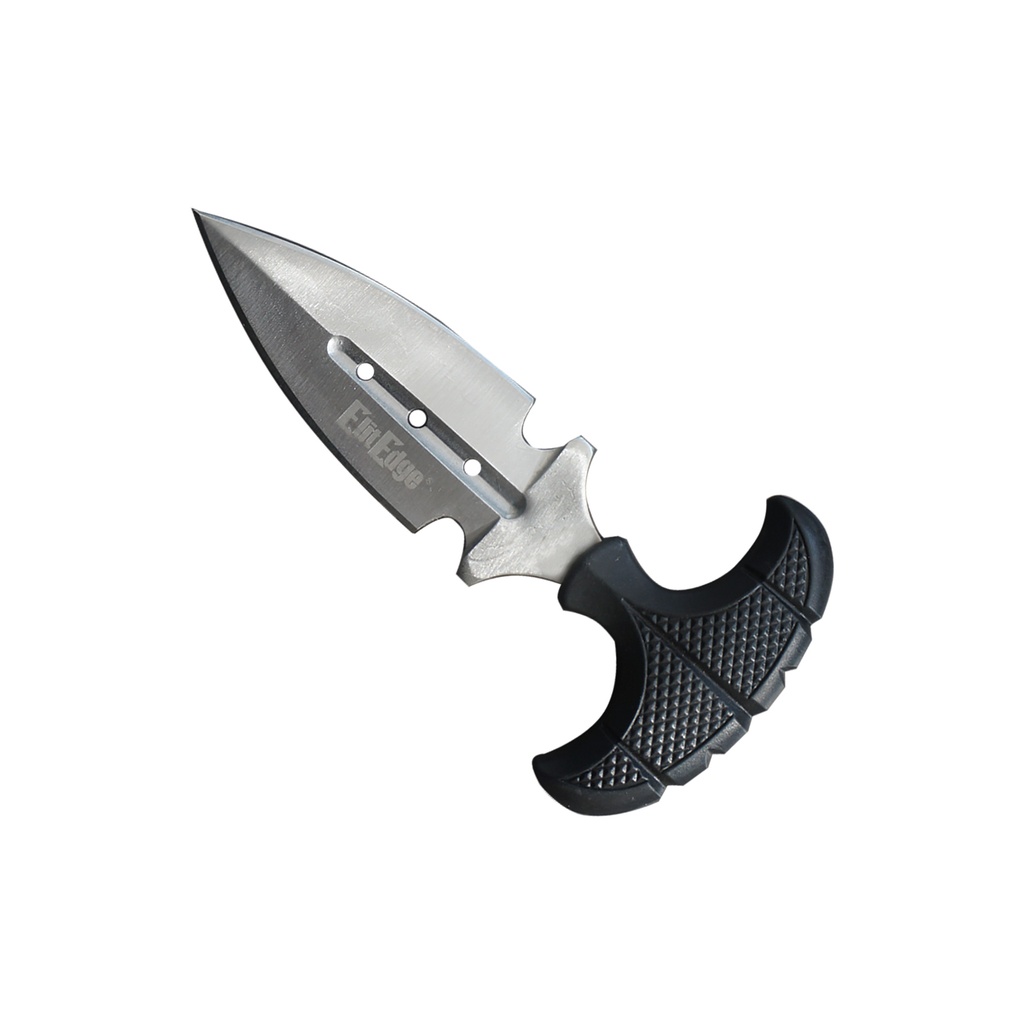
Night Cross Grip-Control Push Dagger - Black Handle
You don’t carry a push dagger because you like the idea of danger—you carry one because you remember the night you wished you’d had more control. This Night Cross grip-control push dagger settles into your palm like it was waiting for you. The double-edged spear point, the textured black T-handle, the way 5.6 inches of steel disappears until you need it—everything says the same thing: this time, you’re not hesitant. You’re ready.
You remember the last time your gut told you something was off. The empty parking lot. The footsteps that didn’t match yours. You walked faster, keys between your fingers, wishing you had something that wasn’t makeshift or imaginary—something that gave you real control instead of just a story you told yourself.
That’s the gap a push dagger quietly fills. Not drama. Not fantasy. Just the calm, specific kind of readiness that lives in the back of your mind and changes how you move through the world.
When a Push Dagger Turns Fear Into Focus
In that first uneasy moment, you don’t want to be fishing around or remembering which pocket holds what. A push dagger is about one instinctive motion: your hand closes, your palm meets the T-handle, and the blade is already aligned with the direction your body wants to move.
This one sits at 5.625 inches overall, with a double-edged spear-point blade that feels like a straight line between your intent and the world in front of you. Because the blade runs in line with your knuckles instead of out to the side, your natural punching motion becomes controlled, directed force. No complicated grip, no weird angles—just your palm driving a fixed blade that does exactly what you tell it.
What this means in real life: less thinking, more focusing. Your attention stays outside you—on the person, the door, the shadow in your peripheral vision—instead of on your own fingers trying to sort themselves out.
Why This Push Dagger Feels Locked In, Not Just Held
There’s a difference between a knife you can hold and a knife that decides how you hold it. This push dagger is the second kind. The black synthetic T-handle has deep finger grooves carved in, telling your index and middle fingers exactly where to land. The textured grip panels bite gently into your skin, so even if your hand is sweaty, shaken, or adrenaline-charged, the handle stays planted.
At 2.65 ounces, it’s light enough that you forget you’re carrying it, but there’s just enough weight at the blade that, when your palm closes, you feel a subtle forward pull—your body’s cue that the edge is where it needs to be. That’s the design detail that clicked on first touch: you don’t have to check your orientation. Your hand already knows.
The satin-finished silver blade stretches out in a spear point with matching double edges. The central fuller with three circular cutouts isn’t just visual flair; it trims a bit of weight and gives the blade a more agile balance, so quick redirects feel natural, not clumsy. Full-tang style construction runs the steel straight into the handle, turning the whole thing into a single piece of intent instead of a blade bolted to a grip.
The Quiet Confidence of Black and Steel
The black handle and silver blade aren’t there to shout. They’re there to disappear until the moment you need them. The contrast is clean and serious—no neon, no theatrics—just a tool that looks like it belongs in the kit of someone who actually thinks about their everyday carry, not someone playing dress-up.
How a Push Dagger Fits Into Your Everyday Carry Without Taking Over
EDC isn’t about carrying everything. It’s about carrying the right thing. A push dagger like this one isn’t your box cutter, your letter-opener, or your food prep blade—it’s the quiet specialist in your lineup. The one that stays out of sight but sits in the back of your mind like a safety net.
At just over five and a half inches and barely more than two and a half ounces, it disappears in a small sheath or tucked where you want a backup: on a vest, inside a bag panel, along a waistband. The T-handle means retrieval is always the same story—two fingers hook the crossbar, your palm closes, and you’re locked in.
If you already carry a folding knife or a standard fixed blade, this doesn’t replace them. It covers a different scenario: close range, limited space, high stress. The kind of moment where fine motor skills vanish and gross motor movements take over. That’s exactly where a push dagger shines, turning a straightforward forward drive of your arm into controlled, directional power.
In the Dark, Your Hand Doesn’t Have Time to Guess
Picture a stairwell that’s one bulb away from burned-out, or the inside of your car when the dome light doesn’t kick on. You’re not going to see a thumb stud or a liner lock. But you will feel a T-shaped handle waiting for your palm—no blade to unfold, no direction to double-check. That’s the quiet advantage of this type of everyday carry blade.
When a Push Dagger Makes the Difference Between Hoping and Knowing
There’s a mental shift that happens when you stop hoping things go smoothly and start knowing you’re prepared if they don’t. A push dagger taps into that shift in a way a general-purpose pocket knife often doesn’t. This isn’t about cutting rope or opening packages. It’s about one job: giving you a controlled, repeatable response in a moment you never wanted but thought about anyway.
You might be comparing it to a small tactical pocket knife or wondering whether a traditional self-defense folder is "enough." The real comparison isn’t about inches of blade—it’s about access and control under pressure. With a push dagger, your wrist stays straighter, your grip stays closer to a natural fist, and the risk of fumbling a deployment drops. It’s less about which is better on paper and more about which one respects the limits of your hands when adrenaline hits.
For some people, that means this becomes a backup to their primary everyday carry knife. For others, it becomes the one piece they absolutely don’t leave behind when the sun goes down. Either way, it changes the question from "What if something happens?" to "If something happens, I know exactly what my hand will do."
Questions People Ask Before Buying a Push Dagger
Is a push dagger legal to carry where I live?
Laws around a push dagger vary a lot by state, city, and even how you carry it. Some areas treat double-edged or knuckle-style knives differently. Before you add this to your everyday carry, check your local and state regulations—search your city name plus "push dagger laws" and read official sources, not just forums.
Can I actually use a push dagger effectively under stress?
If you can make a fist, you can use a push dagger. The T-handle design lines the blade up with your natural punching motion, so you’re not trying to remember fancy grips when your heart rate spikes. That said, any self-defense tool—including a push dagger—benefits from training, practice draws, and understanding when you’re legally allowed to use force.
How does a push dagger compare to a regular EDC knife for self-defense?
A standard everyday carry knife, especially a folding knife, gives you more utility for daily tasks but often demands more fine motor skill to deploy and align in a fight. A push dagger trades general utility for specialization: faster instinctive indexing, straighter wrist alignment, and better control at very close range. Many people carry both—a utility blade for daily use and a push dagger as a dedicated self-defense tool.
Will this push dagger hold up if I actually have to use it?
This design leans on a fixed double-edged spear point and full-tang style construction into a synthetic T-handle, which is exactly what you want for strength in a compact self-defense blade. There are no moving parts to fail, and the textured handle with finger grooves is built to keep your grip stable when it matters most.
The Moment You Make This Push Dagger Part of Your Story
Picture the first night you carry it. Nothing dramatic happens. You lock your door, walk to your car, and feel the light, familiar shape sitting where you chose to keep it. Your fingers find the T-handle without looking, just to test the motion. Palm closes. Blade aligns. It’s smooth, simple, sure.
That’s the quiet identity shift a push dagger like this creates. You’re no longer the person rehearsing worst-case scenarios with empty hands. You’re the one who already decided what your hand will do if the moment ever comes. The world doesn’t look less dangerous—but you move through it with a different kind of calm, because now, control isn’t theoretical. It’s sitting right there in your palm.