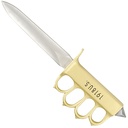
Night Watch Knuckle-Guard Trench Knife - Polished Brass
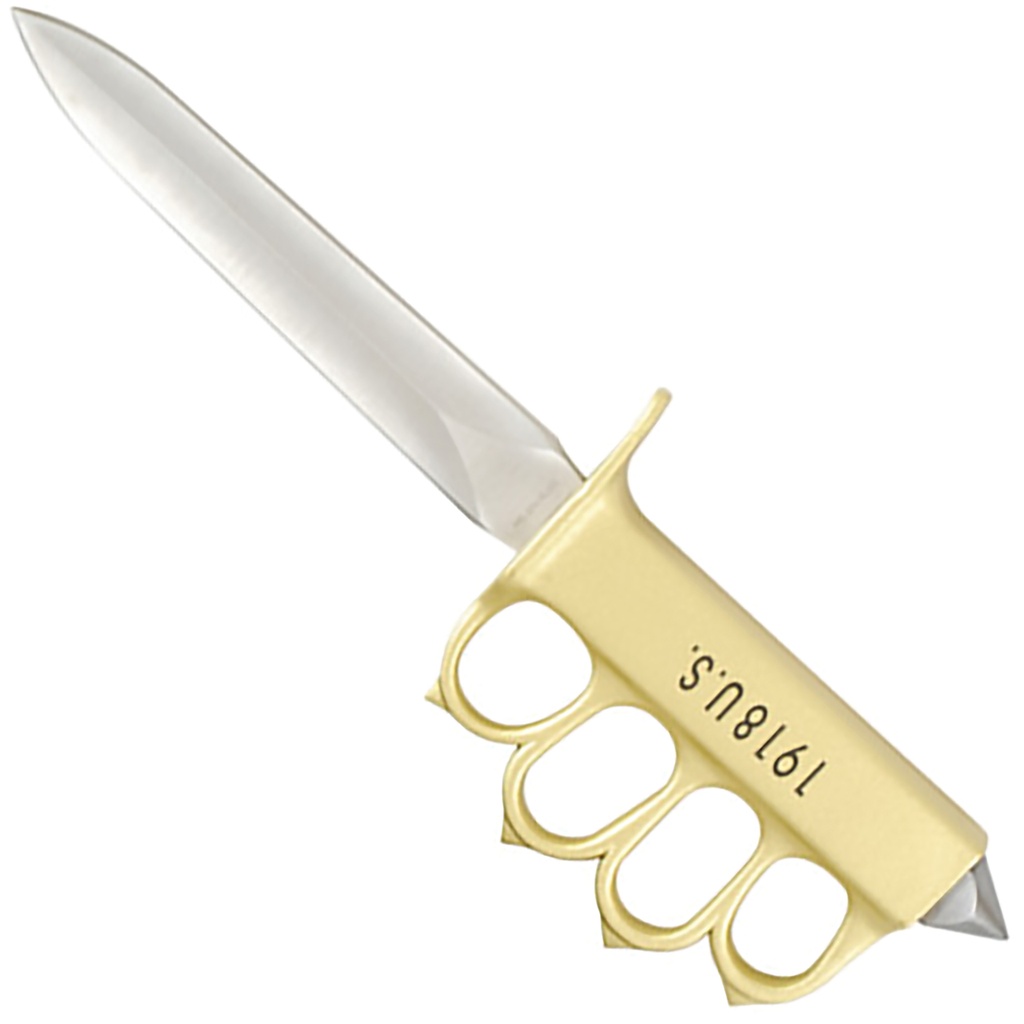
You don’t pick up a trench knife by accident. You reach for it when you want history in your hand and confidence in your grip. This fixed blade trench knife feels like a relic that somehow stayed sharp—6.75 inches of double-edged steel out front, polished brass knuckle guard wrapped around your fist. The weight settles your nerves. The sheath ride becomes ritual. You’re not just carrying a knife; you’re carrying a story that started in 1918 and now continues with you.
| Blade Length (inches) | 6.75 |
| Overall Length (inches) | 12 |
| Blade Color | Silver |
| Blade Finish | Polished |
| Blade Style | Dagger |
| Blade Edge | Plain |
| Blade Material | Steel |
| Handle Finish | Polished |
| Handle Material | Brass |
| Theme | Trench Knife |
| Handle Length (inches) | 5.25 |
| Pommel/Butt Cap | Pommel |
| Sheath/Holster | Sheath |
The first time you wrap your fingers through polished brass, you feel it. Not the weight—though the weight is there—but the shift. The room goes a little quieter. Your everyday EDC blades suddenly feel smaller. This isn’t just another fixed blade knife; this is a trench knife, the kind you’ve seen in black-and-white photos and war stories, now solid and cold and absolutely real in your hand.
Why a trench knife changes the way you see a fixed blade knife
You’ve held plenty of knives before. Folders that disappear into your pocket, utility blades that earn their keep cutting boxes and rope. Useful, sure. Familiar. But the moment you slide this trench knife from its sheath and feel that 6.75-inch double-edged dagger blade balance against the brass knuckle guard, something different happens—you’re suddenly aware of lineage.
This isn’t just a fixed blade knife designed for tasks; it’s modeled after the 1918 U.S. trench fighters that had to work in mud, chaos, and adrenaline. The knuckle guard isn’t a visual gimmick. It locks your hand into place, every finger anchored in brass so the blade feels like an extension of your arm, not just something you’re holding. You know, instantly, that this will not slip if your grip is wet, cold, or shaking. That certainty becomes part of how you stand, how you move, how you imagine using it.
Fixed blade knife heritage you can actually feel in your grip
The first thing you’ll notice is the polish. Brass that catches the light, steel that throws it back. But the second thing—the thing that hooks you—is how the design all lines up with purpose. The dagger-style blade runs long and lean, with a central fuller that lightens the steel without cheapening the feel. It’s double-edged, so whether you’re thrusting, slicing, or just practicing movements in your garage, every direction feels deliberate and controlled.
The handle isn’t some generic tube; it’s a dedicated brass knuckle guard with each finger given a home. Slide your hand in and you can feel the way it spreads impact across your knuckles, how the squared edges give you control if you ever need to strike with the pommel instead of the blade. The engraving—“1918 U.S.”—isn’t loud, but your thumb will find it, trace it, and remember why this design exists at all.
The weight that settles your nerves
At around 12 inches overall length, this trench knife has enough presence that your wrist is always aware of it—but never fighting it. The brass handle pulls the balance back toward your hand so the tip doesn’t feel wild or front-heavy. You can shadow-move with it, practice reverse and forward grips, and you’ll find the point tracks where your eyes go. It’s the kind of control that makes you more careful, not reckless.
How a trench knife fits into your real-life carry
Maybe you’re not crawling through mud under artillery. Your battlefield looks different: unpacking gear at camp, walking your land at dusk, entering a dark parking lot with your senses turned up a notch. This is where a fixed blade knife with a trench profile stops being a display piece and starts becoming a quiet anchor in your kit.
The sheath carry keeps the blade protected and your movements clean. Draw becomes a single practiced motion: hand into brass, thumb on sheath, steel sliding free. You’re not fumbling with thumb studs or springs; there’s no hoping an assisted mechanism behaves under stress. It’s just you, the handle, and an edge that’s exactly where you expect it to be.
Display piece by day, serious tool by choice
There will be days it lives on your wall or in a display case, the polished brass catching afternoon light and starting conversations before people even see the engraved date. And there will be nights you thread it onto a belt, feeling the firmness at your hip as you step outside. You get to decide which role it plays. But you’ll know, every time you sheath it, that it’s not just for show if you don’t want it to be.
When a trench knife beats a regular fixed blade knife
You could carry a standard survival blade. There’s logic in that. But there are moments where a trench knife simply makes more sense for who you are and how you move. If you’re drawn to history, to gear that’s earned its silhouette the hard way, you’ll feel that pull here. The knuckle guard gives you something a normal fixed blade knife can’t—hand armor and grip security rolled into one, especially in close quarters.
In tight spaces, in bad footing, in high-adrenaline encounters, your fingers stay locked behind brass, not sliding along a smooth handle. The pointed pommel offers another option entirely: a controlled, non-blade impact when that’s the smarter choice. You’re not carrying a toy. You’re carrying options, and each one feels intentional.
Questions people ask before buying a trench knife
Is a trench knife like this legal to carry where I live?
That’s the first thing most people type into a search bar, and it’s the right instinct. Trench knives and any fixed blade knife with a knuckle guard sit in a gray area in many regions. Laws vary wildly by state, city, and even how you carry it. Before you belt this on for daily use, check your local knife and weapons laws—sometimes it’s fine to own as a collectible, but restricted as a carry knife in public.
Can I use this as an everyday fixed blade knife, or is it just for display?
You absolutely can use it, but you should be honest about your needs. As a working fixed blade knife, the double-edged dagger profile isn’t ideal for tasks like carving or food prep. Where it shines is in thrust, control, and presence. Many owners treat it as a functional heritage piece: displayed most of the time, trained with and carried selectively when the context fits.
How does a trench knife feel compared to a regular field or combat knife?
The most obvious difference is the grip. Where a standard combat or field fixed blade knife gives you a cylindrical or flat handle, this trench design locks each finger into brass. It feels more like wearing the knife than holding it. That knuckle guard changes your posture—you feel sheltered and braced, which can be reassuring but also demands respect and discipline from you as the carrier.
What kind of maintenance does a polished brass trench knife need?
Brass wants to tell a story over time. Left alone, it will patina, darken, and pick up the kind of character that makes a heritage trench knife look authentically old. If you prefer it bright, you’ll wipe it down after handling and occasionally hit it with a brass polish. The polished steel blade just asks for the basics: keep it clean, dry, and lightly oiled, especially along the double edge and fuller.
The moment this trench knife becomes part of who you are
Picture the first time you show it to someone who gets it. You slide the sheath open, let the polished steel catch a band of light, and their eyes go straight to the brass knuckle guard and that “1918 U.S.” engraving. They don’t ask how much it cost. They ask where you found it. They ask to feel the weight. They ask about the story.
By then, you’ll already have your own. Maybe it’s just quiet nights cleaning the blade at your workbench, or the solidity you felt with it on your belt when you checked a noise outside. Maybe it’s the way your collection suddenly had a centerpiece the day this trench knife arrived. Whatever the details, you’ll know this isn’t just another fixed blade knife in a drawer. It’s the one that changed how you think about blades, about history, about readiness—and the one that feels right when you want something in your hand that has already proven, decade after decade, that it belongs there.