Oathbound Lineage Medieval Hand Sword - Black Leather
You don’t pick up this medieval sword to decorate a wall—you reach for it when you’re ready to step into a story. The weight settles into your grip, the black leather scabbard brushes your side, and suddenly rehearsals, cosplay, or training feel more honest. This medieval hand sword gives you that clean cruciform look, the bright carbon steel, the hand-and-a-half reach that moves the way you imagine it should. You’re not just holding a prop. You’re carrying a role you’ve finally grown into.
You don’t really remember when it happened—only that one day you were done pretending with plastic. The armor got better, the boots got real tread, and suddenly that one thing still felt like dress-up: the sword. That’s the moment you start looking for a medieval sword that actually feels like it belongs in your hand.
You picture it before you find it: a straight, double-edged blade that catches the light, a simple cruciform guard, a grip long enough for two hands when the scene demands it. No dragons carved into the pommel, no fake gold paint. Just steel, leather, and the quiet click of a scabbard that doesn’t apologize for being from another century.
When a Medieval Sword Turns Pretend Into Presence
The first time you draw this medieval sword, there’s a small surprise you don’t expect: it doesn’t feel like a toy that happens to be heavy. It feels like a tool that remembers why it exists.
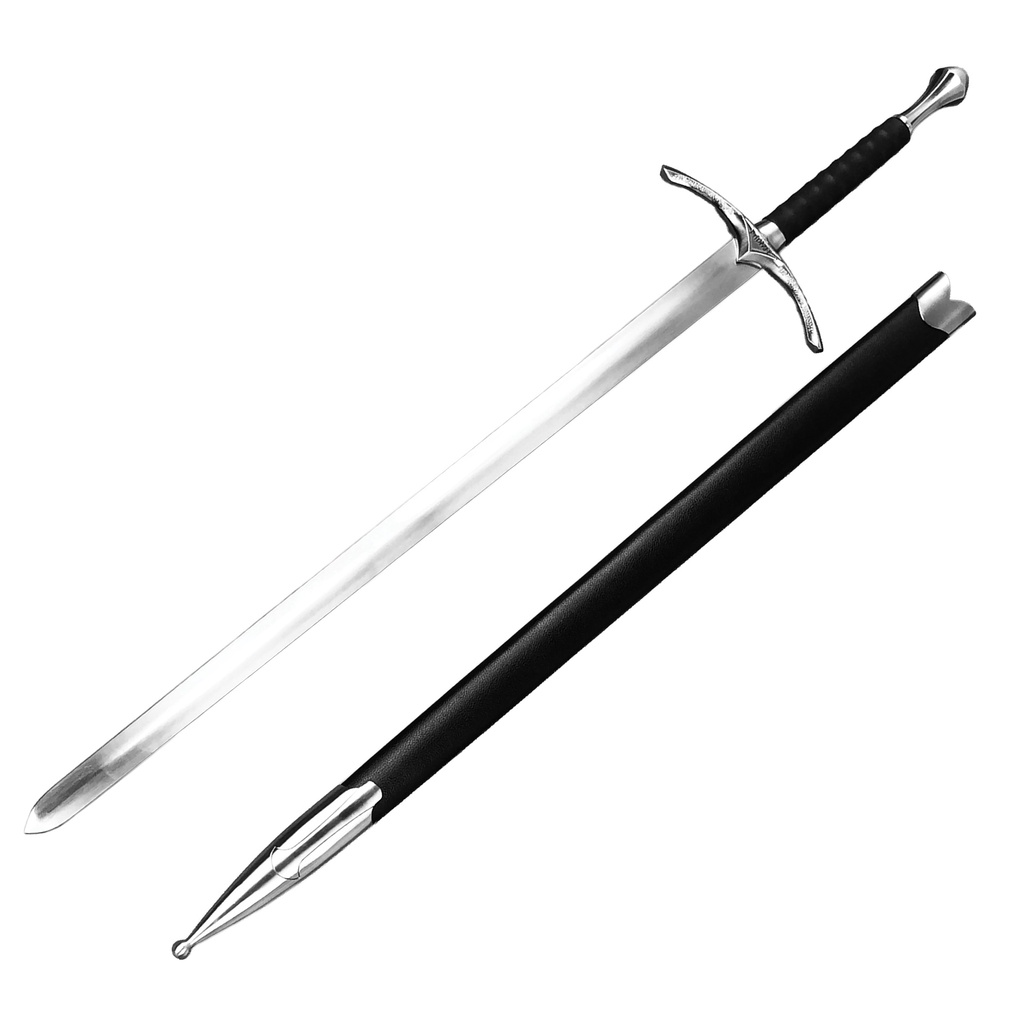
The carbon steel blade stretches over three feet, straight and bright, with a central ridge that runs dead true down the length. It’s long enough to claim space as a proper hand-and-a-half sword, but not so oversized that you feel like you’re waving a movie prop. When you slide it free of the black leather–covered wood scabbard, the sound is soft, real, and oddly grounding—like you’ve just put punctuation on the moment.
That cruciform crossguard does more than look the part. Your fingers know exactly where to stop as you slide your hand down to the ribbed black grip. Whether you wrap one hand close to the guard or add your second at the pommel for a full, controlled swing, the geometry makes sense. The flared scent-stopper pommel counterbalances the blade, giving your cuts a pivot point that feels surprisingly natural, even if your main training is behind a keyboard.
The first time on your belt
You fasten the scabbard at your hip before an event, and something shifts. The black leather matches nearly anything—plate, robes, simple tunic—and the polished metal chape and throat catch just enough light to say, "This isn’t from the costume aisle." You move, sit, stand, and the sword comes with you like it has a right to be there.
How This Medieval Sword Holds Up to Real Use
There’s a gap you’ve probably felt before: swords that look right in photos but feel dead in the hand. This medieval sword is built to be handled, drawn, and sheathed over and over without that nervous "please don’t fall apart" feeling.
The blade’s carbon steel construction brings a seriousness you can sense when you test the flex and follow-through. It’s not razor-honed into a liability for practice, but it isn’t soft wall-hanger metal either. The polished finish lets you see every line and reflection clearly, so alignment checks and choreo adjustments become almost effortless. That straight, double-edged profile gives clean visual lines for stage combat or cosplay photos, without the distraction of fantasy flares or cutouts.
The handle hardware matches the blade in its bright steel tone, tying the whole piece together. That ribbed black grip—synthetic or leather-wrapped over a solid core—gives your fingers something to anchor to when sweat, rain, or stage lights start working against you. You feel textured ridges, not slippery smoothness, and that subtle detail shows up every time you rehearse the same motion for the twentieth take.
The scabbard you don’t have to baby
The wood-core scabbard is wrapped in black leather, which matters more than it sounds. Wood keeps the blade from flopping or clacking; leather shrugs off bumps, corners, and the occasional backstage drop. The long polished metal chape at the tip takes the hits for you—door frames, chair legs, gravel—so your sword keeps looking like something a knight would still respect.
Carrying a Medieval Sword That Actually Fits Your Life
Owning a medieval sword is one thing. Living with it—taking it to practice, events, or display—is where most blades either blend in or start feeling like work.
At just over 42 inches overall, this hand-and-a-half design hits a sweet spot. Long enough to command a room during a performance, short enough that you can navigate hallways, crowded conventions, and small rehearsal spaces without apologizing to everyone you pass. On a wall, the silver-and-black profile reads as clean and timeless, not gaudy. In your hand, the balance invites you to move rather than just pose.
If you train in historical European martial arts, you’ll recognize the proportions as friendly to guards, cuts, and transitions you already practice. If you’re stepping from cosplay into more serious movement, the sword becomes a quiet coach—showing you where your footwork’s off or your grip is fighting the steel instead of working with it. For stage performers, the clear silhouette reads from the back row: blade, guard, grip, pommel—all instantly legible.
When a Medieval Sword Makes the Scene Feel Real
There’s always that one moment—the first draw in front of other people—where you find out if your gear lives up to the character in your head. With this medieval sword, the moment doesn’t evaporate under plastic shine or loose fittings.
You grasp the ribbed handle, thumb brushing the guard without thinking. The blade clears the black leather scabbard in one smooth pull. For a heartbeat, the room changes: a rehearsal hall becomes a great hall, a convention hallway becomes a castle corridor, a backyard becomes a training yard at dawn. You’re not worrying about the sword. You’re inhabiting the role.
That’s the quiet advantage here. The minimalist medieval European styling keeps the sword from locking you into one universe. It belongs at a ren faire, in a fantasy photoshoot, on a HEMA training floor, or hanging as a centerpiece in a study. The same steel and leather that works under stage lights also looks right in candlelight—or LED strip light—when you mount it on the wall.
Questions People Ask Before Buying a Medieval Sword
Is this medieval sword good for cosplay and display, or just one or the other?
You can comfortably use this medieval sword for both cosplay and display. The carbon steel blade and wood-core, black leather scabbard give it enough durability for regular handling at events, while the polished finish and clean medieval lines make it look at home on a wall when you’re offstage.
Is a medieval sword like this safe for training or stage combat?
The blade is straight, double-edged, and not sharpened like a cutting sword, which suits controlled training and choreographed stage work. That said, any medieval sword requires respect—use proper protection, follow your group’s safety rules, and treat this as a real piece of steel, not a foam prop.
Will this medieval sword fit into different costume styles?
The silver blade and fittings paired with a black leather scabbard make this design intentionally neutral. That means this medieval sword slots into knightly armor, dark mage robes, ranger gear, or simple peasant tunics without clashing. Its classic European silhouette supports your character instead of competing with it.
How heavy does it feel compared to other medieval swords?
In hand, it feels substantial but manageable—more like a working hand-and-a-half blade than a hollow wall hanger. The flared pommel helps balance the medieval sword, so you feel guided swings rather than dead weight, even during longer rehearsals or photo sessions.
Later, when the event is over and the armor is stacked on the chair, you slide the blade back into its black leather scabbard and hang it where you can see it. The polished steel catches a bit of room light, the cruciform guard casting a simple shadow on the wall. You notice that every time you pass it, your shoulders straighten just a little. You didn’t just buy a medieval sword. You gave shape to the version of yourself who never quite fit in with plastic.