Knight’s Vigil Medieval Hand Sword - Black and Gold
You don’t pick up this medieval hand sword to hang another prop on a wall. You reach for it because something in you still answers to the word "knight." The carbon steel blade has weight, the black grip bites into your palm, the gold guard catches the light like a quiet challenge. On a stand, at an event, or in your hands at midnight, this sword doesn’t just decorate your space—it declares where your loyalties lie.
You don’t buy a medieval hand sword because you need one. You buy it because, somewhere between childhood and right now, you promised yourself you wouldn’t lose that part of you that still stands guard, even when no one’s watching.
Picture this: late evening, house finally quiet. You set the black scabbard on the table, fingers resting on the gold fittings. The moment you draw that long silver blade, the room changes. It isn’t about reenactment or pretending. It’s about feeling, just for a second, like the person who would have carried a medieval hand sword for real—steady, responsible, quietly dangerous if it came to that.
When a Medieval Hand Sword Becomes More Than Decor
You’ve seen the cheap wall-hangers before—too light, too shiny, too fake to feel like anything but costume. This hits different the second you pick it up. The carbon steel blade has that unmistakable pull of real metal, the kind your wrist actually has to respect. At 42 1/4 inches overall, it fills your reach, not as a toy, but as a tool from another century that somehow slipped into yours.
Owning a medieval hand sword like this isn’t about swinging it around the yard. It’s about what it does to the space it’s in—and to you. On the wall above a bookshelf, inside a home office, or laid across a wooden stand, it rewrites the room’s story. People notice. They pause. They ask. And you’re no longer just someone who likes history. You’re the person who curates it, holds it, keeps it.
How This Medieval Hand Sword Tells a Truer Story
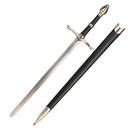
Look closely at the details and you start to see why it feels right in the hand. The straight double-edged blade runs long and clean, a satin silver that catches light without shouting. There’s no wild fantasy geometry here—just a classic medieval profile that looks like it could have stepped out of a manuscript or a museum case.
The crossguard sweeps only slightly, gold-colored quillons forming a quiet barrier between your fingers and the blade. In a world full of overdone designs, this one’s restraint is exactly what sells the illusion: this could have been a working knight’s everyday sidearm, not a ceremonial showpiece.
You notice the grip next. Black, segmented, wrapped in synthetic material that feels solid when you close your hand around it. Those subtle bands and gold-colored spacers give your fingers natural indexing points, so even when you rotate the medieval hand sword in your grip, you always know where you are. It’s a small thing, but that’s where authenticity lives—in the details your hand recognizes before your brain names them.
The Black and Gold Presence: How It Lives in Your Space
The color story matters more than you think. Silver blade, black handle, gold guard and pommel—simple, but deliberate. The black faux leather scabbard ties it together, the gold throat and chape echoing the hardware on the hilt. Put it against a white wall and it becomes a bold vertical line. Lay it across dark wood and the gold pieces glow like embers.
This is where your medieval hand sword shifts from “cool purchase” to “part of your environment.” Maybe it hangs above your desk where you do your best thinking. Maybe it rests on brackets near your media setup, a quiet counterweight to all the screens. Or maybe it waits in a corner of your library or game room, right where your friends’ eyes land when they walk in—and they go, “Okay, you have to tell me about that.”
The matching scabbard changes how you present it, too. You’re not just holding a bare blade floating in space; you’re drawing steel from a fitted black sheath, just as someone centuries ago would have done before stepping into a courtyard, a hall, a battlefield. That full ritual—the reach, the draw, the weight—becomes part of your own private ceremony.
Carrying the Story: Cosplay, Display, and Daily Rituals
If you move in cosplay, LARP, or renaissance faire circles, you already know the difference between a prop and a presence. This sword sits firmly in the second category. The proportions read on camera and in person as convincingly medieval. The straight blade and classic guard mean you can pass as a knight, guard, mercenary, or noble retainer without your gear screaming "fantasy" or "movie replica."
On your hip, the black scabbard with its gold accents doesn’t clash with leather belts or darker outfits—it blends, then pops when the light catches. Draw it in a training yard or photo shoot and your posture changes immediately. You don’t have to force it; your body understands what a real-length blade asks of your stance and balance.
Even if you never wear it out, the daily ritual of interacting with your medieval hand sword has a way of grounding you. Wiping fingerprints off the blade, checking the edge, adjusting how it sits on its hooks—these small, physical actions pull you out of digital noise and back into your hands, your space, your intention for the day.
When Choosing a Medieval Hand Sword Actually Matters
You could scroll past endless swords online and click the first one that looks “cool enough.” But that’s not how you build a collection you’re proud of. You’re looking for a medieval hand sword that looks right, feels right, and tells a story that lines up with your own.
This piece slots cleanly into that sweet spot: a sharp carbon steel blade for real weight and edge retention, a classic medieval silhouette that doesn’t lock you into one character or era, and a black-and-gold aesthetic refined enough for serious display. You’re not buying a movie replica of someone else’s legend. You’re choosing a grounded, believable blade that could plausibly have seen castle walls, torchlight, and rain.
And down the line, when you add more swords—maybe a greatsword, maybe a fantasy piece—this one will still make sense as your “standard issue” knightly sword, the baseline everything else in your collection or costume builds from.
Questions People Ask Before Buying a Medieval Hand Sword
Is this medieval hand sword just for display, or can it be used?
This sword has a sharp carbon steel blade and real weight, so it feels and behaves like a functional medieval hand sword in the hand. That said, most owners treat it as a display and costume piece rather than a training or cutting tool, using it for presence, photos, and collection value more than hard practice.
What makes this feel more authentic than cheaper medieval swords?
The combination of a long straight double-edged blade, traditional crossguard, and solid black grip gives it historically grounded proportions. The carbon steel construction adds believable heft, and the matching black faux leather scabbard with gold fittings completes the look so your medieval hand sword reads as a complete weapon, not just a naked blade.
Will a medieval hand sword like this fit into my home without looking over the top?
Yes. The clean lines and black-and-gold color scheme keep it from feeling gaudy or cartoonish. Mounted above a desk, shelf, or media center, it comes across as a curated medieval accent—something a thoughtful collector chose—rather than a loud novelty item.
How long is this medieval hand sword, and will it overpower a smaller room?
At 42 1/4 inches overall, it has a commanding presence but not an overwhelming one. In a smaller room, your medieval hand sword becomes a focal point rather than clutter, especially when paired with a simple stand or wall mount that lets the blade and fittings speak for themselves.
Later tonight, after everything else quiets down, you’ll walk past where you keep it. Maybe it’s hanging level above the doorway or resting on a stand by your books. Your hand will pause, just for a moment, on the black scabbard. You’ll draw the medieval hand sword free, feel the carbon steel settle into your grip, see the gold guard catch the low light. And in that small, private instant, you’re not playing knight—you’re remembering that a part of you still stands watch, still keeps oaths, still chooses to carry something a little heavier than you strictly have to.