PivotLink Dual-Mode Tactical Rifle Sling - Black Nylon
You feel it the first time you let the rifle hang—this 2 point rifle sling keeps the muzzle where you want it instead of swinging wild. One move to the D-ring and you’re in single point for fast shoulder switches and tight corners. The webbing stays flat, the hardware stays quiet, and you stop thinking about your sling at all. You just move, mount, and settle behind glass like that’s what your rifle was built to do.
You notice it the moment you go hands-free. Your rifle doesn’t slam into your knees, doesn’t pendulum off your chest, doesn’t demand a constant grab. The 2 point rifle sling is doing the quiet work in the background—holding the gun where your instincts want it. Then a doorway, a corner, a change in tempo. One clip to a D-ring, and now it runs as a single point, tracking your shoulders instead of fighting them. No re-rigging, no drama. Just you and a rifle that finally move the same way.
How a 2 point rifle sling quietly fixes the problem you stopped noticing
You’ve probably adapted to bad slings without realizing it. You lean a little more to keep the muzzle off your thigh. You choke up on the handguard because the rifle won’t sit where you want. A good 2 point rifle sling erases those compensations so you can focus on the shot instead of the setup.
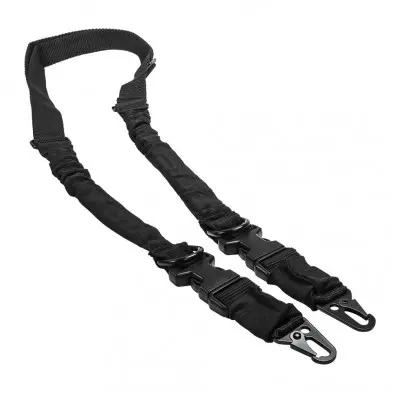
Here, 1.25-inch nylon webbing lies flat against your kit instead of twisting into a rope. Dual bungee sections buried under protective sleeves soak up bounce so the rifle settles against your torso instead of slapping around every time you move. The matte black metal spring clips bite into sling loops without rattling, and polymer quick-release buckles sit low-profile, ready when you need to strip the sling or reconfigure your carry.
Length from 55 to 72 inches means you’re not choosing between plate carrier season and T-shirt season. You dial the 2 point rifle sling once to match your posture, cheek weld, and support-hand reach, then forget it’s even there—until you notice how much calmer everything feels when you start moving.
Why this 2 point rifle sling feels different when you actually run it
On paper, materials all sound the same. In your hands, they don’t. This 2 point rifle sling was built for the kind of days when you’re up, down, and moving more than you shoot. Heavy-duty black nylon shrugs off barricades and sling points without getting fuzzy or rolled. The bungee sections live where they can work—close to the rifle ends—so they absorb shock at the source instead of stretching out near your shoulder.
Every metal component wears a matte black finish that doesn’t flash or ring. The spring clips open with a definite bite, then close around loops with that satisfying, final click you feel more than hear. The polymer quick-release buckles snap in tight and stay that way until you deliberately thumb them free. Nothing dangles, nothing shines, nothing announces itself.
The design moment that matters most is subtle: the paired D-rings mirrored near each buckle. That’s where the “PivotLink” idea lives. By routing one spring clip into a D-ring, the 2 point rifle sling pivots into single point mode without changing where it rides on your body. Your rifle’s anchor point changes; your muscle memory doesn’t.
Texture, tension, and the feel of confidence
Run your fingers along the webbing and you’ll feel a clean, consistent weave—no stiff glossy coating, no flimsy give. There’s just enough edge to grip when you adjust length, but not enough to dig into your neck or plate carrier. Under load, the bungees pull tight then ease back, turning harsh jolts into controlled pressure. That’s the moment you stop bracing for impact and start trusting your sling.
Carry, convert, repeat: living with a 2 point rifle sling that goes single point
Most days, you don’t need a new rifle; you need a better way to hang the one you already trust. This 2 point rifle sling is built around that reality. It anchors your rifle across your chest or back for long walks, admin tasks, or slow pushes down a line. Then, when angles get ugly or transitions speed up, you convert.
Conversion isn’t a project—it’s a habit. One hand finds the near-side D-ring. The other pops the spring clip from the far sling point and hooks it into that D-ring. You’ve just turned your 2 point rifle sling into a single point sling without taking eyes off your surroundings. Now the rifle tracks your shoulders, swings fast between targets, and gets out of its own way when you switch sides.
Think flat range drills that turn into barricade work. Think patrol-style carry that turns into tight hallways. The same sling covers both realities, which means you stop making excuses and start running the drills you’ve been putting off because your setup never quite matched what you wanted to practice.
When the 2 point rifle sling earns its place in your kit
The first time you sprint to cover and your rifle stays hugged in instead of beating up your legs, you’ll know. The first time you drop to a knee, go hands-on with a gate or a door, and the muzzle doesn’t nose-dive into the dirt, you’ll know. A 2 point rifle sling is supposed to manage the chaos, not add to it. That’s when this one stops being gear and starts being default.
2 point rifle sling vs single point sling: you don’t have to choose
You’ve seen the arguments. A 2 point rifle sling controls the muzzle, carries weight better, and plays nice with longer movements. A single point sling keeps you lightning-fast in close quarters and shoulder switches. Both are right—and both are wrong if you’re locked into just one.
By building instant conversion into the hardware, this setup lets you treat those “vs” debates as options instead of camps. On the walk in, you stage as a 2 point rifle sling—rifle flat, safe, predictable. When the environment squeezes down and you need speed, you flip to single point in seconds. No tools, no threading webbing, no re-learning your body position. You’re not buying two philosophies. You’re buying the freedom to use both without ever taking your sling off.
Making this 2 point rifle sling truly yours
Out of the box, you’re working with a 55–72 inch range. Start longer than you think you need. Throw the rifle, establish your grip, settle into your cheek weld. Now shorten the 2 point rifle sling until you can drive the gun out comfortably without feeling yanked back. The bungees should be doing the last bit of work, not your shoulder.
If you run armor or chest rigs, test your mount from low ready, high ready, and slung. Make sure the webbing doesn’t cut across pouches you use most. If it does, adjust routing or length. If your rifle wears standard loops or QD sockets with adapters, clip straight in. If it’s an older platform with fixed points, the metal spring clips still find purchase cleanly.
Once length is set, practice the conversion. From 2 point rifle sling to single point and back again, with eyes up and mind on your surroundings. Do it until you can feel the D-ring without looking and hear the spring clip lock in from muscle memory alone. That’s the moment the sling stops being “new gear” and starts being part of how you move.
Questions People Ask Before Buying a 2 point rifle sling
Is a 2 point rifle sling better than a single point for everyday range use?
If you spend a lot of time walking, resetting drills, or working around other shooters, a 2 point rifle sling usually feels safer and more controlled. You can always convert this one to single point when you want faster transitions, but for most range days, the added stability wins.
Will this 2 point rifle sling work with my AR and older rifles?
The metal spring clips on this 2 point rifle sling are designed to grab standard sling loops, fixed points, and many adapter plates. If your AR or traditional rifle has a solid loop or ring, the clips will usually bite cleanly, making it easy to move one sling between platforms.
How do the bungee sections on a 2 point rifle sling help in real use?
The bungee isn’t about making the sling stretchy; it’s about taming shock. When you run, climb, or suddenly drop to a knee, the bungee sections on this 2 point rifle sling absorb that jolt so the rifle doesn’t slam or whip. You feel less impact and keep the muzzle more predictable.
Can I leave this 2 point rifle sling set up as a single point all the time?
You can, and some shooters do, especially if they live in close quarters or training environments. The advantage here is choice: you can stage it as a single point sling when you know movement will be tight, then switch back to 2 point when you’re covering distance or need better retention.
Picture your next range day. Rifle slung, webbing flat against your chest, the 2 point rifle sling holding the gun where your hands expect it. You run a string, let the rifle hang, and it settles instead of swinging. A drill calls for fast shoulder switches; your fingers find the D-ring, clip in, and now the rifle floats with you in single point mode. Nothing felt complicated. Nothing felt improvised. It’s just you, carrying the way you always meant to—calm, ready, and completely in control of what your rifle does when it leaves your hands.