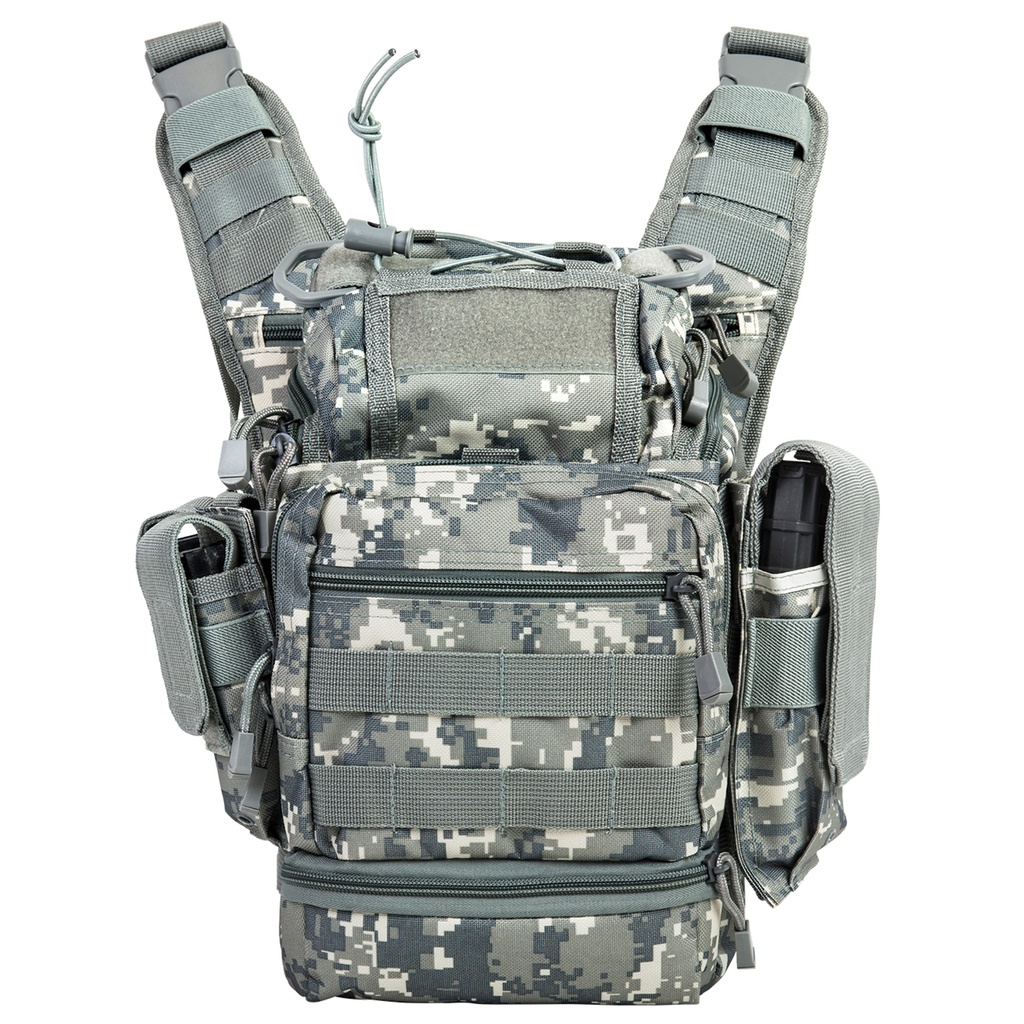
Quiet Command Tactical First Responder Bag - Digital Camo
You know that moment the call comes in and your world narrows to what’s on you? That’s where this tactical first responder bag lives. Digital camo rides close against your side, MOLLE and seven compartments turning panic into muscle memory. Mag pouches, concealed carry pocket, mesh, and dividers all sit exactly where your hands expect them. You’re not digging. You’re deciding. And this is the bag that moves like it already knows what you’ll need next.
You’re halfway through a quiet shift when the radio changes its tone. That clipped voice. That address that sounds familiar. You’re already moving before the sentence finishes—not because you’re rushing, but because your brain has done this calculus a hundred times. Shoes. Keys. Bag. The only question that matters now: did you build your gear right for this moment?
That’s where a tactical first responder bag stops being just something you carry and starts feeling like the calmest part of you.
How a Tactical First Responder Bag Turns Chaos Into Muscle Memory
You’ve been on the wrong side of a bad bag before. The zipper that sticks. The one big compartment that turns tourniquets, gloves, mags, and med kits into a nylon junk drawer. The frantic pat-down when you know you packed that one thing and can’t find it.
This tactical first responder bag is built so your hands don’t have to ask your eyes for permission. Seven separate compartments mean everything you stage has a home—and stays there. Front pockets hold the fast-grab gear you burn through first. The lower zip compartment swallows bulk without swallowing access. Inside, mesh pockets and nylon dividers keep your layout visible and locked, so you’re not dumping your life on the pavement just to reach one tool.
When your heart rate spikes, this is the difference: your fingers go straight to the right zipper pull, and the tactical first responder bag opens exactly where you expect, every single time.
Why This Tactical First Responder Bag Feels Like Worn-In Gear on Day One
The first thing you notice when you pick it up isn’t the digital camo—it’s the structure. PVC gives the bag that quiet rigidity that keeps it from collapsing in on itself. You can drop it next to a vehicle, on a gravel shoulder, or against a wall and the compartments hold their shape, ready to open instead of folding over and swallowing your hand.
The MOLLE webbing across the front turns the whole face of the tactical first responder bag into a modular workbench. You add what your world demands: extra med pouches, light holsters, radio mounts. The webbing rows run clean and straight, so your attachments don’t sag or twist over time. Those dual side pouches are sized for rifle and pistol magazines, but you already know they’re just as ready for tools, flashlights, or multi-mission gear.
The feel of real-world durability
Run your hand along the seams and you feel tight stitching that doesn’t puff or wander. The zipper tracks sit protected, with cord pulls big enough to grab with gloved hands. That’s the kind of detail you only notice when someone’s thought about a bloody or shaking grip trying to get inside this bag fast—and designed for it anyway.
Carrying a Tactical First Responder Bag That Moves With You, Not Against You
There’s a specific kind of fatigue that comes from fighting your own gear. Straps that cut in. A bag that swings wild every time you pivot. A load that always seems to slide to the one sore spot on your shoulder.
The padded shoulder strap on this tactical first responder bag is built to sit where you’d actually wear it during a long shift or a long day of training: high enough to clear your belt line, low enough that it doesn’t choke your neck or tangle with a plate carrier. Adjusters and buckles sit out of the way of your natural arm swing, so you’re not punching hardware every time you reach forward.
The top carry handle changes the game when you need to drag, lift, or reposition in one clean motion. Grab, move, drop—it stays oriented, instead of barrel-rolling and spilling your loadout across the sidewalk. That kind of control matters when you’re stepping out of a vehicle into gravel, snow, or glass.
The quiet comfort details you only notice at hour six
Balance is the unsung design story here. With mags on the sides, bulk gear below, and organized kits through the core, the bag carries like a tight, compact block instead of a swinging sack. You feel that most not at the start of the shift, but at the end—when your back and shoulder aren’t as torched as they should be for what you’ve carried.
When a Tactical First Responder Bag Becomes Your Mobile Command Post
There’s a moment that separates hobby gear from serious kit: the first time you build it out with intention. You lay everything on the table—IFAK components, shears, gloves, flashlight, notebook, extra mags, maybe a small backup blade—and you start assigning positions.
With this tactical first responder bag, that process feels less like packing and more like designing a cockpit. You decide what gets top billing in the front compartments. You tuck sensitive or legal-critical items into the concealed carry pocket, where they stay close to the body and out of casual view. That pocket sits in a sweet spot: hidden from the outside, fast from your perspective. No digging, no fumbling in the middle of a scene to access what you never want to advertise.
The digital camo isn’t loud; it’s functional. In urban light, it doesn’t scream for attention, but anyone who lives in this world recognizes it immediately as a quiet signal: this isn’t a fashion pack. This is a working tactical first responder bag riding on someone who takes readiness seriously.
A bag that tells a story about how you work
Hook-and-loop up front gives you space for patches, ID, blood type—whatever you use to say, without words, “I’m here for a reason.” Over time, the bag starts to look less like something you bought and more like something you’ve earned. The scuffs on the PVC, the frays on the MOLLE straps, the way the mag pouches shape to your load—that all becomes a record of the calls you answered and the drills you didn’t skip.
Questions People Ask Before Buying a Tactical First Responder Bag
Is this tactical first responder bag only for professionals?
No. It’s purpose-built for first responders, law enforcement, and medics, but preparedness-focused civilians and range regulars use this style of bag all the time. If you carry med gear, mags, or organized EDC tools, a tactical first responder bag like this gives you structure and speed that a basic backpack can’t match.
Can a tactical first responder bag really stay organized under daily use?
Yes—if the layout is right. The combination of seven compartments, mesh pockets, and nylon dividers in this bag means you’re not just stuffing gear into one cavern. Once you stage your loadout, it tends to stay put. You’ll still refine your setup over time, but you won’t be re-packing from scratch after every call or range day.
How comfortable is it to carry a fully loaded tactical first responder bag?
Comfort depends on weight and fit, but the padded strap and balanced design keep this from feeling like a lopsided duffel. Because mags ride along the sides and bulky gear drops low, the center of gravity stays close to your body. That makes a long walk from vehicle to scene—or in and out of training days—much more manageable.
Is the concealed carry pocket obvious from the outside?
No. From a casual glance, it reads like another panel in the bag’s structure. Access is designed from your perspective, not from the outside world’s. That’s the point: a tactical first responder bag that lets you carry discreetly without broadcasting what’s inside.
End of the day, you drop your keys in the bowl, peel off your boots, and set the bag down where you always do. For a second you look at it—the digital camo, the worn webbing, the way it holds its shape even empty—and you remember three separate moments this week when your hand went straight to the right pocket without you thinking.
That’s when you know it’s not just a tactical first responder bag anymore. It’s part of the way you show up: ready, organized, and a little calmer than the world expects you to be when everything goes sideways.