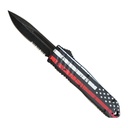
Red Line Honor OTF Tactical Knife - Stonewash Steel
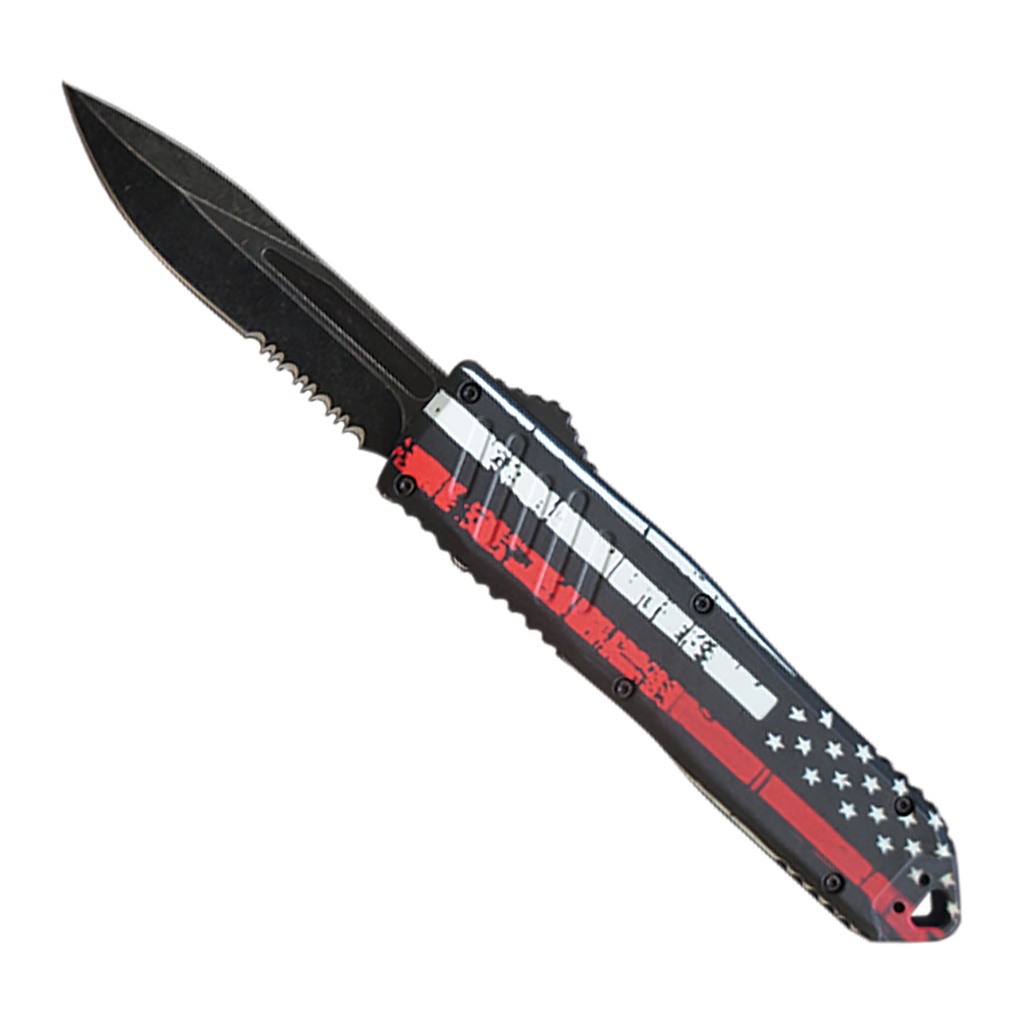
You don’t carry this OTF knife to show off—you carry it because that red line means something to you. The stonewash blade snaps forward with purpose, serrations ready for strap, cord, or seat belt without hesitation. The flag in your hand feels solid, real, and a little worn—like it’s already seen a few long nights with you. This is the everyday carry that quietly says you’re the one people count on when things go sideways.
| Blade Length (inches) | 3.75 |
| Overall Length (inches) | 9 |
| Closed Length (inches) | 5.375 |
| Weight (oz.) | 8.52 |
| Blade Color | Silver |
| Blade Finish | Stonewash |
| Blade Style | Clip Point |
| Blade Edge | Partial-Serrated |
| Blade Material | Steel |
| Handle Finish | Glossy |
| Handle Material | Aluminum |
| Button Type | Slide |
| Theme | USA Flag |
| Double/Single Action | Single |
| Pocket Clip | Yes |
You’re not thinking about gear when the call comes, or when the car in front of you clips the guard rail. You’re thinking in seconds: how fast you can move, how clean you can cut, how steady you can stay when everyone else is shaking. That’s when an OTF knife stops being a cool piece of kit and becomes the thing between a bad moment and a worse one.
Picture your hand already on the Red Line Honor OTF tactical knife in your pocket. Thumb finds the slide by feel alone. A single push, a solid mechanical snap, and there’s a stonewashed blade out front—ready before your mind has finished the sentence, I need a knife. You don’t fumble, you don’t unfold, you don’t hunt for the nail nick. It’s just there. Out the front. Working.
When an OTF knife is the tool you reach for without thinking
The reason you look for an OTF knife in the first place isn’t because it’s flashy—it’s because you want a blade that’s there now. Single-action deployment means you send the blade forward with one decisive push, no second motion, no partial open. At around 9 inches overall with a 3.75-inch blade, this isn’t a toy; it feels like a full-size tool that belongs in serious hands.
The clip point tip gives you that precise control when you’re slicing tape off a delivery, trimming cord, or working into tight spaces, while the partial serrations near the handle quietly wait for tougher work. Seat belt, nylon strap, stubborn rope—the kind of things that don’t care how sharp your edge is, they just fight back. Here, you’ve got a blade that bites and keeps going.
What you notice once you actually carry it is the rhythm: slide up, solid thunk, cut, then the simple reset when you’re done. You’re not babying a mechanism, you’re running a tool that feels made to be used and reset, again and again.
The OTF knife build that feels like duty gear, not desk candy
You can tell in three seconds if a knife is a drawer piece or an everyday carry blade you’ll trust on the street. The stonewash finish on this OTF knife’s steel blade is one of those details that tips the scale. It doesn’t glare, doesn’t scream for attention—it hides the small scuffs and tells you it’s ready to get marked up doing real work.
The aluminum handle carries the weight you expect from a tactical pocket knife made to be used, not displayed. Around 8.5 ounces means when you clip it into your pocket, you don’t forget it’s there—but you also don’t feel dragged down. The jimping along the handle edges isn’t just decorative; it’s the difference between a sure grip and a slip when your hands are wet, gloved, or shaking a little from adrenaline.
How it feels in the hand when things get real
Wrap your fingers around the flag graphic and you feel the smooth gloss of the aluminum, the subtle texture breaks where the hardware sits, the rounded edges that don’t bite your palm. Your thumb lands on the top-mounted slide, centered where it makes sense for both right- and left-handed use. There’s no searching, no weird reach—it feels like where your thumb was already going.
The lanyard hole at the end isn’t an afterthought. If you run a retention cord or tether, you know why it matters. In water, in the dark, or in the back of a moving rig, that extra line between you and your blade can mean the knife stays with you instead of skittering across metal and out of reach.
Carrying an OTF knife as part of your everyday routine
Owning an OTF knife like this is less about the spec sheet and more about how it disappears into your day until the second you need it. Closed, you’re looking at a 5.375-inch handle that sits deep along your pocket seam. The pocket clip hugs tight enough to stay put when you’re getting in and out of vehicles, crouching, or running, but not so aggressive that it shreds your pocket hem.
Morning, you’re using it like any everyday carry blade: cutting open boxes at work, trimming zip ties in the garage, taking down stray packaging that somehow made it into the cab. The partial serrated edge saves you time on those fibrous, annoying materials that regular edges skate over. Evening, it’s there in your pocket at the gas station, walking the dog, or stepping out of the station house after a shift—quiet, ready, not drawing eyes unless you decide to show it.
The subtle weight of confidence
There’s a different kind of calm that comes from carrying a tactical OTF knife you already trust. It’s not about looking tough; it’s about knowing that if something goes sideways—a tangled strap, a stuck latch, a quick cut that has to be clean—you have a blade that gets there fast and does what you ask it to do.
That calm lives in the muscle memory: you know exactly how far to push the slide, exactly how the mechanism sounds when it’s fully deployed, exactly how the stonewashed blade looks when it catches the light. Familiar. Dependable. Yours.
Why this OTF knife hits different when you care about that red line
The first thing your eye catches isn’t the blade at all—it’s the flag. Black, white, and a single bold red stripe cutting through the middle. If you’ve ever pulled on turnout gear, ridden in the jump seat, responded to a wreck, or loved someone who does, that line means something you don’t have to explain.
This isn’t a generic tactical pocket knife with a random graphic slapped on. The distressed USA flag design looks worn, like it’s already gone through some heat. The white stars near the butt of the handle, the way the red line runs the full length—these are the details that turn a carry knife into a quiet tribute. When you set it on a table, people who know will recognize it immediately.
What that means for you is simple: every time you clip this OTF knife into your pocket, you’re carrying more than a tool. You’re carrying a reminder of why you show up, why you stay late, why you answer when it would be easier to look away. It can be a nod to your own time on the line, or a way of keeping someone else’s service close.
Questions people ask before buying an OTF knife like this
Is an OTF knife good for everyday carry, or is it just tactical?
An OTF knife absolutely works as an everyday carry blade if you value fast, one-hand deployment and a secure, full-size handle. You still get all the daily utility—opening boxes, cutting rope, trimming straps—with the added benefit of quick access if something urgent happens. It feels like a tactical tool, but it lives comfortably in regular life.
Is this kind of OTF knife legal to carry where I live?
OTF knife laws vary a lot by state, city, and even county. Some places treat an OTF knife like any other pocket knife, while others restrict automatic knives or blade length. Before you carry this as your daily blade, it’s smart to check your local and state regulations on automatic and OTF knives so you’re confident you’re within the law.
Will the single-action OTF mechanism hold up to real use?
A single-action OTF knife is built around a strong forward deployment, then a manual reset. When you use it as a working everyday carry knife—cutting, slicing, and stowing it respectfully—the mechanism stands up well over time. You’ll feel and hear if it ever needs cleaning or light maintenance, the same way you do with any trusted gear you run hard.
Is a partially serrated blade actually useful day to day?
If you ever deal with nylon strap, paracord, heavy plastic, or stubborn packaging, a partial serration on your OTF knife ends up doing more work than you’d expect. You still have a clean slicing edge toward the tip for finer tasks, with aggressive teeth near the handle that chew through material that laughs at a plain edge.
Later, when the noise of the day finally drops, you’ll find yourself turning the knife over in your hand. Thumb resting on the slide, eyes tracing that single red line down the flag. You’ll remember the last time you needed a blade right now—and how it felt to have one you trusted. That’s the quiet shift this OTF knife brings: you’re not just someone who carries a pocket knife. You’re the person who’s ready, the one people look to when things get messy, the one who answers that thin red line with your own steady hand.