Ridgewave Dawnline Damascus Hunting Knife - Blue Wood
First light on the ridge, your Damascus hunting knife is already in hand, not riding forgotten on your belt. The patterned blade slides through rope, hide, and camp chores with that clean, biting feel you only get from full-tang steel. The blue wood handle warms under your grip, even when your fingers are cold and clumsy. You don’t baby it; you trust it. And as the leather sheath creaks softly when you re-sheath it, you know this isn’t just another knife—it’s your hunting story, carried in steel.
| Blade Length (inches) | 4.5 |
| Overall Length (inches) | 9 |
| Weight (oz.) | 12 |
| Blade Color | Silver |
| Blade Finish | Patterned |
| Blade Style | Clip Point |
| Blade Edge | Plain |
| Blade Material | Damascus Steel |
| Handle Finish | Polished |
| Handle Material | Wood |
| Theme | Blue Damascus |
| Handle Length (inches) | 4.5 |
| Tang Type | Full |
| Carry Method | Leather Sheath |
| Sheath/Holster | Leather |
That Morning You Finally Stopped Fighting Your Knife
You know the moment. Breath fogging in the early cold, gloves already damp, and you’re fighting the blade that’s supposed to be helping you. The edge slips, bites where it shouldn’t, or just feels dead in your hand. You don’t say anything out loud, but you feel it: this isn’t the hunting knife you wish you had.
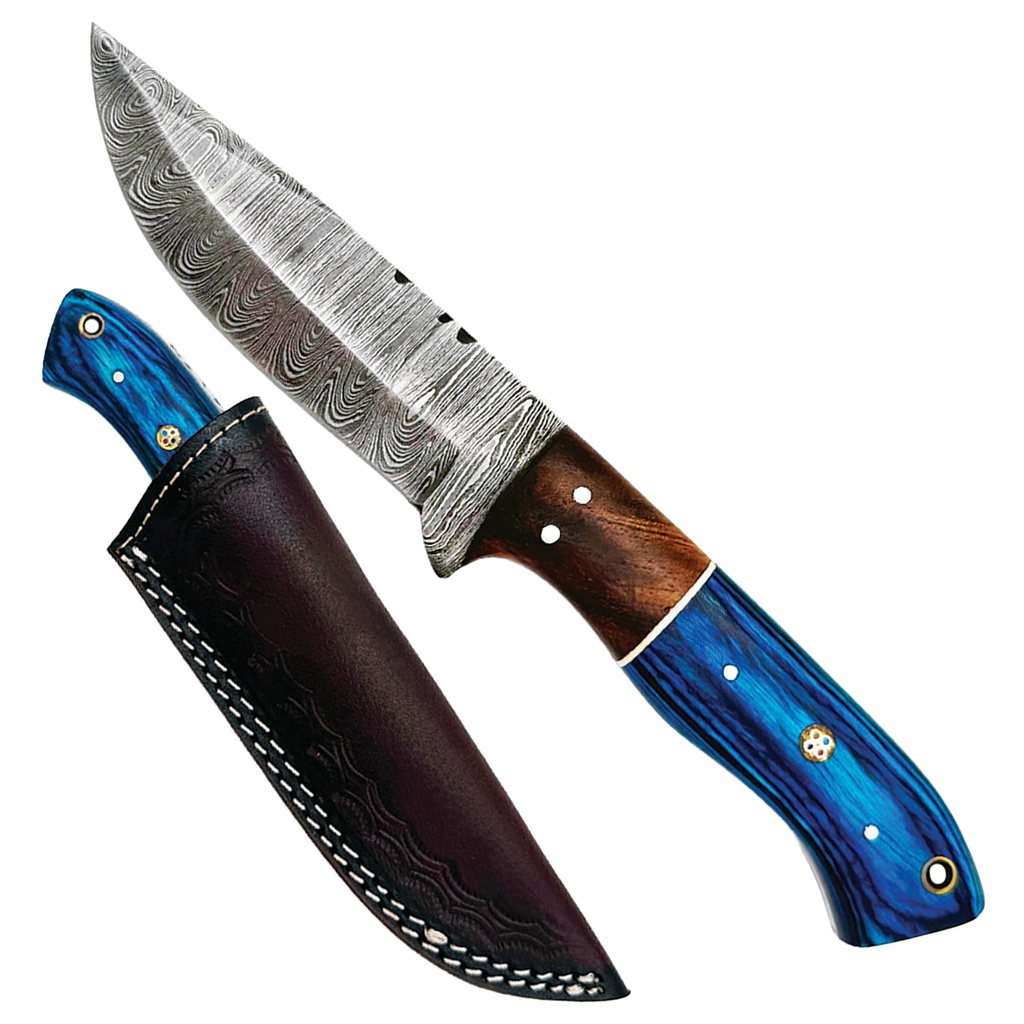
Now imagine the same ridge, same cold, same work ahead—but the Damascus hunting knife at your hip feels different the second you draw it. The full-tang spine runs like a straight line of intention from your palm to the 4.5-inch clip point. The patterned steel catches the low light. The blue wood handle seats into your grip like it’s been there for seasons, not seconds. Suddenly field chores don’t feel like chores anymore—they feel like a rhythm.
How a Damascus Hunting Knife Changes the Work in Front of You
When you carry a real Damascus hunting knife, the work shifts from wrestling to guiding. That layered steel isn’t just for looks; you feel it the first time the blade meets hide, rope, or stubborn green wood. Instead of forcing the cut, you steer it. At 9 inches overall and 12 ounces, this knife settles into that sweet spot where it has enough presence to do real hunting work without feeling like a clunky camp machete.
The clip point earns its keep fast. You notice it when you’re making the first careful opening cut on a deer, or when you’re cleaning up a cut that has to be precise, not just deep. The tip knows where you want it to go. The spine stays steady under your thumb, and because this is full-tang, there’s no wobble, no mystery about what’s happening inside the handle. Every ounce is honest.
And the Damascus pattern? It’s not just something you’ll show off at camp—though you will. It’s a constant, visible reminder that this isn’t a disposable tool. It’s a blade that looks like it was made by someone who understands why hunting knives matter to the people who carry them.
Why Full-Tang Damascus Matters When Your Hunting Knife Is Wet, Cold, and Bloody
It’s easy to talk about a full-tang Damascus hunting knife in abstract terms. But where it matters is when your fingers are slick, the wind has picked up, and you’re working on the ground instead of at a clean bench. That’s when the full spine of steel running through the blue wood handle stops being a spec and starts being a feeling: solid, anchored, trustworthy.
The contoured handle is where you notice the design choices most. The polished wood—brown and blue layered like earth and sky—gives you something real to press into. The curve tucks into the meat of your palm so you don’t feel like you’re pinching the knife into obedience. Mosaic pins and multiple rivets don’t just look custom; they keep the scales unmoving when you bear down.
Because the tang is visible along the spine, you always know exactly how the strength of the knife runs. No hidden gaps, no hollow surprises. You can baton light kindling, split tough packaging, or twist the blade free from sticky cuts without worrying about what might give first. The steel takes the stress; your hand just guides.
Carrying a Damascus Hunting Knife That Actually Belongs on Your Belt
Plenty of blades look good on a shelf. A real Damascus hunting knife has to look right on your belt and feel right when you forget about it—until you need it. That’s where the leather sheath comes in. Dark, stitched, and tooled with just enough detail, it rides like a piece of real gear, not an afterthought. When you sit on a log, squat at the fire, or climb into the truck, it stays out of your way but right where your hand expects it.
The draw becomes a small ritual you don’t think about, but you’d miss if it were gone. Leather creak. Fingers close around blue wood. The blade clears the sheath with that soft Damascus shimmer. Whether you’re making feather sticks, trimming paracord, or breaking down game, the knife always feels like an extension of the same motion: reach, draw, work, sheath.
As an everyday field companion, this isn’t a delicate showpiece you baby. It’s the hunting knife you’re comfortable setting in the dirt beside you while you work, then wiping clean on your pant leg before sliding it home again. That’s the difference between a knife you own and a knife that belongs to your routine.
When Choosing a Damascus Hunting Knife Quietly Changes Your Standards
Some gear raises the bar in ways you only notice the next time you pick up something lesser. Once you’ve carried a solid full-tang Damascus hunting knife, the shortcuts in other blades become obvious. You feel the hollow handles. You see the edge fatigue faster. You notice how uneasy you are about pushing harder into a cut.
This is where the 4.5-inch blade length quietly shines. Long enough to handle field dressing, camp prep, and general outdoor use; short enough to stay nimble and under control. If you’ve ever wondered what knife is best for hunting and camp carry without feeling overbuilt, this is that middle ground. Not a tactical cosplay piece. Not a flimsy bargain tool. Just a hunting knife that pulls its weight without screaming for attention.
Over time, this choice becomes part of how you see yourself. You’re the person who doesn’t show up with a gas station blade. You’re the person who knows their tools, trusts their edge, and doesn’t have to explain why this patterned steel and blue wood ride at their hip. People will ask anyway. You’ll just hand it over and let them feel it for themselves.
Questions People Ask Before Buying a Damascus Hunting Knife
Will a Damascus hunting knife hold up to real everyday field use?
Yes—when you choose a true full-tang Damascus hunting knife like this, you’re getting layered steel built to bite and keep biting. With normal field sharpening, it handles repeated hunting seasons, camp chores, and daily carry work without feeling fragile or decorative.
Is a Damascus hunting knife hard to sharpen or maintain?
Not if you treat it like any serious hunting knife. A basic stone or guided sharpener works well with Damascus steel; you’ll feel the edge come back quickly. Wipe it dry after wet or bloody work, keep it lightly oiled, and that patterned blade stays both functional and beautiful.
Is a fixed-blade Damascus hunting knife practical to carry every day?
If your daily life includes ranch work, outdoor projects, or frequent trips into the woods, a fixed-blade hunting knife in a proper leather sheath can be more practical than a pocket folder. You always know where it is, the blade is instantly ready, and the full-tang build gives you confidence for heavier tasks.
What makes this different from a regular stainless hunting knife?
A Damascus hunting knife brings two things: a distinct cutting feel and a visible story in the steel. You still get toughness and reliability, but the layered pattern tells you this blade was made, not stamped. In the hand, it feels more alive than typical stainless, especially when paired with a contoured blue wood handle.
The Moment This Damascus Hunting Knife Quietly Becomes “Your Knife”
Picture the next time you head out before sunrise. You grab your gear on autopilot—the worn jacket, the cap, the rifle or bow—and your hand finds the leather sheath without searching. The Damascus hunting knife comes free in one smooth motion, blue wood catching the faint morning light. You don’t think, “This is my new knife.” You just think, “Let’s get to work.”
Later, when the animal is down or the fire is going and everyone else is borrowing, fumbling, or apologizing for their blades, you’re not part of that scramble. Your edge is steady. Your grip is certain. And somewhere between first draw and last cut, this stopped being just a knife you bought and became part of how you show up: prepared, calm, and quietly proud to carry steel that’s as honest as you are.
That’s what owning a Damascus hunting knife like this really does—it doesn’t change who you are. It just lets who you already are show up more clearly, with a blade that finally matches the stories you’re out there to live.