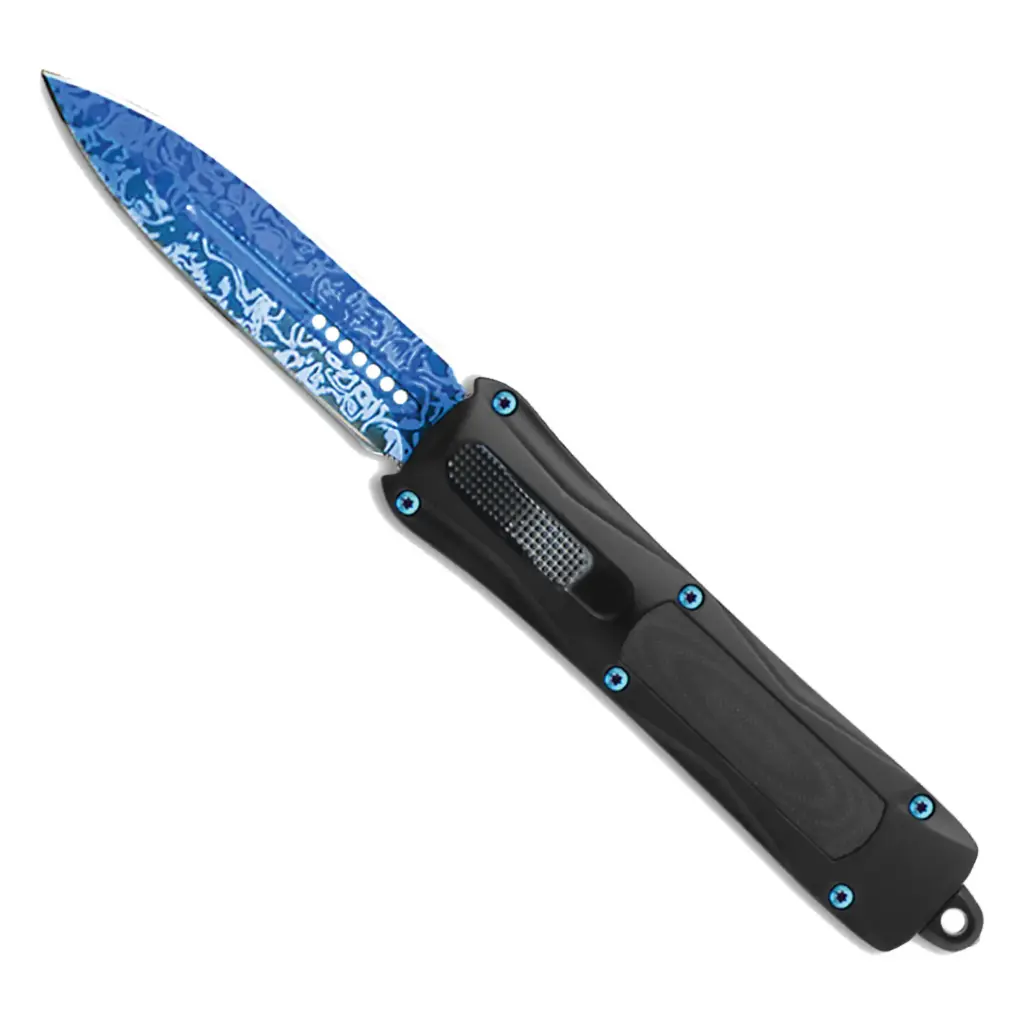
Riptide Ripple Front-Switch OTF Knife - Blue Damascus
You notice the blue ripples first, then the way your thumb finds the front switch without thinking. This OTF knife turns that tiny motion into a clean, controlled rush of steel, dagger-straight and ready. The G10 texture, the pocket clip you forget is there, the soft thump back into the nylon pouch—every detail makes you feel more dialed-in, more prepared. You’re not just carrying a blade. You’re carrying the confidence that whatever needs cutting, you’re already a step ahead.
| Blade Length (inches) | 3.75 |
| Overall Length (inches) | 9.25 |
| Closed Length (inches) | 5.375 |
| Blade Color | Blue |
| Blade Finish | Damascus |
| Blade Style | Dagger |
| Blade Edge | Plain |
| Handle Finish | Matte |
| Handle Material | G-10 |
| Button Type | Front Switch |
| Theme | Blue Damascus |
| Pocket Clip | Yes |
| Sheath/Holster | Nylon Pouch |
Your hand is already in your pocket before you realize why. Tape, cord, plastic—another small frustration between you and done. Your thumb finds the front switch by memory now. One straight push, and the blade of your OTF knife doesn’t just appear; it answers. Blue Damascus ripples flash once in the light, and in the space of a breath, the problem in front of you becomes one clean, controlled cut.
When an OTF Knife Turns a Thumb Movement into Control
This isn’t about collecting another cool piece of gear. It’s about that moment when you stop fumbling for tabs or hunting for a thumb stud and simply do what your hand already knows. With a front-switch OTF knife, the motion is linear: forward to deploy, back to retract. Your thumb rides a textured track on the face of the handle, exactly where it wants to rest anyway.
You feel the spring tension build, then release into a crisp, controlled launch. The 3.75-inch dagger blade doesn’t snap out wildly; it runs a straight rail until it locks with a quiet finality you can feel through your fingers. No guesswork about whether it’s fully engaged. No half-open limbo. Just yes—it’s out and ready—and that certainty lets you focus on the cut, not the mechanism.
The Blue Damascus Story Your OTF Knife Tells Before You Speak
There’s a reason your eye goes straight to the blade first. The blue Damascus pattern doesn’t shout; it pulls. Ripples track down the center line, framing the fuller and small cutouts so your attention lands where it matters: the edge and the point. On this OTF knife, color is not a gimmick—it’s a visual cue that helps your hand align instinctively.
In person, the blue Damascus etch feels almost like movement frozen mid-wave. That subtle shimmer shifts as you tilt your wrist, giving you a quick, silent confirmation of blade orientation. The double-edged dagger profile adds symmetry, which your brain reads as balance. You don’t have to see the handle to know how it sits; your senses already mapped it the first time you deployed it.
How the Handle Disappears So the Blade Can Matter
The matte black handle with G10 inserts is intentionally understated. It’s there to serve your grip, not steal the spotlight. Texture gives your fingers traction without chew, so sliding the front switch on this everyday carry blade feels confident, even if your hands are damp, cold, or dusty. Blue hardware accents echo the blade without turning it into a toy. You get the visual hit without losing the seriousness of a real working carry knife.
Why This OTF Knife Fits Into Your Everyday Carry Without Drama
Think about your daily rhythm: pockets loaded the same way each morning, the quiet inventory you run with a pat—keys, wallet, phone, knife. A lot of knives end up being "carried" more than used because they’re bulky, awkward, or annoying to open. This OTF knife wants the opposite: to be used without you having to think about it.
At 5.375 inches closed, it fills your hand without printing hard through fabric. The pocket clip holds it snug against the seam, so it rides where your thumb can instantly find the switch. No flipping the knife around in your hand to find a flipper tab, no angling for a liner lock to close. Forward. Back. Out. In. That’s the whole cycle.
On the loading dock, it slices through strapping and shrink-wrap in one smooth motion. On the living room floor, it glides through cardboard without crushing or tearing. In the field, it trims cordage and nylon cleanly instead of chewing it. Over time, your brain stops thinking, “I’m using my knife,” and starts thinking, “I handle this kind of thing quickly.” The OTF knife becomes part of your competence.
The Feel of Reliability in Your Pocket
The nylon pouch is there when you want extra protection or off-body carry, but most days, you’ll probably trust the clip. The handle profile is rectangular but softened at the edges, so it rests against your leg without hot spots. That quiet comfort adds up; you stop being aware of the knife until the moment you need it. That’s when the front switch and the dagger-point precision remind you why you chose this specific daily carry blade.
OTF Knife vs Folding Knife: When Speed and Alignment Matter
You’ve probably handled plenty of folders and assisted openers. They’re good tools. But the first time you run a well-tuned OTF knife, you feel the difference: no arc, no pivot—just a direct line. Your thumb doesn’t hunt for a flipper. It doesn’t angle sideways for a stud. It goes straight forward, and the blade follows.
Compared to a standard pocket knife, this front-switch design keeps your grip neutral. Your knuckles stay where they’ll be for the cut, even as you deploy. That means less repositioning after the blade locks, especially in tight spaces. The dagger geometry gives you a perfectly centered point, useful when you’re piercing plastic, starting a cut in dense material, or making controlled tip work without fear of slipping off.
If you’ve ever had a folder fail to fully lock and had to flick or adjust it mid-task, you know how much that breaks your rhythm. With this OTF knife, lock-up is binary: either it’s riding home in the handle, or it’s fully out and engaged. You feel both states in your thumb and in the subtle feedback through the handle. That certainty is the quiet advantage you only notice once you’ve lived without it.
When an OTF Knife Becomes Part of How You Handle the Day
There’s a small satisfaction in being the person who doesn’t wrestle with packaging, tangled cord, or stubborn material. When you carry a dependable OTF knife, you start volunteering for the annoying cuts because they’re no longer annoying. The thing that slowed everyone else down is a two-second motion for you.
That identity shift is subtle but real. You stop thinking of yourself as “someone who owns a knife” and more as “someone who handles things.” The blue Damascus blade becomes part of your signature—noticeable enough that people ask about it, restrained enough that you can carry it without feeling loud. The front switch and G10 grip become muscle memory; your hand knows exactly how far to push and when the lock has engaged.
Questions People Ask Before Buying an OTF Knife
Is an OTF knife good for everyday carry, or is it just tactical?
A well-designed OTF knife like this one shines in everyday carry because it trades flash for function. The front switch gives you repeatable, one-hand opening for boxes, tape, cord, and daily tasks, while the slim profile and pocket clip keep it comfortable and low-profile in your pocket.
Is a front-switch OTF knife hard to control or unsafe?
The straight-line motion of a front-switch OTF knife actually helps control. Your thumb pushes and stops in a defined track, and you feel the lock engage. As with any automatic knife, basic awareness and respect matter, but the mechanism is built for predictable deployment and secure retraction.
How does an OTF knife compare to a regular pocket knife for speed?
With a traditional folder, you have to find the stud or flipper and swing the blade out. A front-switch OTF knife uses a single linear push, so it reaches lock-up faster and keeps your grip aligned for cutting. Over a day of repeated use, that small time savings turns into a smoother, more efficient rhythm.
Later tonight, you’ll empty your pockets and set your gear on the dresser. Keys. Wallet. Phone. And this: a black handle with a hint of blue Damascus waiting beneath the surface. You’ll remember how many small moments went smoother today because of that one straight push of your thumb and the effortless answer of your OTF knife. In that quiet inventory, you won’t just see a blade—you’ll see the version of yourself who shows up ready, moves cleanly through the day, and always has one simple, decisive motion left in reserve.