Sentinel Heritage Spear-Point Bayonet Knife - Leather Handle
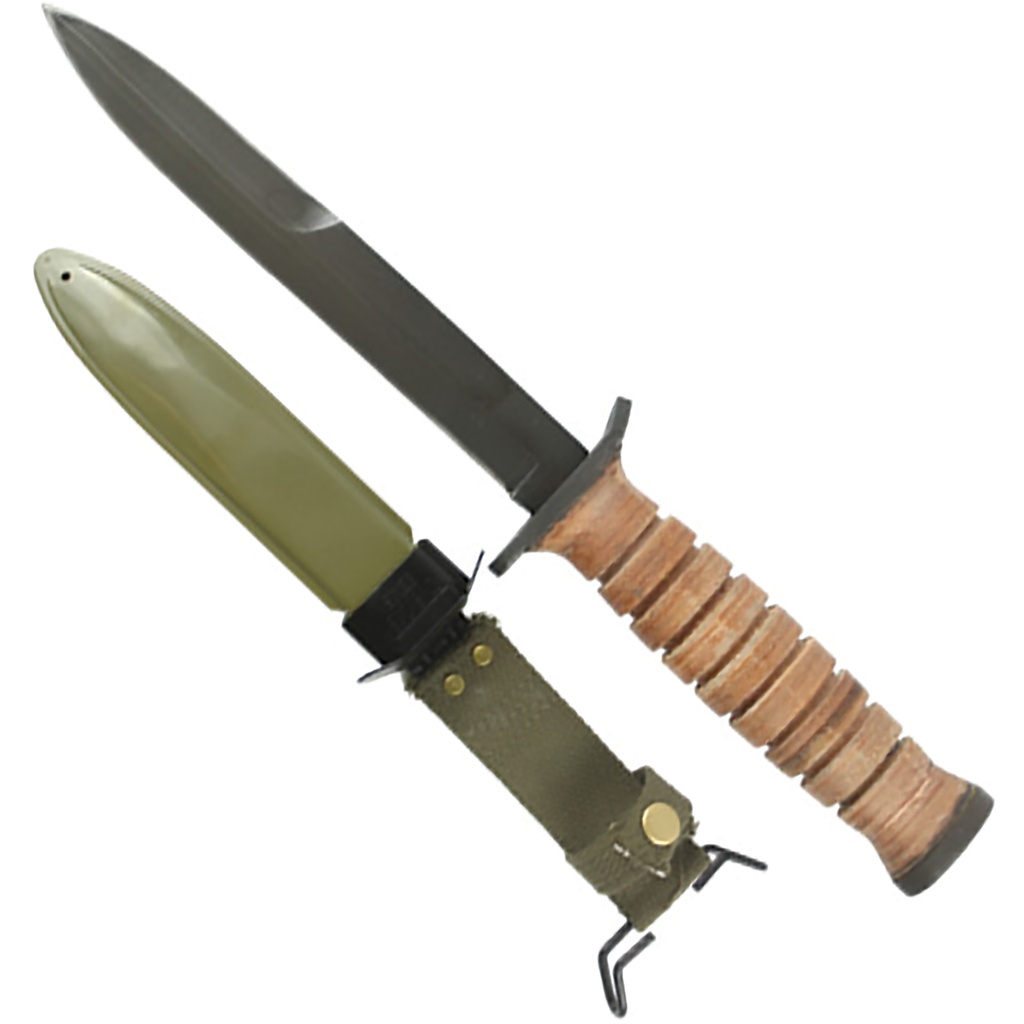
You don’t just want another fixed blade knife—you want something that feels like it could have seen service, then followed you home. This spear-point bayonet knife lands on your belt with that quiet, earned authority. The stacked leather handle warms to your grip, the matte steel looks ready for work, not for show. Slide it from the olive sheath and you feel it: you’re carrying a piece of history that still answers when called.
| Blade Length (inches) | 6.625 |
| Overall Length (inches) | 11.75 |
| Blade Color | Silver |
| Blade Finish | Matte |
| Blade Style | Spear Point |
| Blade Edge | Plain |
| Blade Material | 440 Stainless Steel |
| Handle Finish | Matte |
| Handle Material | Leather |
| Theme | Military |
| Handle Length (inches) | 5 |
| Pommel/Butt Cap | Metal pommel |
| Carry Method | Belt Carry |
| Sheath/Holster | Sheath |
You notice it before you even touch it—the way this spear-point bayonet knife doesn’t look new so much as timeless. The stacked leather handle could have hung from a soldier’s belt in a black-and-white photograph. The olive sheath feels like it’s already seen rain, mud, and long roads. And as your hand closes around the leather, you realize you’re not just picking up a tool. You’re picking up a story you get to continue.
Why a Spear-Point Fixed Blade Knife Feels Different in Your Hand
If you’ve only carried folders, the first moment with a true fixed blade knife is a little startling. There’s no hinge, no moving parts—just a solid line of steel from pommel to tip. When that steel is a spear-point bayonet style, like this one, the balance changes the way you move.
Here, the 6.625-inch matte 440 stainless blade sits dead center in your grip. You feel it the instant you wrap your fingers around the leather: the weight isn’t front-heavy and clumsy, and it doesn’t disappear into the handle either. It rides that narrow middle ground where a blade feels like an extension of your hand, not an object you’re fighting to control.
In practical terms, that means when you’re cutting cord, slicing cardboard, or working around camp, you’re not constantly adjusting your grip. The spear-point fixed blade gives you a straight, predictable path through whatever’s in front of you. You’re not wrestling with a mechanism—you’re just working.
A Fixed Blade Knife With Service-Era Roots and Modern Steel
Part of what draws you to this fixed blade knife is that it looks like it could have come from a footlocker. But the moment you look closer, you see the modern upgrades hiding inside that heritage silhouette.
The blade is 440 stainless steel with a matte finish—nothing flashy, nothing mirror-bright to baby. It shrugs off moisture and daily use in a way older bayonet steels never did. You can wipe it on your pant leg after a quick camp chore or a garage job and trust it won’t complain. The finish keeps glare down, which matters more than you’d think when you’re working in bright sun or under a garage light.
Then there’s the handle. Those stacked leather rings aren’t just there for nostalgia. They give your palm something honest to bite into. As the leather seasons with use—your sweat, your oil, your weather—it darkens and polishes in all the places your hand returns to again and again. One day you’ll notice the grip shining where your thumb lands, and you’ll know: this isn’t just a generic combat-style blade anymore. It’s yours.
The steel guard and metal pommel frame that leather with a kind of quiet toughness. You don’t have to baby this thing. Toss it on the workbench, drop it in your pack, let the sheath knock against a fence post. It’s built with the expectation that life happens outside, not just in display cases.
How a Fixed Blade Knife Like This Fits Into Real Life
Owning a heritage-style fixed blade knife is one thing. Actually carrying it is where it earns its place in your routine. That’s where the olive drab sheath and belt carry setup come in.
The hard-plastic sheath gives you that satisfying, secure fit when you slide the knife home. You hear it settle. You feel it lock. There’s a drainage hole so rain, river water, or a surprise downpour doesn’t turn your gear into a rust trap. The olive web belt loop rides flat against your hip, held by a brass snap that feels like it could outlast the belt itself.
On a normal day, that means you can walk, sit, climb into your truck, or crouch in the yard without the knife poking or shifting all over the place. The 11.75-inch overall length feels substantial, but not like a sword hanging off your side. If you’re used to a smaller EDC blade in your pocket, this becomes your deliberate carry—your "I’m working outside" companion, your "I’m heading into the woods" choice.
And when you pull it free, you’re not fumbling with flippers, studs, or springs. There’s a strange kind of calm in knowing you have a blade that’s always ready the instant your hand finds it. No thinking, no fine motor skills, no wondering if a mechanism will fail when it’s cold, wet, or muddy. Just reach, draw, cut, done.
The quiet details that change how you use it
There’s one small thing you’ll notice on day one: the leather warms to your hand faster than synthetic handles. In winter or early morning chill, that matters. In summer, the textured grooves help lock in your grip when your hands get sweaty. These are tiny details, but they’re the ones that sneak up on you and make you choose this knife over others without even thinking about it.
When a Heritage Fixed Blade Knife Becomes Your Story Piece
Sometime after you start carrying this, someone is going to ask about it. Maybe it’s at the range, maybe at a campfire, maybe in your own garage. They’ll see the stacked leather and the bayonet profile and say something like, "That looks like an old service knife. What is it?"
That’s when this stops being just a tactical-style blade and becomes a story you get to tell. Maybe you talk about a grandfather who carried something similar. Maybe you talk about how you were tired of knives that felt disposable, so you went for something that looks like it belongs in a footlocker but works like modern gear. Either way, you’re not just showing off a purchase—you’re showing who you are when you choose gear with history and intention.
This is why people who build their everyday kit with care gravitate toward a heritage-style fixed blade knife. It’s not about having the biggest, wildest, or most aggressive-looking blade. It’s about having something that feels earned. Something that looks just as right on a wall hook in your study as it does on your belt in the woods.
Display piece on the wall, work knife on your belt
Hang it by the sheath next to your range bag or over a workbench and it instantly reads as a military history nod. Clip it on your belt before a field day or a weekend away, and it stops being decoration and starts being a partner. The same lines that make it display-worthy are the ones that make it feel naturally at home outdoors.
Questions People Ask Before Buying a Fixed Blade Knife
Is a fixed blade knife like this practical for everyday use?
It depends on how you live your days. If your "everyday" involves working outside, spending time in the woods, or tackling hands-on projects, a fixed blade knife gives you faster access, more strength, and fewer parts to fail than a folder. For office life with occasional chores, it’s more of a deliberate carry than a pocket companion.
What makes this fixed blade knife different from a modern tactical knife?
Functionally, you still get a durable 440 stainless blade, solid belt carry, and real-world toughness. The difference is in the heritage design—stacked leather handle, bayonet-style spear point, and olive sheath. You’re choosing something that looks like it has a story, not just another aggressive tactical profile.
How hard is it to maintain a 440 stainless fixed blade?
Basic care goes a long way: wipe the blade after use, avoid long-term moisture in the sheath, and touch up the edge when you notice it slowing down. 440 stainless is forgiving, which means you don’t have to be a sharpening expert or baby it after every task.
Will this fixed blade knife be comfortable to carry on a belt?
At 11.75 inches overall, you’ll know it’s there, but the sheath and belt loop keep it riding close to your body. Most people find that after an hour or two, it just becomes part of the kit—especially if you’re moving, working, or walking instead of sitting at a desk all day.
The Moment This Fixed Blade Knife Truly Becomes Yours
Picture this: early light, breath in the air, jacket zipped halfway. You thread your belt through the olive loop, feel the weight of the fixed blade knife settle at your hip, and snap it in place almost without thinking. Later, when you reach for it—cutting a length of rope, shaving tinder, opening a stubborn crate—the leather is already familiar under your fingers.
By the time the handle darkens where your palm rests and the sheath picks up the scuffs of real use, it won’t feel like something you bought. It will feel like something that’s been with you for a while now. A quiet sentinel at your side—heritage on the outside, reliability at the core, ready every time your hand reaches down and expects steel instead of excuses.