Shadow Arc True-Balance Throwing Axe - Black Paracord
You know the feeling when a throwing axe leaves your hand and you can tell—before it lands—that it’s dialed in. That’s the calm this true-balance throwing axe gives you. The matte black head tracks clean in the air, the paracord grip bites into your palm, and the rotation feels honest. Misses become data, not frustration. Hits start sounding like something you can repeat on demand. This isn’t just another backyard toy—it’s how your throw finally catches up to your expectations.
You step up to the line and the noise drops out. It’s just you, the target, and the way this true-balance throwing axe sits in your hand—centered, predictable, already familiar. You haven’t even thrown yet, but you can feel the rotation in your wrist, the way the weight wants to move. When you finally let go, it doesn’t wobble or fight you in the air. It flies like it understood the plan.
When a True-Balance Throwing Axe Makes Practice Feel Honest
If you’ve thrown with hardware-store camp axes or random “tactical” novelties, you already know the frustration. One throw sticks, the next buries sideways, and you’re left wondering if it’s you… or the tool. A true-balance throwing axe answers that question fast. The weight is centered for rotation, not chopping. The double-edged head is shaped to enter the target clean from multiple angles. Your throw stops being a guessing game and starts feeling like a repeatable motion your body can learn.
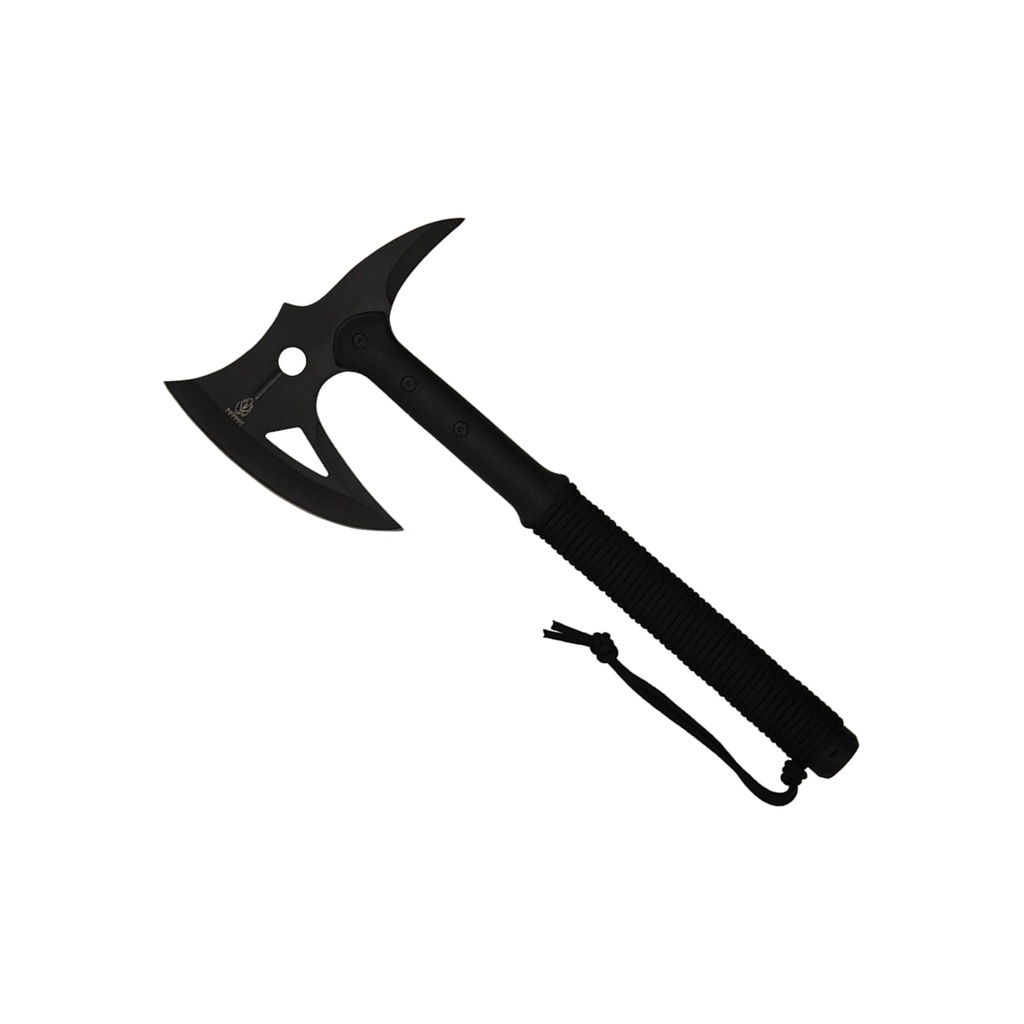
This 17-inch axe gives you that rhythm. The wide, double-edged head and 7.375 by 6.25-inch profile spread the weight across the flight path instead of stacking it in a lump at the top. That means smoother rotation and a bigger, more forgiving sticking zone. You’re not wrestling a blunt tool into doing a job it wasn’t designed for—you’re working with a throwing axe that was built to match what your muscles are trying to do.
How This True-Balance Throwing Axe Earns Your Trust in the Air
You can see the intent in the steel before you ever take a throw. The matte black head isn’t just there to look tactical; it cuts glare so your eyes track the head’s rotation instead of catching reflections. The large circular cutout and smaller triangular opening aren’t random style—they shift weight where it matters so the axe turns around a predictable center.
On the back, the rear spike balances the curved cutting edges up front. Together, they create a rotation that feels smooth instead of lopsided. That consistency is what lets you practice distances with confidence. One and a half turns at this mark, two full rotations at that one—you start mapping your space because the throwing axe behaves the same way, every time.
The double edges also mean more chances to stick. Coming in high? The front edge bites. A bit under-rotated? The trailing edge or spike still has a chance. Instead of punishing every small mistake, this axe turns near-misses into useful feedback. It’s not hiding your flaws; it’s just honest enough to turn them into a better next throw.
Grip, Control, and Carry: Living With a Throwing Axe Day to Day
A throwing axe can look great on a screen and still feel wrong the second you pick it up. Here, the straight handle and black paracord wrap are what make it belong in your hand, not just in a product shot. The corded texture bites just enough to anchor your fingers without shredding skin during long sessions. Even when your hands are damp, dusted with dirt, or chilled from the evening, that paracord grip keeps the axe from twisting at release.
The handle length gives you options. You can choke up for tight indoor distances at the club or slide your grip lower for longer outdoor throws in the backyard or training field. The wrist lanyard is there quietly doing its job—an extra layer of security when you’re tired or experimenting with new distances, helping make sure your throwing axe only travels where you intend.
Between throws, you’re not juggling bare steel. The included nylon sheath wraps the head so you can move between stations, walk back from the target, or pack up without worrying about catching an edge on gear or skin. It’s a small detail, but if you’ve ever tried hauling a bare-head axe in and out of the car or around a range, you know how much cleaner life gets when the sheath is just there, doing its job.
The tactile difference you feel every throw
There’s a moment right before release where everything you’re holding either settles or shifts. With this true-balance throwing axe, you feel it settle. The paracord tightens under your grip, the head aligns with your forearm, and your shoulder finally stops compensating for bad balance. That small, physical relief is what gives you the confidence to commit fully to the throw.
Backyard, Club, or Field: Where This Throwing Axe Fits Your Routine
Maybe your range is a pallet leaned against a fence in the backyard. Maybe it’s a competition lane under bright lights with a row of throwers next to you. Maybe it’s a quiet training field where you run drills alone. Wherever you throw, you need a tool that doesn’t make you start over every time you change locations.
This true-balance throwing axe carries easily with its nylon sheath, so it slides into the backseat or your gear bag without drama. The all-black profile doesn’t scream for attention when you unbag it at a club or meet-up; it just looks like you care about your setup. And once you start throwing, the rotation is familiar whether you’re ten feet from a backyard target or pacing out competition distances on a range.
If you’re still learning, the consistency gives you something priceless: clear cause and effect. When you adjust your grip or distance, the axe reacts in obvious, predictable ways. If you’ve already got experience, it lets you tune the small things—foot placement, wrist angle, release timing—without fighting a badly balanced head. Either way, this throwing axe becomes part of your practice, not another variable to manage.
That first clean thud you don’t forget
There’s a sound when a throwing axe hits right. It’s not the clatter of a sideways impact or the awkward bounce of a handle-first miss. It’s a solid, hollow thud that lets everyone nearby know the throw landed true. The first time you hear that sound with this axe, you’ll know it wasn’t luck—you’ll feel how everything that happened in your hand matched what happened at the target.
True-Balance Throwing Axe vs. Regular Axes: Why It Matters
You can throw almost anything with a blade, but not everything wants to be thrown. A camp hatchet or felling axe puts most of its weight out at the head so it can bite deep into wood with a chopping motion. When you try to spin that, it turns like a sledgehammer on a stick—heavy, unpredictable, and punishing when you’re off by even a little.
A true-balance throwing axe is built the opposite way. The weight is distributed for rotation first, impact second. Instead of sheer chopping force, you get stable flight and a more consistent stick. Over time, that means faster skill growth, fewer mystery misses, and less fatigue because you’re not over-muscling a tool that’s fighting your form.
If you’re wondering which is better for actually learning to throw—a regular hatchet or a real throwing axe—the answer shows up in your progress. With a true-balance design, your notebook fills with distances and turns, not excuses about bad hardware.
Questions People Ask Before Buying a True-Balance Throwing Axe
Is a true-balance throwing axe easier to learn with?
Yes. Because the weight is centered for rotation, a true-balance throwing axe gives more predictable flight than a random hardware-store hatchet. That makes it easier to map distances and turns, so you spend your time improving your throw instead of guessing what the axe will do.
Can I use this throwing axe in my backyard safely?
Backyard throwing can be safe if you’re intentional. Use a solid target that can absorb hits, keep a clear zone around your throwing lane, and be mindful of local noise and tool rules. The included nylon sheath helps you move the axe around the yard without exposed edges in between throws.
Will this true-balance throwing axe hold up to regular practice?
It’s built with repeated impact in mind. The steel head, secure fasteners, and paracord-wrapped handle are meant for backyard sessions, club nights, and field training. As with any throwing axe, regular inspection and basic care keep it ready for the next round.
Is a black throwing axe hard to see in low light?
The matte black finish cuts glare, which actually helps you track the head’s rotation under many lighting conditions. In very low light, you’ll rely more on distance markers and muscle memory than on visually tracking every part of the arc—just like you would with any dark-finished throwing axe.
Later that night, you’ll remember one specific throw. The way the true-balance throwing axe left your hand clean, the air felt quiet for a split second, and the head turned over exactly once before burying into the target with that satisfying, centered thud. In that moment, you weren’t just trying a new piece of gear—you were the person who knows their distance, trusts their release, and can send a throwing axe where they say it’s going. Owning a tool like this doesn’t change who you are overnight, but it does something subtler: it lets the thrower you know you could be finally show up.