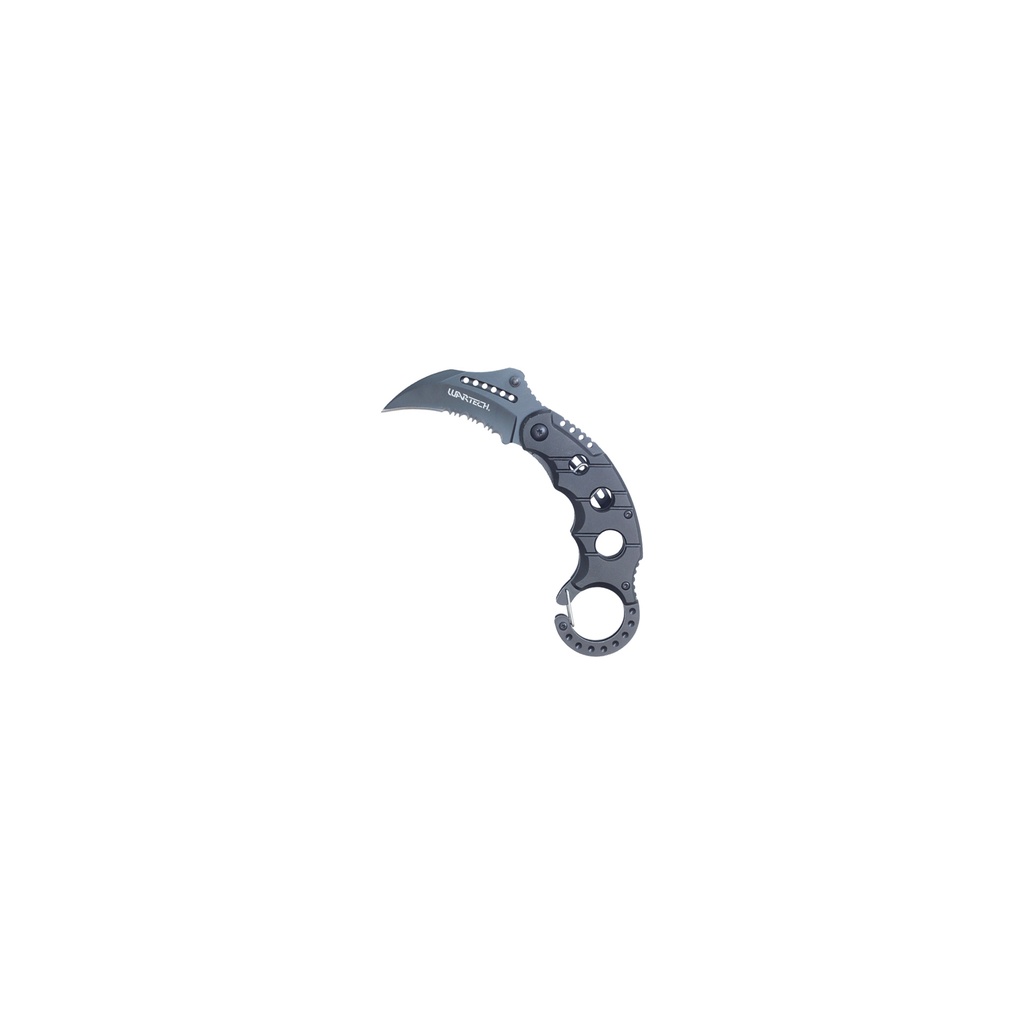
Shadow Claw Spring-Assisted Karambit Knife - Black Steel
You don’t reach for this by accident—you reach for it because you decided you’d never feel caught off-guard again. A spring-assisted karambit knife sits low in your pocket or bag, all black steel and quiet intent, until your thumb moves and the claw-shaped blade snaps into place. The finger ring locks your grip, the partial serrations bite through what smooth edges can’t, and suddenly you’re not just carrying a knife—you’re carrying the comfort of knowing you’re ready.
| Blade Color | Black |
| Blade Finish | Matte |
| Blade Style | Talon |
| Blade Edge | Partial-Serrated |
| Blade Material | Steel |
| Handle Finish | Matte |
| Handle Material | Steel |
| Theme | Tactical |
| Pocket Clip | No |
| Deployment Method | Spring-assisted |
| Lock Type | Liner lock |
You’re walking to your car at the end of a long day. Parking lot lights are buzzing, your keys are somewhere at the bottom of your bag, and a shape moves in your peripheral vision just a little too close, a little too fast. In that split second, you don’t have time to wonder where your confidence went—you either have it on you, or you don’t. That’s where a spring-assisted karambit knife quietly changes the story.
How a Spring-Assisted Karambit Knife Turns Nerves into Control
Owning a spring-assisted karambit knife is less about having a flashy tactical toy and more about knowing you have a fast, instinctive tool when adrenaline hits. The curved talon blade is already angled for close-quarters control; you don’t have to fight it into position. With a small push on the flipper, the spring-assisted mechanism snaps the blade open, liner lock clicks in, and suddenly your hand feels anchored instead of empty.
If you’ve ever fumbled a basic pocket knife when your hands were wet or your heart was racing, you know how slow "two-handed" can feel. Here, your thumb moves, the black blade arcs into place, and the finger ring locks your grip so everything else—fear, shake, doubt—has less room to creep in. You’re not just holding a knife; you’re holding a decision you already made: I’m not going to be the one who wishes they had something.
Why This Karambit Knife Feels Different the First Time You Grip It
Pick up a cheap folder and it feels like it’s borrowing strength from you. Pick up a well-built karambit knife in matte black steel and it feels like it’s lending you some of its own. The full blacked-out finish isn’t about looking mean; it’s about not drawing attention until you choose to. The steel handle flows into the talon-shaped blade in a clean S-curve, so your fingers naturally find the grooves without conscious thought.
You’ll notice the finger ring right away. Slide your index or pinky through and close your fist—the knife becomes an extension of your hand, not an object you’re trying to hang onto. The partial serrations near the base of the blade aren’t a design flex; they’re there for the frustrating, real-world moments: cutting stubborn zip-ties, tearing into heavy plastic, sawing through cord when a clean slice won’t do it. The matte finish kills glare so you’re not flashing shiny steel under streetlights or in a crowded train.
The First Click You Hear Tells You It’s Locked, Not Lucky
That liner lock you see tucked inside the handle is the quiet promise that once this spring-assisted karambit knife is open, it stays open until you say otherwise. No wobble, no vague half-open feeling—just a decisive click that tells your nervous system it can focus on the moment, not on whether your blade is going to fold back on your fingers.
Carrying a Karambit Knife in Daily Life Without Feeling "That Person"
Maybe you’ve seen tactical knives that feel more like costume props than something you’d actually carry to work or class. This karambit knife leans tactical, but it doesn’t scream for attention. The compact folding design lets it slip into a bag, waistband, or glove box without a pocket clip printing against your clothes. You know it’s there. No one else needs to.
Day to day, it quietly does all the unglamorous things you never see in action movies: breaking down boxes after a delivery, slicing paracord, trimming nylon straps, cutting tape when your hands are full. The curved blade gives you leverage for pull cuts, so you’re using your body’s natural motion instead of forcing awkward angles. Over time, you stop thinking of it as “that tactical knife” and start thinking of it as the tool you automatically reach for whenever something fights back against being opened, cut, or freed.
When the Everyday and the "Oh-No" Moment Use the Same Tool
The real power of a spring-assisted karambit knife is that the blade you use for ordinary tasks is the same blade that’s ready in an emergency. You don’t have a “this one’s for boxes” knife and a “this one’s for self-defense” knife. You have one tool that’s already broken in, already familiar in your hand, already trusted.
When a Spring-Assisted Karambit Knife Makes the Difference
There’s a particular kind of calm that shows up when you know your everyday carry blade isn’t just symbolic. If you’ve ever asked yourself, "What knife is best for that moment I hope never happens?" a spring-assisted karambit knife keeps showing up in the answer. The compact, folding design keeps it legal in many areas where full fixed tactical blades would be a non-starter, yet the speed of deployment and aggressive curve still give you an edge—literally and mentally—if that "hope it never happens" scenario shows up.
Compared to a standard pocket knife for daily use, this design is built for retention and control. The finger ring keeps the handle from being knocked free. The talon-shaped blade naturally hooks instead of slipping. The partial serrations bite where straight edges might skate. You’re not waving steel around hoping for the best; you’re using a tool shaped specifically for close, controlled work—whether that’s cutting a seat belt or putting one more barrier between you and someone’s bad intentions.
Questions People Ask Before Buying a Spring-Assisted Karambit Knife
Is a spring-assisted karambit knife good for everyday carry or just self-defense?
It works for both. As an everyday carry blade, the folding design and compact profile make it easy to keep nearby for boxes, cord, tape, and general utility. In a self-defense role, the spring-assisted opening, finger ring, and curved blade give you faster deployment and better retention than a typical straight pocket knife.
Will this karambit knife hold up to regular use, or is it just for looks?
The all-black steel construction and liner lock are built for real use, not just display. The steel blade takes a working edge, the partial serrations handle tougher cutting jobs, and the matte finish shrugs off the kind of scratches and scuffs that come with actual daily carry.
How does a spring-assisted karambit knife open compared to an automatic?
With a spring-assisted karambit, you start the motion with your thumb on the flipper or stud; then the internal spring snaps the blade the rest of the way. It’s fast like an automatic knife but gives you more control over when it opens, and in many places it’s treated differently under the law than full autos. You still get a quick, confident deployment without feeling like the knife might open on its own.
Is a curved karambit blade hard to sharpen?
Sharpening a karambit knife is a little different from a straight blade, but not difficult once you’ve done it once or twice. A rod-style sharpener or small stone lets you follow the curve of the talon edge, and the partial serrations can be touched up with a tapered rod. The payoff is a blade shape that cuts aggressively with less force once it’s tuned up.
The Moment You First Open Your Spring-Assisted Karambit Knife
Picture your first real deployment. Not the test flick on your couch—the first time you actually need it. Maybe it’s a dark parking lot, maybe it’s a tangled mess of rope and nylon around a trailer hitch, maybe it’s a split-second where your body moves before your thinking brain catches up. Your fingers find the familiar curve of the handle, your thumb hits the flipper, the spring-assisted mechanism snaps the karambit knife into place, and the ring catches your grip like it’s been waiting there the whole time.
The sound is a soft, decisive click—no drama, just confirmation. In that moment, you’re not the person wishing they’d carried something more serious than a dull box cutter. You’re the one who quietly chose readiness weeks ago when you slipped this black steel blade into your rotation. From then on, every time you feel its weight, you’re reminded of what you actually carry: not just a knife, but the steady kind of confidence that comes from knowing you’ve already thought one move ahead.