Shadow Claw Tactical Survival Axe - Blackout
You don’t carry a tactical survival axe because things always go right. You carry it because you like knowing you’re ready when they don’t. The Shadow Claw Tactical Survival Axe rides in your rig or pack like a quiet promise—16.75" of chopping edge and claw spike waiting behind that nylon sheath. The nylon‑fiber handle feels locked in when your palms are sweaty and the light is fading. This isn’t wall décor. This is the moment you stop hoping and start handling.
You don’t really think about your tactical survival axe on the drive out. It’s just there—handle down in the truck door, nylon sheath brushing your leg when you grab your pack. But when the weather shifts, when daylight thins faster than you planned, when camp isn’t set and the wind says, “Move now,” that’s when this becomes the tool that decides whether tonight is a story you tell later, or a night you’d rather forget.
When a Tactical Survival Axe Turns Chaos Into a Plan
Picture the moment you realize you pushed it too close to dark. The firewood you thought you had is a scatter of thick limbs and stubborn roots. You reach down, wrap your hand around that ribbed nylon-fiber handle, and your pulse settles a notch. This is why you brought a tactical survival axe instead of a cheap hardware-store hatchet—because you wanted something that feels like control when everything else feels rushed.
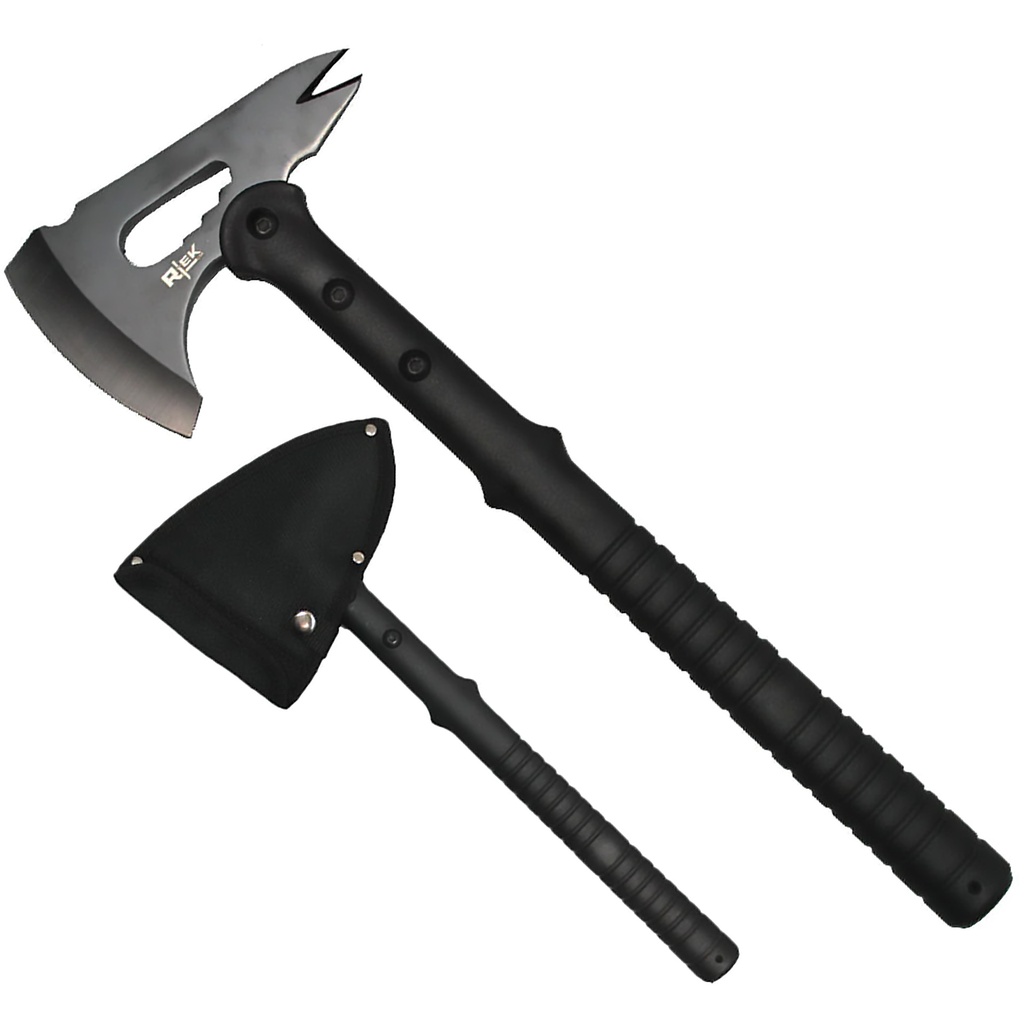
The 16.75" overall length gives you real swing, not toy momentum. A 4" curved cutting edge bites into wood with a clean, confident arc—enough head weight to do work, but still precise enough to feather sticks without feeling clumsy. You don’t think in measurements in that moment; you just notice that it splits what needs splitting and doesn’t fight you while it does.
How This Tactical Survival Axe Is Built To Take a Beating
You’ve handled tools that felt good in-hand but rang like a tuning fork at impact. This isn’t one of them. The nylon-fiber handle runs a long 14.75", giving you room to choke down for power or slide up for control. That ribbed texture and subtle finger swell matter when your hands are cold, wet, or gloved—because that’s when you really learn what a survival axe is made of.
Up top, the axe head wears a black tactical finish with a satin/stonewashed edge, the kind of look that doesn’t scream for attention but quietly tells you it’s seen work. The large oval cutout isn’t decoration—it trims unnecessary weight and gives you a visual reference point when you’re indexing the blade in low light. The three fasteners in the upper handle tell you this isn’t some glued-together gimmick; there’s a real connection between you and the steel every time you swing.
The Claw Spike You Don’t Appreciate Until You Need It
Flip the head and you’ve got the reason you chose this over a basic camp axe: that aggressive claw spike. This is where the tactical side of your survival axe shows up. It digs into stubborn roots you can’t quite chop. It hooks and drags logs into place without you stepping closer than you want to. It pries, notches, and bites into material when a flat poll would just slide off.
On a trail-clearing day, that spike becomes your lever. On a stormy night, it’s how you pull debris off a fence or free a stuck tarp line without shredding the rope. You may not use it every trip—but the first time you do, you’ll be very clear on why you wanted a claw spike on your axe.
Carry, Comfort, and How a Tactical Survival Axe Fits Your Life
Tools that never leave the gear bin don’t count. The question is: will you actually carry this tactical survival axe? The nylon sheath answers that. It snaps over the head with metal buttons, covering both the cutting edge and the claw spike so you can toss it in a truck bed, strap it to a pack, or slide it behind a seat without worrying what it might catch.
The all-black profile and straight handle with a lanyard hole at the butt make it easy to rig the way you like—carabiner off the pack, loop through paracord, or hang it from a nail in the shed. At around 2 lbs, it feels substantial enough to matter but not like you’re hauling a full-size felling axe on a casual overnighter. You carry it because it earns its space, not because you feel like you “should” bring an axe.
From Backyard to Backcountry Without Feeling Out of Place
This isn’t a tool that has to wait for a survival scenario to justify itself. You’ll grab it to break down branches after a windstorm, knock loose frozen pallets, or carve out a quick fire pit on a riverbank. The same tactical survival axe that looks at home on a bug-out rack also feels right at your family campsite—quiet, capable, not trying to be the center of attention.
When a Tactical Survival Axe Makes the Difference
There’s always that one moment when you realize why you bothered to research gear instead of grabbing whatever was cheapest. Maybe it’s a late-season camp when the wood is damp and stubborn and you need a reliable chopping tool. Maybe you’re that friend people call when a tree drops across the driveway in a storm and they need help now. In those moments, a tactical survival axe with a claw spike isn’t overkill—it’s exactly the kind of everyday readiness you expect from yourself.
You’re not buying an axe to hang on the wall. You’re buying the confidence to say “I’ve got it” when everyone else is looking around for someone with the right gear. The blackout finish, the modern silhouette, the RTEK logo on the head—they all point to the same thing: a tool you chose on purpose, not by accident.
Questions People Ask Before Buying a Tactical Survival Axe
Is a tactical survival axe actually useful for everyday carry in a vehicle?
For most people, a tactical survival axe lives in a truck, SUV, or pack—not on a belt. In a vehicle, it’s incredibly useful: cutting branches after a storm, freeing stuck gear, clearing a quick path. You get chopping power and a claw spike in one tool, which beats trying to improvise with a small pocket knife.
What makes this different from a regular camp axe or hatchet?
A regular camp axe chops; a tactical survival axe like this one chops and problem-solves. The claw spike lets you pry, hook, and drag, while the blackout finish, long nylon-fiber handle, and nylon sheath are built for real-world carry and abuse. It’s designed around readiness, not just splitting kindling.
Will a tactical survival axe like this hold up to hard use?
That’s what it’s built for. The synthetic nylon-fiber handle, full-size 16.75" length, and solid head mounting are meant to take real swings and real impacts. It’s not a display piece—you’re meant to slam it into wood, roots, and debris and trust it to come back for more.
Is it overkill if I mostly camp and don’t do “tactical” stuff?
Only if you consider extra capability a problem. In regular camping, you’ll use it like any reliable camp axe—processing firewood, clearing ground, pounding in stakes with the head. The tactical touches—the claw spike, blackout finish, and sheath—just mean it’s ready if your plans ever go sideways.
Later, when the fire’s down to coals and your hands still remember the weight of that 2 lb head, you’ll look at the silhouette of your tactical survival axe leaning against a log and feel it click: this is one of those tools that changes how you move through the world. Not louder, not flashier—just more prepared. And the next time you step out the door, you won’t wonder if you should bring it. You’ll reach for it on instinct, because by then, carrying a tactical survival axe isn’t about the tool at all. It’s about who you’ve decided to be when things get real.