Shadow Ridge Quick-Return OTF Automatic Knife - G10 Black
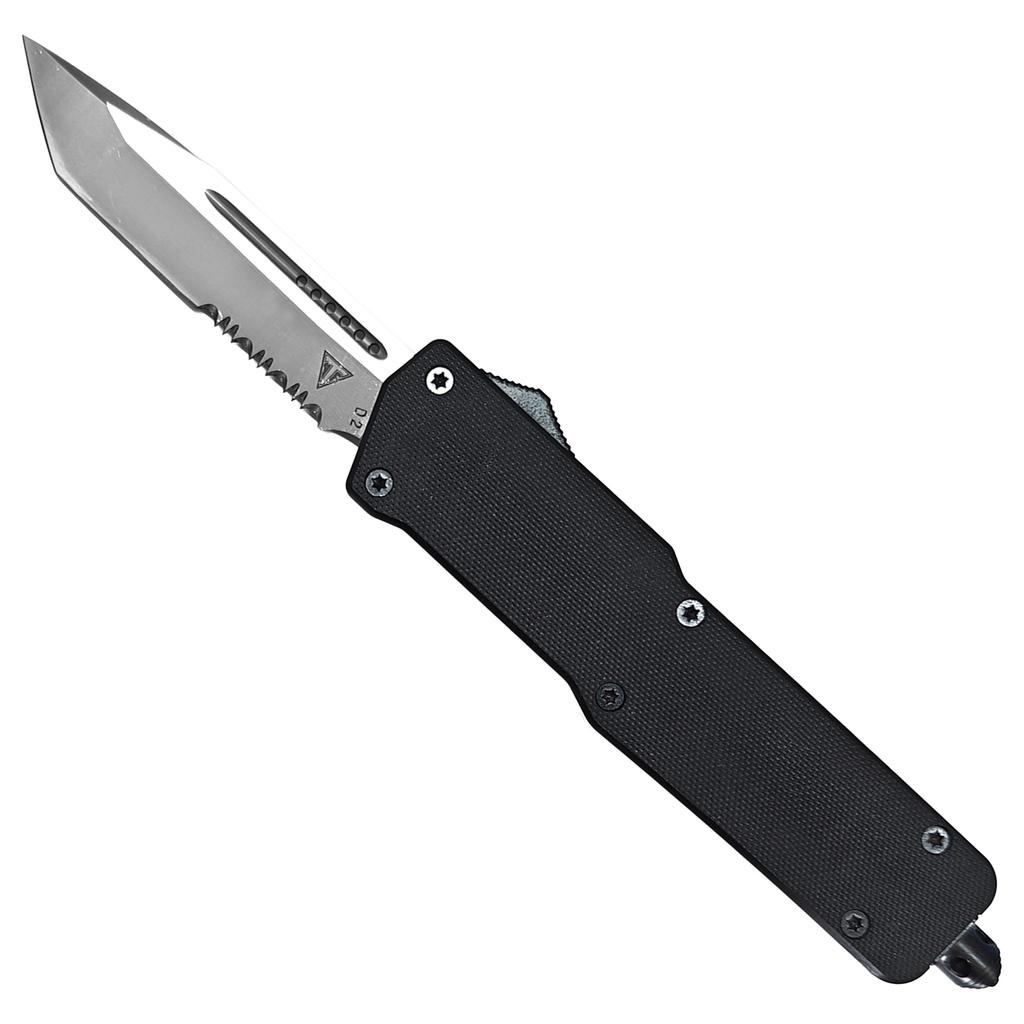
You know the moment: seatbelt jammed, strap won’t give, your heart already three steps ahead. That’s where an OTF knife like this earns its ride. The D2 tanto blade snaps out with a thumb sweep, serrations chewing through webbing while the G10 stays locked in your grip. In pocket, it disappears. In hand, you turn panic into a task you know how to handle.
| Blade Length (inches) | 4 |
| Overall Length (inches) | 9.75 |
| Closed Length (inches) | 5.75 |
| Weight (oz.) | 4.64 |
| Blade Color | Silver |
| Blade Finish | Matte |
| Blade Style | American Tanto |
| Blade Edge | Partial-Serrated |
| Blade Material | D2 |
| Handle Finish | Textured |
| Handle Material | G-10 |
| Theme | Tactical |
| Pocket Clip | Yes |
You’re halfway through your drive when the sirens flare behind you. Not for you—but close. Two cars up, someone’s having the worst day of their year. You pull over anyway. It’s automatic now. You step out, walk toward the crumpled metal, and your hand is already at your pocket. This is where an OTF knife stops being gear and starts being part of how you move in the world.
When an OTF knife turns a bad moment into a controlled one
Most days, your OTF knife just rides along, clipped in your pocket, forgotten until there’s something stubborn to cut. Cardboard that laughs at scissors. Nylon straps that bite into your fingers. Plastic zip ties that don’t care how late you are. You feel the slide under your thumb, hear that clean double-action snap as the blade drives out, and suddenly it’s a one-motion problem.
This out-the-front knife leans into that moment: a 4-inch American tanto blade in D2 steel shooting straight from the handle, not folding out to the side. The partially serrated edge near the base doesn’t ask politely—it saws through webbing and rope when time or patience is thin. The point is all business: angular, strong, made for decisive punctures instead of delicate slicing games.
What you notice, after a week of carrying it, isn’t just the speed. It’s the way the action feels confident instead of twitchy. The slide has resistance, like it expects to be worked with gloves on or with your hands shaking in the cold, and still do exactly what you ask.
Why this OTF knife feels like it was built for real use, not a display case
There’s a reason people who live with a blade every day care about steel and handle more than paint and logos. You don’t need a brochure word for it; you just want to know: will this thing hold up when you’re tired, wet, or one mistake away from bleeding?
That’s where the D2 steel on this blade quietly earns your trust. It’s not some mystery metal. D2 holds an edge like it has something to prove, tough enough to keep biting through boxes, straps, and the kind of dirty cutting jobs that would roll a softer blade. You don’t baby it. You cut, wipe, maybe strop it once in a while, and it keeps coming back ready.
The G10 handle is the other half of the story. If you’ve ever had a slick, pretty handle twist in your hand when things got wet, you already know why textured G10 matters. This one is squared-off and honest: a rectangular profile with CNC texture that locks into your fingers without chewing them up. When you squeeze harder, it doesn’t punish you. It just stays where you put it.
The hardware is the quiet tell. Torx screws along the handle, a solidly anchored slide switch, and a glass-breaker pommel that’s more than a cosmetic spike. You see it and instantly know what it’s for: one hard, focused hit on a side window that won’t open fast enough. The lanyard hole at the tail gives you options—clip, cord, or run it bare. Either way, this OTF knife feels less like a toy and more like something you’d be fine handing to a friend in a crisis.
How this OTF knife actually carries, day after day
The big question with any out-the-front knife: does it carry like a tool or like a brick? On paper, 9.75 inches overall sounds like a lot. In pocket, the story changes. Closed, it sits at 5.75 inches with a slim, straight body that slides along the seam of your jeans instead of bulging out like a rock. At 4.64 ounces, you feel it just enough to know it’s there, not enough to resent it.
The deep-carry pocket clip does the social work. It buries the OTF knife low, leaving only a clean line at the edge of your pocket instead of a full tactical billboard. When you sit, drive, or crouch, it doesn’t jab or roll. After a week, grabbing it on your way out feels as automatic as your keys.
The small moments when it quietly proves itself
You’ll probably use it first on something boring: breaking down shipping boxes, trimming a strap, freeing a cable from a plastic clamp the size of a thumb. It’s in these small, forgettable cuts that the design clicks. The tanto tip lets you score tape and cardboard without digging too deep; the serrations near the handle handle the fibrous stuff with a fast back-and-forth. The handle’s flat sides give your thumb a sure platform behind the blade, so you’re pushing with control, not guessing.
Then there’s the night you’re loading gear in the dark and can’t see what you’re doing. You don’t have to look for a thumb stud or flipper tab. Your thumb finds the slide switch by feel alone. Forward: snap. Back: locked. The OTF knife returns to neutral with the same certainty it left it. No fiddling. No half-deployed awkwardness. Just out, cut, away.
When the right OTF knife is the difference between watching and stepping in
People talk about tactical gear like it’s about looking prepared. You know better. It’s about that one time when you don’t have to ask, “Does anyone have a knife?” because you already feel yours under your hand.
Picture a roadside tangle of airbags and glass. A kid half-strapped in the back. A dog’s leash twisted around a seat bracket. You’re not a superhero; you’re just the person who has an OTF knife with a serrated D2 blade that doesn’t hesitate. The tanto point slides under a belt; the serrations chew through in seconds. One quick punch from the glass-breaker pommel clears a window that refused to cooperate. You’re not thinking about steel types and handle materials then. You’re thinking: I’m glad I didn’t talk myself out of carrying this today.
Later, back home, the same knife is flicking out to open packages, slice cord, and handle the mundane, almost silly little tasks that fill up most of a blade’s life. That’s the real test: a knife that can live a normal day and still be ready for the abnormal ones.
Texture, sound, and the feel of being ready
There’s a specific sound when this out-the-front knife deploys—a sharp, mechanical thunk that’s more reassuring than aggressive. Your thumb rides the ribbed slide, feels it click into place, and your fingers tighten around G10 that doesn’t slide, doesn’t squirm, just sits there solidly. The matte silver blade catches light without flashing. It looks like what it is: a working edge, not a mirror.
That sensory memory builds over time. The weight in your pocket as you step outside. The habit of checking clip, wallet, keys, knife in a single sweep. You’re not carrying a conversation piece. You’re carrying a quiet promise you’ve made to yourself about the kind of person you are when things go wrong—or just when something needs doing right now.
Questions people ask before buying an OTF knife like this
Is an OTF knife like this reliable enough for everyday carry?
If you’re thinking of an OTF knife as a fidget toy, no. If you’re thinking of it as a working tool, this one is built for it. The double-action mechanism is slide-driven and positive, the D2 blade steel shrugs off daily cutting, and the G10 handle gives you a stable platform whether your hands are dry, sweaty, or gloved.
Is an OTF knife legal to carry where I live?
Laws on any OTF knife and automatic knife vary a lot by state, city, and even country. Some places treat an OTF like any other pocket blade, others restrict blade length or automatic mechanisms. Before you decide to carry this as your everyday knife, check your local and state regulations so your readiness doesn’t turn into a headache.
How does this compare to a regular folding pocket knife for daily use?
A standard folding pocket knife opens sideways and usually needs more deliberate motion—a thumb stud, flipper tab, or two hands. An OTF knife sends the blade straight out the front with a single thumb stroke on the slide. Day to day, that means faster, more controlled access with less chance of fumbling, especially when your angle is awkward or your off-hand is busy.
Will the partial serrations get in the way of clean cuts?
The straight edge toward the tip still gives you clean, controlled slicing for things like food, tape, and detail work. The serrations live closer to the handle where your leverage is strongest, so when you hit tough rope, nylon, or webbing, you can drop back, engage them, and let the knife do the hard part while you keep your grip steady.
Later that night, you empty your pockets onto the dresser. Keys. Wallet. Phone. And this: a slim black rectangle of G10 that you now know by weight and sound alone. You thumb the slide once more, watch the matte D2 tanto blade of your OTF knife punch out cleanly, and then draw back, disappearing into itself. Tomorrow it’ll ride quietly at your side again—until the next time you need to be the person who doesn’t hesitate.