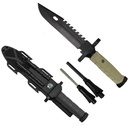
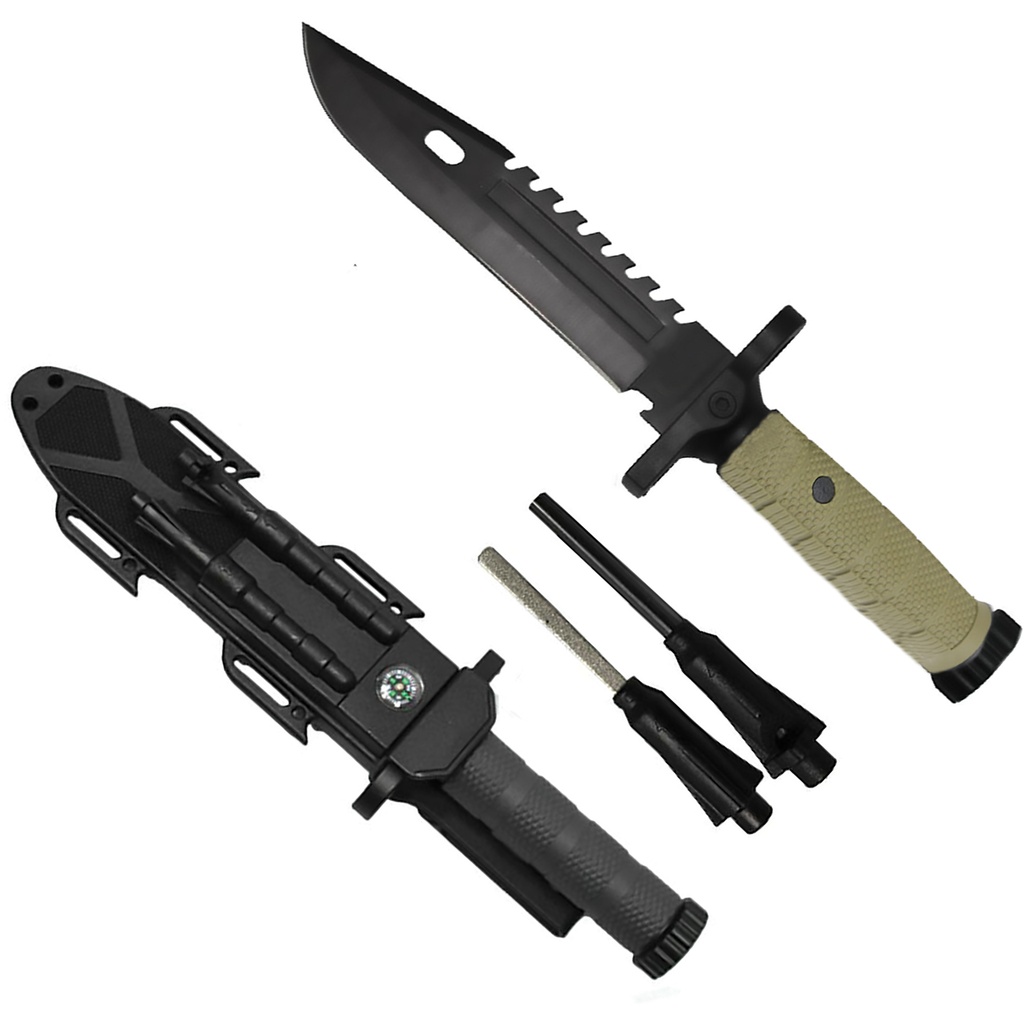
Shadow Spine Hybrid-Edge Tactical Knife - Matte Black
You know that moment when the noise spikes and everyone else hesitates? That’s when your tactical knife quietly earns its place. The matte black blade stays low-profile, the hybrid edge bites clean through webbing, rope, or stubborn packaging, and the rubberized grip locks into your palm even when your hands are cold or wet. You don’t have to baby it, sharpen it every weekend, or think twice in the dark. You just reach, draw, cut—and things go from problem to handled.
| Blade Color | Black |
| Blade Finish | Matte |
| Blade Style | Clip Point |
| Blade Edge | Partial-Serrated |
| Blade Material | Steel |
| Handle Material | Rubber |
| Theme | Tactical |
| Tang Type | Full Tang |
| Pommel/Butt Cap | Flat |
| Sheath/Holster | Sheath |
You don’t plan for chaos, but you know exactly what it feels like when it shows up. The truck stuck after dark. The snapped strap mid-hike. The sudden need to cut someone free when seconds feel louder than sirens. In those moments, you either have a tactical knife that just works, or you wish you did.
This is the spot where a matte black, full-tang blade with a hybrid edge stops being “gear” and quietly becomes part of how you move through the world—steady, prepared, and hard to rattle.
Why a Tactical Knife Matters When Things Get Loud
When you carry a tactical knife, you’re not showing off steel—you’re removing friction from the worst moments. The Shadow Spine concept comes into focus the first time you drag that hybrid edge through something stubborn. The forward section of the blade gives you a clean, controllable slice for everyday cuts: breaking down boxes, trimming cord, shaving tinder. Then, when you hit webbing, rope, or nylon that doesn’t want to cooperate, the small section of serrations near the handle grabs and tears through like it’s cashing a check.
The serrated spine adds a second layer of quiet capability. You notice it most when you’re not in a rush—using the back of the blade as a saw on small branches, notching a stake, or working through plastic that would dull a cheaper edge. The tactical knife becomes less about one dramatic emergency and more about a hundred small wins: less wrestling, less swearing, more “done.”
And because the blade rides in a sheath instead of a pocket, your tactical knife is where your hand expects it to be—on your belt, on your pack strap, or lashed to gear you trust. No fumbling for a folder. No wondering if lint has jammed the hinge. Just draw, use, re-sheath, move on.
The Build That Makes This Tactical Knife Feel Unshakable
There’s a specific kind of confidence that comes from a fixed blade you don’t have to second-guess. This tactical knife runs a full-tang core under that tan, rubberized handle—the steel runs all the way from tip to pommel. You feel it the moment you bear down on a tough cut: no creak, no flex, no "is this too much?" in the back of your mind. Just solid, predictable resistance.
The matte black clip point blade earns its keep in low light. No glare bouncing off a polished finish, no flash when you don’t want attention—just a subdued surface that disappears until you need it. The clip point profile gives you a fine, controllable tip: detailed work, careful punctures, starting cuts exactly where you want them instead of wherever the steel decides to wander.
That tan rubber handle isn’t just there to look tactical. The texture grabs your palm when it’s cold, sweaty, or grimy from camp chores. The full guard and straight quillon keep your hand from sliding forward when you’re driving the knife hard, while the flat pommel gives you a small striking surface for nudging tent stakes, tapping hardware into place, or making your point against a stubborn lid.
There’s a lanyard point at the butt for when you want redundancy—loop a cord around your wrist on a steep slope, or tie it into your kit so your tactical knife stays yours, even when everything is moving faster than you planned.
How This Tactical Knife Fits Your Daily and Field Carry
Owning a tactical knife only matters if you actually carry it. This one earns carry status by not getting in your way. The sheath keeps the blade covered and predictable, so you can clip or lash it exactly where your hand expects it: on your belt during a yard project, on your pack during a weekend hike, or in your go-bag where you don’t have to dig around for it.
In everyday use, the hybrid edge does the quiet work: cutting straps in a parking lot, trimming paracord at camp, slicing open feed bags or heavy packaging. The serrations near the handle pick up the slack when your day throws something denser at you—old hose, zip-ties, layered rope. Meanwhile, the serrated spine lets you turn the tactical knife into a micro-saw, giving you control when you’d rather not pull out a larger tool.
The feel of rubber and steel in your grip
Close your hand around the handle and you feel the difference immediately. The rubberized texture gives you a sure grip without chewing your skin, and the full guard becomes muscle memory quickly—your fingers know where to land. That means you can use this tactical knife when your hands are wet, numb, or gloved without worrying about slip.
It’s the knife you reach for when you’re tired, when daylight’s fading, when your patience is already thin. Because the last thing you need at that point is a tool that fights you back.
When a Tactical Knife Becomes the Quiet Advantage
There’s a difference between owning a blade and owning a tactical knife that feels like an advantage. You notice it in the in-between moments—the late-night roadside stop where you’re cutting away loose strap ends so they don’t flap themselves to shreds. The sudden storm when you’re slicing paracord under rain to rig a quick tarp. The rescue-flavored moment cutting someone’s pack strap so they can wriggle free from a bad angle.
In those scenes, speed and control matter more than specs on a page. The hybrid edge keeps you fast because you don’t stop to think, “Will this cut?” You just adjust your grip: straight edge for precision, serrations for aggression, spine for sawing. Your tactical knife becomes a series of options baked into one tool, all accessible by instinct.
The legal and lifestyle reality check
Carrying a tactical knife also says something quietly about you: you’re the person who fixes things instead of filming them. You’re the one people turn to when a strap breaks, a knot jams, or a quick cut means the difference between stuck and moving again. It’s not about playing soldier—it’s about having a tool that matches how seriously you take responsibility.
And because this is a fixed blade, you treat it with the same respect you’d give any serious tool: carried deliberately, used with intention, stored where it’s safe but reachable when the moment calls for it.
Questions People Ask Before Buying a Tactical Knife
Is a tactical knife like this legal to carry where I live?
Laws on fixed blades and tactical knives vary a lot by state and city. Some places limit blade length, others care more about how you carry it. Your best move is to check your local knife laws and decide how you’ll carry this tactical knife—on private property, in your vehicle, or as part of outdoor gear—to stay within the rules.
What is a hybrid edge on a tactical knife actually good for?
A hybrid edge combines a plain cutting edge with a section of serrations. On this tactical knife, the straight edge handles clean, controlled cuts—food prep, carving, precise slicing—while the serrated section near the handle bites into rope, straps, and webbing that fight back. It gives you versatility without needing two different blades.
Will the matte black finish on this tactical knife wear off fast?
Any coating will show honest wear over time, especially on a tactical knife that sees real cuts through abrasive material. The matte black finish here is designed to reduce glare and keep the blade low-profile, and while you’ll eventually see marks from use, that patina becomes part of your story with the knife—not a sign that it’s failing you.
Is a fixed blade tactical knife better than a folding knife for everyday carry?
It depends on how you live and work. A folding knife is easier to pocket, but a fixed blade tactical knife like this one is stronger, faster to access, and has no moving parts to fail. If you spend time outdoors, work with your hands, or maintain a go-bag, a fixed blade often becomes the tool you trust most when things get serious.
Picture this: you’re kneeling on gravel beside a dim-lit shoulder, wind shoving at your jacket while you secure a load that shifted at the worst time. Your breath hangs in the air, your fingers are clumsy, and the only light is what your vehicle throws off the asphalt. You reach to your belt, feel the sheath, and draw the matte black tactical knife that’s been riding with you for months.
The handle settles into your palm like it’s been there a hundred times before. Hybrid edge bites, straps fall clean, the serrated spine saws through the last stubborn edge, and the tension in your shoulders finally drops. You slide the blade back into its sheath and stand up a little taller—not because of the knife itself, but because you’ve become the kind of person who doesn’t get caught unprepared. That’s what owning a tactical knife like this really means.