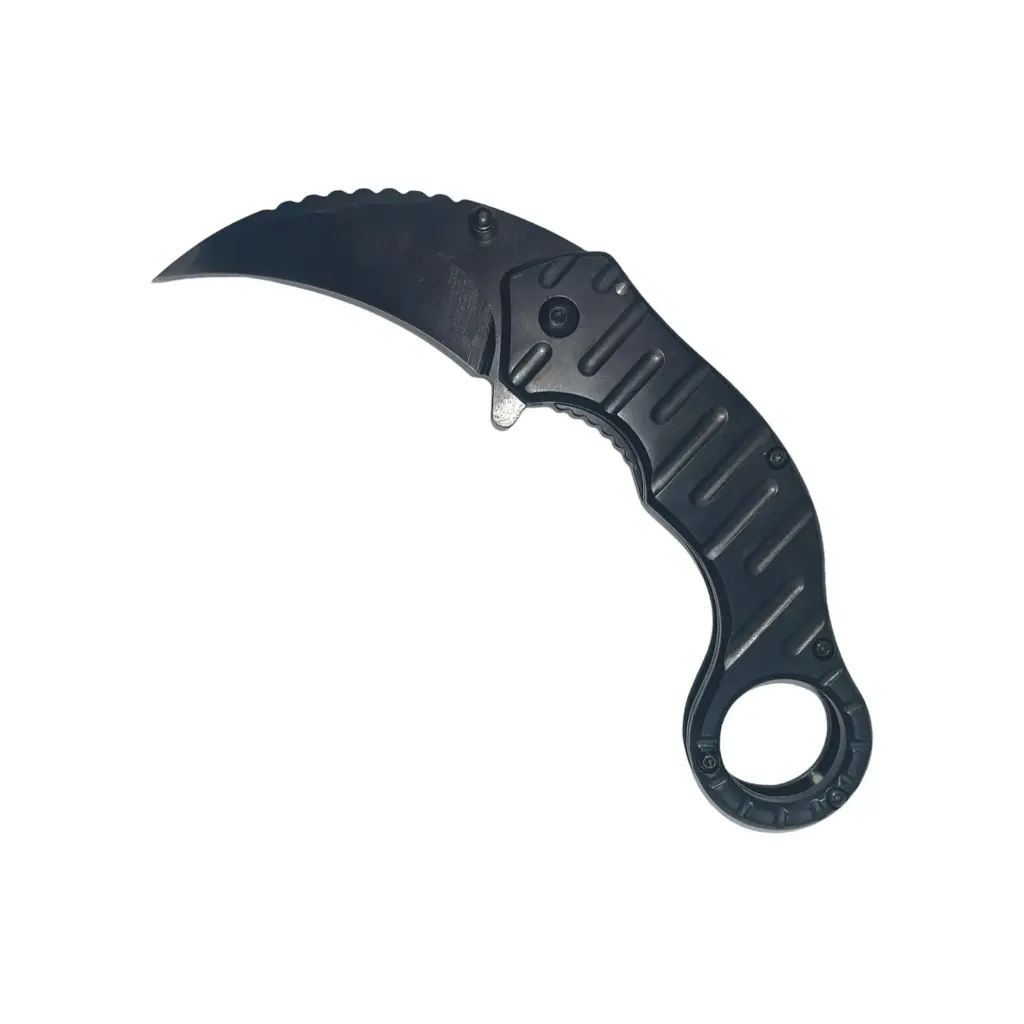
Shadow Talon Assisted Karambit Knife - Midnight Black
You’re walking to your car later than planned, keys in one hand, awareness turned up a notch. Your assisted karambit knife sits low and calm in your pocket, midnight black and unseen—but never out of reach. One deliberate motion and that hooked blade is locked, centered in your grip, feeling more like an extension of instinct than a tool. You carry it because you like knowing that when things shift from normal to “now,” your hands already know what to do.
You don’t plan for trouble. You plan for calm.
Late night. Empty lot. The air feels a little too quiet as you cross the distance between the door and your car. Your phone is in your pocket this time, not in your hand. Instead, your fingers rest on something smaller, denser, shaped to your grip—a karambit knife that waits without demanding attention, midnight black against the fabric. You don’t feel nervous. You feel ready.
How an Assisted Karambit Knife Changes That "What If" Moment
There’s a specific kind of silence that happens right before something feels off. It’s not dramatic. It’s a pause—footsteps that shouldn’t be there, a shadow that lingers too long, a noise behind you when everything should be in front of you. In that space, speed and control matter more than anything.
An assisted karambit knife exists for that space. The curved, talon-style blade isn’t about looking aggressive—it’s about how your hand naturally closes around it, how the hook shape bites into material when pulled instead of pushed, how a quick, assisted-open motion gives you a locked blade without a second attempt. You’re not fumbling for a thumb stud in the dark. You’re making one practiced movement your muscle memory already understands.
Why This Karambit Knife Feels So Natural in Your Hand
If you’ve ever held a straight folding blade and then picked up a karambit knife, you notice the difference immediately. The curve nests into your palm. The ring (if present on your model) or the hooked end gives you an anchor point. Your fingers wrap not around a handle and blade as separate pieces, but around one continuous arc.
This assisted karambit knife in midnight black is designed for that feeling of "locked in." The shape keeps your hand from sliding forward under pressure. The assisted mechanism helps the blade swing out with a clean, mechanical certainty—no wrist flick theatrics, just a solid, confident open. You’re not thinking about the tool at all; you’re thinking about the task, the direction of your pull, the line you need to cut or the space you need to defend.
The Quiet Confidence of Midnight Black
There’s a reason the finish matters. A high-polish blade calls attention. A bright handle telegraphs what you’re carrying from across the room. Midnight black does the opposite. It turns your EDC karambit knife into a shadow—there when you need it, invisible when you don’t.
That blackout look also changes how you feel. It doesn’t shout, it doesn’t posture. It simply waits. When you pull it from your pocket, there’s no flash—just the muted outline of a hooked blade, a dark curve against your knuckles that already feels like it belongs there.
Everyday Carry: Living with an Assisted Karambit Knife, Not Just Owning One
Most people think of a karambit knife as purely tactical, something that lives in a bag or a drawer until "something happens." You know better. You understand that the tool you trust when it matters should also earn its place in the small, ordinary moments you repeat every day.
Opening packages at the doorstep. Cutting zip ties in the garage. Slicing cord, tape, or stubborn plastic that refuses to tear by hand. That hooked blade makes short work of all of it. Instead of forcing a straight edge through a tough cut, you pull the curve through the material, letting the geometry do most of the work. And when you’re done, the assisted mechanism that snapped it open settles back into a safe, folded profile just as quickly.
Carry Comfort: Pocket, Waistband, or Bag
A good everyday carry karambit knife disappears until called on. The compact size tucks easily into your pocket or clips along the waistband, where the midnight black profile blends into whatever you’re wearing. No bulk. No printing through your clothes. Just a solid, dependable shape that stays put when you run, sit, climb, or bend.
You’re not adjusting it all day. You forget it’s there—until the second you deliberately remember.
When a Karambit Knife Makes the Difference Between Panic and Control
The real value of a karambit knife isn’t just the steel or the curve—it’s who you are when the situation tilts. You’ve already run the scenarios in your head, not because you’re paranoid, but because you respect the gap between "I wish I had something" and "I’ve got this."
In a self-defense context, that curved blade changes the angle of everything. You’re not trying to fence with a straight edge. You’re using tight, controlled movements that keep the blade close to your body and difficult to disarm. The assisted opening means you’re not wrestling with your own gear when your hands are shaking and adrenaline is high. You draw, anchor your grip, and the blade is there—no hesitation, no second attempt.
The same qualities that matter in that worst-case scenario also serve you in the small, frustrating moments: when you’re cutting rope in the rain, working with gloves on, or managing fine work in low light. The assisted karambit knife becomes less of a thing you own and more of a habit your hands have.
Questions People Ask Before Buying a Karambit Knife
Is a karambit knife practical for everyday carry, or is it just tactical?
It’s more practical than most people expect. A karambit knife excels at pull cuts—opening boxes, stripping wire, cutting rope, tape, or plastic. Once you get used to the hooked blade, it often feels more controlled than a straight everyday carry knife for the tasks you actually do.
Is an assisted karambit knife legal to carry where I live?
Laws around an assisted karambit knife vary widely by state, city, and even country. Some places treat assisted-opening knives like standard folders, others restrict blade length or certain mechanisms. Before you carry daily, check your local knife laws and any specific rules about assisted opening or tactical designs.
Will a karambit knife be harder to use than a regular pocket knife?
At first, the grip and motion feel different—but that’s the point. A karambit knife is designed for secure, close-in control. With a few practice draws and opening reps, you’ll likely find it more intuitive, especially when cutting by pulling instead of pushing. The assisted mechanism actually makes consistent opening easier than many standard folders.
Can I rely on an assisted karambit knife in a real emergency?
Assuming you maintain it and practice, yes. An assisted karambit knife gives you a predictable, repeatable opening motion and a grip that resists slipping under stress. The key is treating it as real gear—keep the pivot clean, the edge sharp, and spend time drawing and opening it until it feels automatic.
Who You Become When a Karambit Knife Is Part of Your EDC
Picture another late night. Different parking lot, different weather, same you. Your hand brushes past loose change, past your phone, and closes around that familiar midnight-black curve. You’re not reaching for courage—you already have that. You’re reaching for confirmation that your readiness isn’t theoretical.
In that moment, your karambit knife isn’t about steel, finish, or mechanism. It’s about identity. You’re the person who doesn’t leave things to chance. The person whose gear is chosen, not random. The one who moves through the world with a little more calm because you’ve quietly closed the gap between “I hope nothing happens” and “I’m ready if it does.”