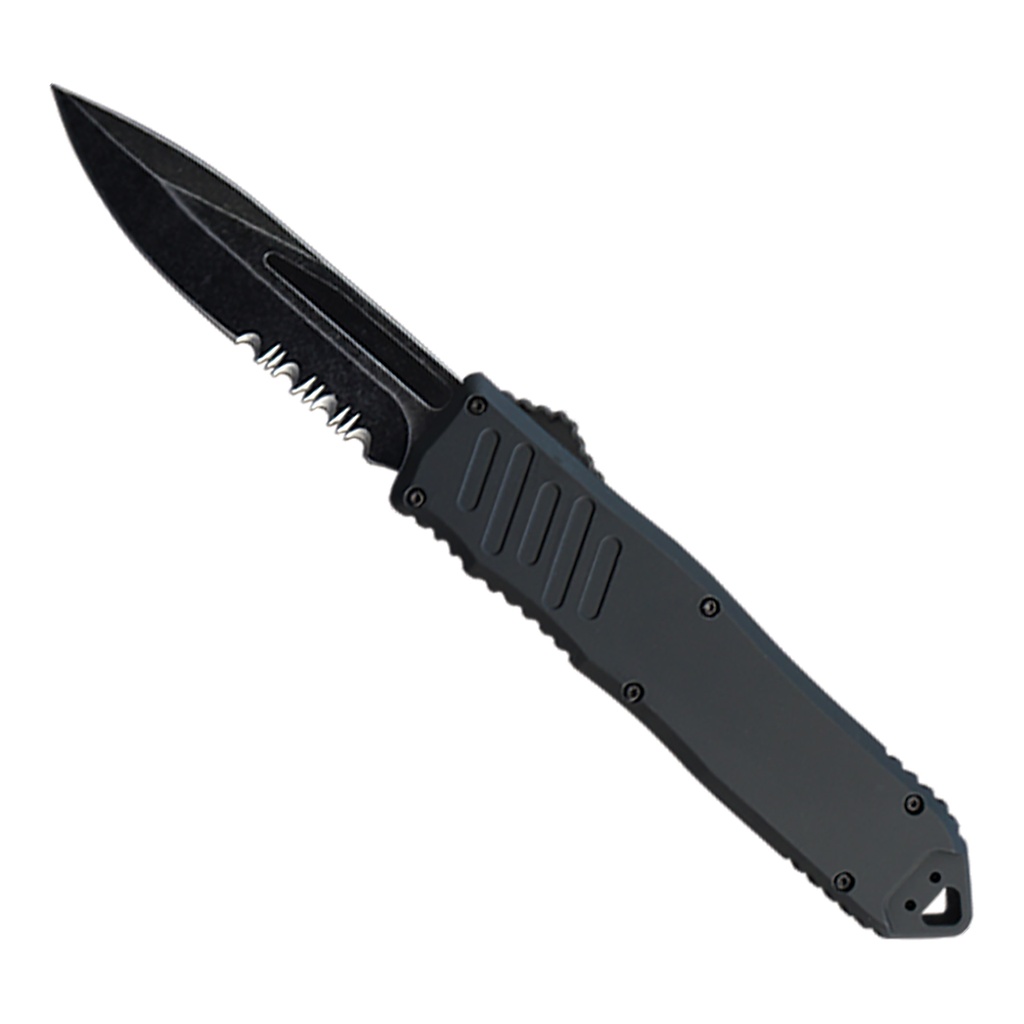
Shadowline Rapid-Deploy OTF Knife - Black Aluminum
You know that split-second when you either fumble or you just handle it? That’s where an OTF knife like this earns its place. Your thumb finds the low-profile slide, you feel the snap, and the black stonewash blade is already working through cord, zip-ties, or stubborn packaging. It rides deep, disappears in your pocket, and shows up only when you decide. Carry it long enough, and it stops feeling like a knife—you just feel more ready.
| Blade Color | Black |
| Blade Finish | Stonewash |
| Blade Style | Clip Point |
| Blade Edge | Partial-Serrated |
| Blade Material | Steel |
| Handle Finish | Matte |
| Handle Material | Aluminum |
| Button Type | Slide |
| Theme | None |
| Double/Single Action | Single |
| Pocket Clip | Yes |
You’re at the tailgate, on the trail, or in a half-lit parking lot cutting a stray strap in the rain—and there’s that tiny moment where your hands either scramble for something sharp, or they move like you’ve done this a thousand times. Your thumb finds the slide without looking. The blade of your OTF knife snaps out in a straight, confident line. No unfolding, no two-handed dance. Just there when you need it, and gone when you don’t.
How an OTF knife turns hesitation into muscle memory
When you carry an OTF knife, the first change isn’t the steel—it’s your rhythm. Instead of thinking, “Where’s my blade?” you start thinking, “How cleanly can I do this?” The top-mounted slide sits where your thumb naturally rests, so deployment becomes a single motion. Push up, feel that solid mechanical track, hear the snap, and the blade is locked open, ready to cut without any drama.
This single-action setup means you get that fast, confident deployment, then a deliberate manual reset when you’re done. You’re not babysitting a spring or worrying about accidental retraction. You run the blade, finish the cut, then bring it home on your terms. Over time, that predictability builds trust; not the kind you talk about, the kind you just feel every time you reach for your pocket.
Why this OTF knife feels built for quiet confidence
Look at it closely and you see why it disappears until it’s needed. The matte black aluminum handle doesn’t shout for attention. It’s slim, rectangular, with softened edges that slide past pocket seams instead of catching on them. The texture grooves along the sides and spine give you traction without tearing up your hand or your jeans. It feels like a tool, not a toy.
Then there’s the blade. A black stonewash clip point gives you two things at once: a tip precise enough for detail cuts and a surface that hides the scuffs and scrapes of daily carry. The partial serration near the handle quietly solves the cuts you usually hate—thick cord, plastic clamshells, webbing, zip-ties—while the plain edge up front stays ready for cleaner, more controlled slices. It’s the mix you reach for when you don’t know what the day is throwing at you.
The OTF knife that actually lives in your pocket, not in a drawer
You’ve owned blades that looked great on day one and then somehow ended up in a box. An OTF knife only earns space in your everyday carry if it carries well. That’s where the deep-carry pocket clip and straight-line profile matter more than specs on paper. This clip tucks the handle low, so only a hint of black shows at the pocket line. To anyone else, it’s just another piece of gear. To you, it’s a ready edge, riding quiet.
The matte black aluminum keeps weight down without feeling fragile. You feel solid, not bulky. The handle’s flat sides settle against your leg instead of printing with odd angles. That low-profile slide actuator? It gives you enough purchase to move confidently, but not so much that it snags on fabric. You can sit, drive, climb, or crouch without constantly adjusting it. After a week, you stop noticing it’s there—until the moment you need it.
The small details that matter when you actually use it
At the pommel, that pointed glass-breaker nub isn’t just a look—it’s a last-resort option that quietly rides along. Maybe it never touches a window, and that’s fine. But knowing you could hit hard glass with focused force changes how prepared you feel in the back of your mind. The lanyard hole there gives you options: a short cord for easier retrieval, or a tie-down point for pack or vest carry when pocket carry isn’t the move.
Why an OTF knife beats a folder when seconds actually count
If you’ve ever tried to open a traditional folding knife with cold, wet, or gloved hands, you already know why people search for an OTF knife when they get serious about their everyday carry. That straight-line deployment means no flipping, no centering, no trying to dig out a thumb stud when your fingers don’t want to cooperate. Your thumb stays in line with the handle; the blade tracks forward on rails and locks into place. Fast becomes simple, and simple is what holds up under stress.
In real life, that plays out in small but important ways. Cutting a seatbelt angle from an awkward seat. Slicing a strap overhead while you’re on a ladder. Opening heavy plastic in the back of a truck. Those are the moments where you don’t want clever—you want certain. An OTF knife like this gives you certainty in one motion, from closed to working without a mental checklist in between.
Feel and sound: the honest feedback loop
There’s a particular satisfaction to the snap of an OTF mechanism when it fires correctly. It’s not just cool factor; it’s feedback. The travel of the slide, the resistance, then that final click into lock-up—your hand learns that rhythm. You know when it’s fully open, you know when it’s safely closed. No half-guessing. That feedback loop is what makes this more than a novelty. It becomes a habit you trust.
When choosing an OTF knife changes how prepared you feel
There comes a point when you stop asking, “Do I really need another blade?” and start asking, “Does the blade I carry match how I live?” If your days bounce between work, commuting, weekend projects, and the occasional late-night run, an OTF knife like this quietly aligns with all of it. It’s tactical in silhouette, but its real edge is practicality: fast deployment, low visibility, real cutting capability, and a profile that doesn’t fight your clothing or your hand.
You’re not carrying this to impress anyone at a glass case. You’re carrying it because you’re the person people turn to when something needs to be opened, cut, trimmed, or fixed—without a speech, without a delay. It’s the difference between feeling like you own a knife and feeling like you’re genuinely equipped.
Questions people ask before buying an OTF knife
Is an OTF knife good for everyday carry, or is it just tactical hype?
An OTF knife shines in everyday carry because it trades flash for function. You get one-handed deployment in a straight line, a deep-carry clip that keeps it discreet, and a blade that’s ready for real tasks like cutting cord, packaging, and webbing. It feels tactical, but it works daily.
Is an OTF knife legal to carry where I live?
Laws around carrying an OTF knife change a lot from state to state and even city to city. Some places treat OTF knives like regular pocket knives, while others restrict them as automatic knives. Before you commit to daily carry, it’s worth checking your local and state regulations so you can carry with confidence, not guesswork.
Will the mechanism on an OTF knife hold up with regular use?
A well-made OTF knife is built around its mechanism, not in spite of it. The slide, internal tracks, and lock-up are designed for repeated cycles. If you keep the blade reasonably clean and avoid grinding grit into the handle, the action should stay smooth and reliable for everyday carry and regular use.
What’s the point of having partial serrations on an OTF blade?
Partial serrations on an OTF knife give you a built-in problem-solver for tougher materials. The plain edge handles clean, controlled cuts, while the serrations near the handle bite into rope, zip-ties, and heavy plastic without extra effort. It’s like having two cutting personalities on one everyday carry blade.
Later, you’ll clip this OTF knife into your pocket almost without thinking. The matte black handle will vanish against dark denim or work pants; the deep-carry clip will keep it close without broadcasting anything. Then something will need cutting—fast, cleanly, without fumbling. Your thumb will find the slide, the blade will drive out in one straight, sure motion, and in that quiet snap you’ll feel it: you didn’t just bring a knife. You brought the version of yourself that’s always ready, always steady, and never caught flat-footed.