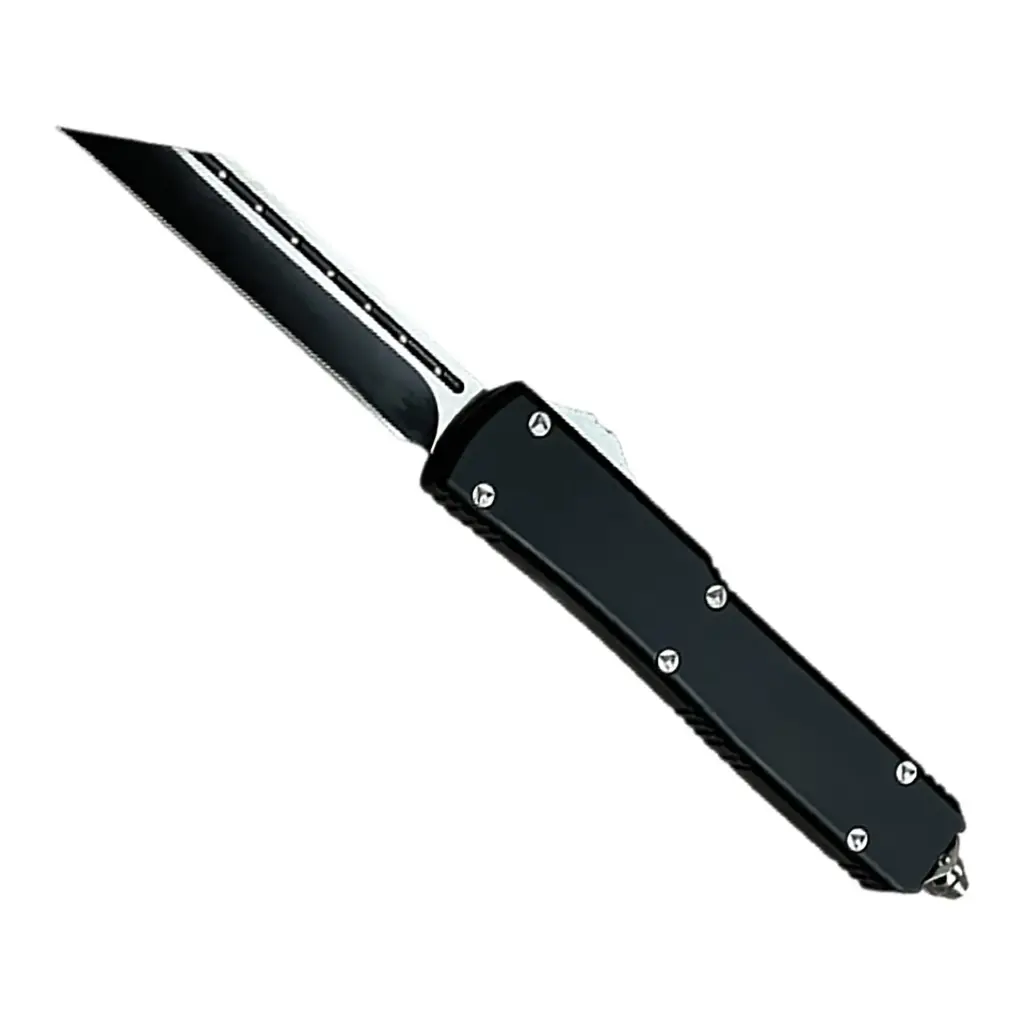
Shadowline Rapid-Response OTF Knife - Matte Black
You know that half-second where you decide if you’re ready or not? That’s where an OTF knife like the Shadowline earns its keep. Your thumb finds the slide without thinking, the American tanto snaps out, and suddenly you’re in control—seatbelt, pallet wrap, or something less forgiving. The matte black handle disappears against your kit, the glass breaker waits at the pommel, and the motion becomes muscle memory. Carry this once and your hands start expecting that straight-line response every time life gets sharp.
| Blade Length (inches) | 3.5 |
| Overall Length (inches) | 8.75 |
| Closed Length (inches) | 5.25 |
| Weight (oz.) | 5.94 |
| Blade Color | Black |
| Blade Finish | Two Tone |
| Blade Style | American Tanto |
| Blade Edge | Plain |
| Handle Finish | Matte |
| Button Type | Thumb Slide |
| Theme | Tactical |
| Double/Single Action | Double Action |
| Pocket Clip | Yes |
| Sheath/Holster | Nylon Pouch |
When that half-second asks if you’re ready
You’ve been there before—hands full, light fading, something that has to give. A seatbelt that won’t release. A crate banded so tight it might as well be welded. That quiet moment where you feel the clock ticking and realize it’s on you. This is where an OTF knife stops being a cool mechanism and starts being the difference between hesitating and moving.
With the Shadowline Rapid-Response OTF Knife - Matte Black in your pocket, that gap shrinks to one motion. Your thumb finds the slide. The blade drives straight out the front, locks with a decisive click, and you’re already cutting before your brain finishes the thought. No flipping, no fumbling for a stud—just a clean, repeatable action that turns pressure into control.
How an OTF knife changes what your hands do under stress
If you’ve carried folders, you know the little dance they demand. Turn the handle, hunt the thumb stud, swing the blade, feel for the lock, then get to work. An OTF knife like this throws that choreography out the window. The motion is brutally simple: forward to deploy, back to retract. Straight line. Same grip. Same thumb path every time.
That matters when your fingers are cold, wet, or jammed in a tight space. The side-mounted thumb slide runs along the chassis of the matte black handle, right where your thumb naturally rests when you draw. You don’t need to rotate the handle or re-adjust your grip mid-deployment. The OTF knife action keeps the blade aligned with your intent—from pocket to target in one controlled stroke.
After a week in your rotation, something subtle happens: your hand reaches for this first. Not because it’s flashy, but because your nervous system remembers how simple it is. One motion in, one motion out. No thinking. Just response.
Why this OTF knife feels built for real-world use, not a display case
Look close and you’ll see why this isn’t just another novelty automatic. The American tanto blade doesn’t taper to a fragile tip; it carries strength all the way forward, giving you a reinforced point that can punch through tough material without feeling delicate. That break between the front and main edge creates a crisp corner, turning controlled push cuts and precision scoring into a reliable move, not a gamble.
At 3.5 inches of plain edge inside an overall length of 8.75 inches, this OTF knife hits that sweet spot where reach and control stop arguing and start working together. You’ve got enough blade to deal with straps, webbing, cardboard, and emergency cuts, without feeling like you’re swinging a short sword in tight quarters. The two-tone finish on the blade isn’t about flash—it gives your eye a quick read on edge orientation the instant the steel clears the handle.
The handle itself stays visually quiet: matte black, clean lines, exposed fasteners that say “serviceable” more than “decorative.” The edges give you grip without tearing up pockets, and at 5.94 ounces, the knife feels like a tool, not a toy. You feel it’s there, but it doesn’t drag your waistband or shout for attention every time you sit down.
Matte black in the real world
There’s a reason blackout gear has a following. In a pocket, on a belt, or clipped to a vest, matte black doesn’t reflect. It doesn’t print as hard. It doesn’t ask for questions before you’re ready to answer them. This OTF knife leans into that: the blade goes loud only when you decide it’s time.
Everyday carry with an OTF knife that disappears until it matters
EDC isn’t about what looks cool laid out on a table—it’s about what you actually carry on a Tuesday when nothing dramatic is supposed to happen. This OTF knife was built for that kind of quiet, consistent presence. The deep-carry pocket clip tucks the handle low, letting the base ride almost flush with the pocket edge. It’s there when you reach for it, but strangers in line won’t notice a thing.
When your day is basic—breaking down boxes, trimming paracord, cutting tape—this feels like a clean, predictable utility blade. The plain edge sharpens quickly, and the American tanto geometry gives you two distinct work zones: a main edge for longer cuts and a reinforced front tip for those precise, high-pressure moments.
When your day isn’t basic, the tool doesn’t change; the way you use it does. The glass breaker tucked into the pommel turns the end of the handle into the kind of thing you hope you never need—but you’ll be grateful for if a car door won’t open or a window needs to go from barrier to exit. In that kind of moment, having an OTF knife that already lives in your pocket means you’re not hunting for a “specialized tool.” You’re just doing what needs to be done.
Slide, cut, stow: the rhythm that becomes habit
One of the quiet benefits of a double-action OTF knife is the way it teaches your hands a closed loop. Deploy. Do the work. Retract. The same thumb that sends the blade out brings it home. No two-handed close, no reaching for a liner lock, no awkward half-folded blade waiting to bite. Over time, that rhythm becomes second nature—and that’s where safety and confidence live.
OTF knife vs folder: when straight-line speed earns the front pocket
You might already own a stack of folders. You know their personalities: the flipper that needs just the right angle, the assisted opener that snaps hard but hates gloves, the slim gentleman’s knife that feels out of place on a job site. An OTF knife like this changes the equation by stripping the deployment down to your strongest movement pattern—forward and back along the spine of your grip.
In cramped spaces—inside a vehicle, crouched under a desk, wedged in a gear locker—that straight-line deployment shines. You don’t need swing clearance. You don’t need perfect wrist positioning. You just need one thumb-width of motion. And when you’re done, another thumb-width sends the blade back into its steel track, fully contained, no exposed edge waiting to snag a seat or a hand.
Compared to carrying a fixed blade, the advantage is simple: you’ll actually have this on you. A full-tang knife might win on raw toughness, but it usually loses the pocket test. This OTF knife slides into normal life without demanding a sheath on your belt every day—and gear you carry daily is gear that’s there when things go sideways.
Questions People Ask Before Buying an OTF Knife
Is an OTF knife like this practical for everyday carry, or just a gimmick?
For EDC, the practicality lives in the motion. An OTF knife gives you straight-line deployment and retraction with the same thumb, so tasks like opening boxes, cutting straps, or quick utility cuts become one smooth habit. If you value speed and control more than fidget factor, the mechanism quickly feels less like a gimmick and more like a system.
How reliable is an OTF knife compared to a standard folding knife?
A well-built OTF knife relies on a guided internal track and a strong spring, not a pivoting arm. That means less sideways stress on a hinge and a blade that travels the same path every time. While you’re not batoning logs with it, for real-world cutting—webbing, packaging, light tactical and emergency use—it holds up as a dependable daily carry tool.
Is this kind of OTF knife legal to carry where I live?
OTF knife laws vary a lot by state, city, and even country. Some places treat them like other automatic knives, while others restrict blade length or outright ban them. The smart move is to check your local and state regulations before you decide to carry. If in doubt, many owners keep an OTF knife as part of a home, work, or vehicle kit instead of on-body.
Does an OTF knife need more maintenance than a regular pocket knife?
Not much more—just different attention. Keeping lint and debris out of the blade channel with occasional compressed air, and a light, correct lubricant on the mechanism, keeps the slide crisp. Like any everyday carry knife, sharpness still comes down to how often you use it and how often you’re willing to touch up the edge.
That first slide, and the version of you that doesn’t hesitate
Picture the first time you clip this OTF knife into your pocket. The matte black handle vanishes against denim or duty pants. Hours go by. Then a moment shows up—a stuck strap, a stubborn package, a situation in a parking lot that doesn’t feel right. Your hand finds the handle, thumb hits the slide, and the two-tone tanto jumps to attention in a straight, honest line.
In that instant, you’re not the person wondering where your tool is or how it opens. You’re the one who already has steel between problem and consequence. That’s what carrying an OTF knife like this really buys you—not just a mechanism, but a quiet kind of readiness that lives in your hands long after you pocket the blade and move on with your day.