Signal Ember Lifeline Survival Fire Starter - High-Vis Orange
You don’t plan to get turned around at dusk, but you prepare like you might. A compact survival fire starter on your keys means you carry flame, sound, and visibility in one hand. The flint bites, the sparks jump, the whistle cuts through trees. You’re the one in the group who quietly has a way out—and you know exactly where it is.
You don’t notice the woods getting darker at first. The temperature dips, the conversation fades, and suddenly everyone is looking at each other, then at you. Because you’re the one who always has a way to make fire, a way to call for help. Your hand drops to your keys, and that bright orange survival fire starter is right where you left it.
When a Survival Fire Starter Turns an ‘Oh No’ into ‘We’ve Got This’
Most days, your survival fire starter is just a small flash of orange on your keyring or buried in a pack pocket. It doesn’t ask for attention. But the first time the wind picks up, the light falls fast, and phones start losing signal, you feel how different it is to carry a real answer instead of a hope. Flint on striker, sharp scrape, shower of sparks—everyone can hear the shift from worry to focus.
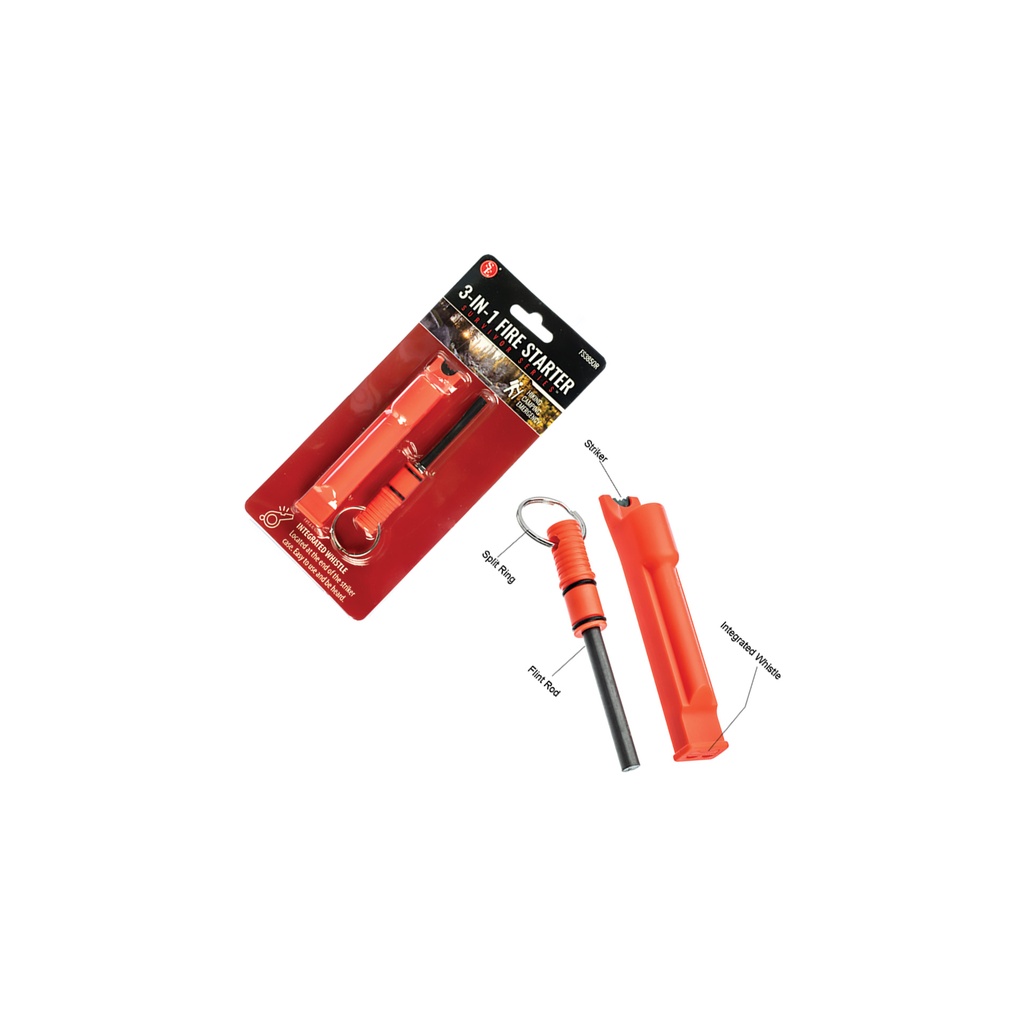
This isn’t some bulky camp gadget that lives in a bin in the garage. The flint rod is compact, the striker is small but efficient, and the whistle is molded right into the body. In a tight moment, you’re not fumbling with separate pieces or digging through gear. One hand, one motion, and you’re already creating sparks on dry tinder or wet bark curls you shaved earlier because you think that way now.
Why This Compact Survival Fire Starter Actually Gets Carried
Owning survival gear is easy. Carrying it every day is where most people drop off. That’s where this survival fire starter quietly wins. It’s built to live where you already reach: clipped to your keys with a simple split ring, bright enough in high-vis orange that it stands out against dirt, leaves, and the bottom of a black backpack.
The flint rod feels dense and ready, not toy-like. You can tell the first time you drag the striker along it—there’s resistance, a rough bite, and then that first satisfying spray of orange sparks. The integrated whistle shares the same body, so you aren’t juggling a second tool just to call out across a valley or along a dark campsite road. You move like someone who’s used this before, because even if you haven’t in an emergency, you’ve tested it in your backyard, a parking lot, or on the last trip out.
How a Survival Fire Starter Fits Quietly into Your Everyday Carry
Adding another piece to your EDC kit usually means asking, “Will I actually carry this, or will it sit in a drawer?” This survival fire starter earns its place by disappearing until it matters. On your belt loop, it’s just a small orange accent. On your keychain, it rides next to your everyday carry blade, not competing for space, just waiting.
You might use it to light a camp stove when the cheap lighter fails, or to coax damp twigs into a small fire when the group is cold and pretending they’re not. Maybe it sits in your glovebox, part of a simple roadside kit: flashlight, small knife, compact first aid, and this. Knowing it’s there changes the way you drive at night on empty roads. You’re not fearless—but you’re not helpless either.
The Feel of Readiness in Your Hand
There’s a particular sound when steel meets flint with intent—short, gritty, and then the soft crackle of tinder catching. Add the sharp, piercing tone of the whistle, and suddenly you’re not invisible out there. The texture on the orange plastic gives your fingers something to bite into when it’s cold or raining. Even with numb hands, you can tell which end is which by feel alone.
When a Survival Fire Starter and Whistle Make the Difference
Ask anyone who spends real time outside and they’ll tell you: it’s not the big, dramatic gear that saves you most often. It’s the small, repeatable tools—a reliable blade, a dependable light, and a survival fire starter with a built-in whistle that just works when you need flame or a signal. That combination is more than a camping accessory; it’s a quiet promise you make to yourself and the people who trust you.
Hiking with kids, that whistle becomes a way to call them back from just-out-of-sight. Solo on a trail, it’s your voice when your actual one doesn’t carry far enough. Waiting out a stalled car in winter, the ability to build a small, controlled fire feels less like prepping and more like basic respect for your own life. You don’t buy this to show off. You buy it because you don’t want to be the person who wishes they had.
A Small Tool That Changes How You Move
There’s a subtle confidence that comes from knowing you can make fire without relying on fuel that leaks or fails. Flint doesn’t run out overnight. The whistle doesn’t care if your phone is dead. Together, they turn you from a passenger in whatever happens to you, into someone with options and time.
Questions People Ask Before Buying a Survival Fire Starter
Does a survival fire starter like this really work when it’s wet or cold?
A good survival fire starter isn’t bothered by a little rain or cold air. The flint rod will still throw sparks as long as you can scrape it cleanly with the striker, and the high-vis orange body makes it easier to handle with numb fingers. Your main job is having some kind of reasonably dry tinder ready to catch those sparks.
Is a whistle on a survival fire starter actually useful, or just a gimmick?
An integrated whistle on a survival fire starter is one of those features you forget about until it’s the only thing that matters. When you’re lost, injured, or trying to get attention at a distance, blowing a whistle repeatedly is far easier than yelling, and it carries farther through trees or over wind. Having that signal built into the same tool that gives you fire means your basics are covered in one grab.
How big is this survival fire starter—will it weigh down my keys or pack?
This style of survival fire starter is intentionally compact and lightweight, designed to ride on a split ring with your keys or clip onto a zipper pull or pack loop. It’s small enough that you forget it’s there during your daily routine, but substantial enough to grip securely when you actually need to strike flint or blast the whistle.
Is a survival fire starter better than carrying a lighter?
A lighter is convenient until it’s out of fuel, cracked, or too cold to work well. A survival fire starter gives you a more durable, weather-resistant backup that’s not dependent on gas or fluid. Most people carry both—a lighter for convenience, and a flint-based survival fire starter as the thing that still works when the easy option fails.
The Moment You Realize You’re the One Who Came Prepared
Picture your next late hike, last-night-at-camp, or roadside wait. The light is going, the air cools, and worry starts to creep in around the edges of everyone else’s faces. You don’t make a speech. You just reach for the bright orange shape you already know by touch, slide flint against striker, and watch sparks bloom into flame. The whistle hangs there too, ready to cut through distance if you need it. In that moment, you’re not just someone who bought a survival fire starter—you’re the one people relax around, because you thought about this long before anyone had to.