

Silent Approach Wireless Driveway Alarm - Off-White
You know that half-second of unease when you hear something outside and aren’t sure what it is? A wireless driveway alarm quietly removes that guesswork. You hear a gentle chime the moment someone crosses into your space—car, visitor, or wandering toddler heading for the door. The neutral off-white sensor blends into trim and siding, the receiver tucks into a hallway or kitchen, and you stay one step ahead without cameras, passwords, or complicated apps. It just lets you know, every single time.
You’re in the middle of something—cooking, working, wrestling a backpack zipper closed—and you hear it: a soft, clear chime from the other room. Not a crash. Not a bark. Not your imagination. That single sound tells you more than a dozen glances out the window ever could: someone just crossed into your space.
Maybe it’s a delivery you’ve been waiting on, a guest pulling up the driveway, or a small child wandering a little too close to the door. Either way, you already know, before anyone knocks, calls, or cries. That’s what living with a wireless driveway alarm really feels like—your awareness stepping out ahead of you by a few hundred feet.
How a Wireless Driveway Alarm Quietly Extends Your Awareness
This isn’t about gadgets or tech specs—it’s about not being caught off guard. A wireless driveway alarm gives you a private early-warning line around your home, without turning your house into a fortress.
You place the motion-sensing transmitter near a driveway, walkway, side gate, or doorway. Any movement crossing its field—from a vehicle to a person to a curious toddler—triggers a signal that jumps wirelessly up to about 400 feet to the receiver inside. A pleasant chime sounds, not a blaring siren, so you get information, not anxiety.
What that means for you in real life: you hear the chime and instantly decide. Do you keep chopping vegetables because it’s just the mail truck you always expect at 3 p.m.? Do you wipe your hands and meet a guest at the door so they never have to knock twice? Or do you bolt toward the entryway because the sound came right as you realized the toddler isn’t where you left them?
Why This Wireless Driveway Alarm Works in Real Homes, Not Just in Manuals
On paper, a wireless driveway alarm is simple: battery-powered transmitter outside, plug-in or battery receiver inside, about 400 feet of range between them. But the details that matter to you show up when you actually live with it.
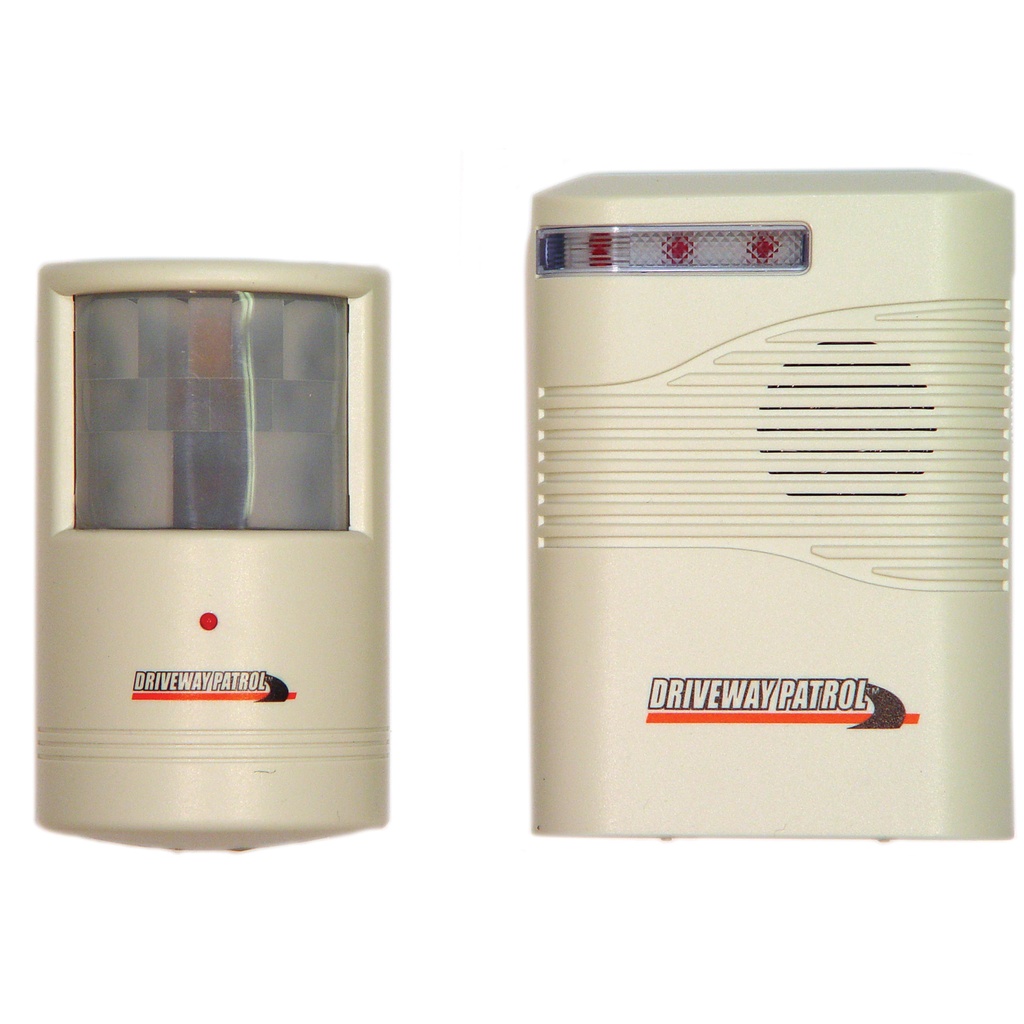
The sensor housing is a neutral off-white, shaped like a small speaker or thermostat, so it disappears against siding, trim, or a porch post instead of screaming "security device" to every passerby. The receiver is just as understated: a rounded rectangle with a horizontal speaker grille and small indicator lenses on top. It looks like another normal household gadget on a shelf, not a piece of tactical gear.
Inside that simple casing, the motion detector does the real work. It watches the same way you would if you stood at the window all afternoon—except it never gets bored, never looks down at its phone, and never forgets to listen. Anything crossing its path sends the signal. No Wi‑Fi. No app. No account to create. Just a direct line from "something moved" to "you hear the chime."
The Little Design Choices You Actually Feel Day to Day
What made this design click is how it respects your space. The logo and subtle road graphic tell you exactly what it’s for—driveway, path, movement near the home—without shouting. The small red LED on the sensor lets you see, at a glance, that it’s active when it triggers. The wireless link means you can experiment: mount the sensor near the drive today, move it to a back gate this weekend without running a single wire.
And because the alarm is a chime, not a siren, it fits into family life. You can hear it over kids’ shows or kitchen noise, but it doesn’t scare anyone or set the dog into a panic every time a car pulls in.
Living With a Driveway Alarm: Everyday Scenarios You’ll Recognize
Picture a normal week once a wireless driveway alarm becomes part of your everyday routine.
Morning: You’re getting ready, coffee in hand, when the chime sounds. It’s the rideshare pulling into the driveway a minute earlier than expected. You walk out calmly instead of sprinting, because you already know they’re there.
Afternoon: You’re home with small kids. One is playing near the front door, and you’re switching laundry over. If that door cracks open and they wander toward the porch, the outside sensor catches the movement and the indoor chime snaps your attention back before they get far.
Evening: Packages tend to disappear in your neighborhood. Now, the moment a delivery truck rolls up the driveway or a person walks toward your porch, the chime calls you to the front of the house. You don’t need to check a camera app, scroll through alerts, or guess who made that noise outside.
Comfort, Not Paranoia
The goal here isn’t to make you suspicious of every sound. It’s to replace the low-level hum of "What was that?" with a calm, "I know what just moved." A simple driveway motion detector becomes the quiet reassurance in the background of your day: you can be in the back room, the basement, or the kitchen and still stay connected to what’s happening outside.
When a Wireless Driveway Alarm Becomes the Difference Between "Too Late" and "Right on Time"
The moments that justify a wireless driveway alarm aren’t always dramatic, but they’re sharp in your memory.
There’s the day your dog slips the collar and bolts toward the road. The sensor by the driveway hears them before you do. The quick chime sends you flying out the door in time to call them back.
There’s the weekend you’re in the backyard when someone pulls into the front drive. Without an alert, they’d sit there wondering if you’re even home. Instead, you hear the chime through the open window, wipe your hands, and greet them like you were expecting them.
There’s the night your teen is learning to drive. You’re not hovering by the window, but when the chime finally sounds, you know they’ve made it safely into the driveway. You can meet them at the door with a smile instead of checking your phone every two minutes.
In all of those scenes, the device doesn’t feel like a gadget. It feels like an extra sense—one that quietly reaches farther than you can see or hear on your own.
Questions People Ask Before Buying a Wireless Driveway Alarm
Does a wireless driveway alarm really reach all the way from my driveway to inside?
In normal conditions, this kind of wireless driveway alarm is designed for up to about 400 feet between the outdoor sensor and the indoor receiver. That’s plenty for most driveways, front walks, or doorways to reach a central room in the house. Very thick walls or metal structures can reduce range, so placing the receiver in a relatively open spot helps.
Will a driveway motion detector go off constantly from every little thing?
A driveway alarm motion sensor is tuned to notice movement crossing its view—people, vehicles, and larger motion. You may occasionally get alerts from pets or blowing branches if they’re directly in front of the sensor, but placement is everything. Aim it across the area you care about (like the path into your driveway or the line near a doorway), and you’ll get useful chimes when something actually crosses that zone.
Is a wireless driveway alarm hard to install if I’m not technical?
Installation is more like hanging a small decoration than wiring a security system. You put batteries in the transmitter, place or mount it where you want coverage, then plug in or power the receiver inside. Once you hear the test chime, you’re done. No Wi‑Fi setup, no phone pairing, no passwords—just a simple alert from driveway to room.
Can I use a driveway alarm inside the house for kids or interior doors?
Yes. Many people use a wireless driveway alarm sensor by a back door, basement stairs, or a hallway leading to an exit. The principle is the same: when someone small heads toward a space you want to monitor, the chime lets you know in time to respond. It becomes a quiet safeguard around the parts of your home where "I thought they were in the other room" can turn into a scare.
Imagine your next quiet evening at home. Someone steps onto your drive, walks toward your porch, or a little pair of feet pad too close to the front door. Instead of guessing what that sound was, you hear the calm chime of your wireless driveway alarm and simply know. You move—not in a panic, but with the confidence of someone who’s always a moment ahead of whatever’s coming up the path.