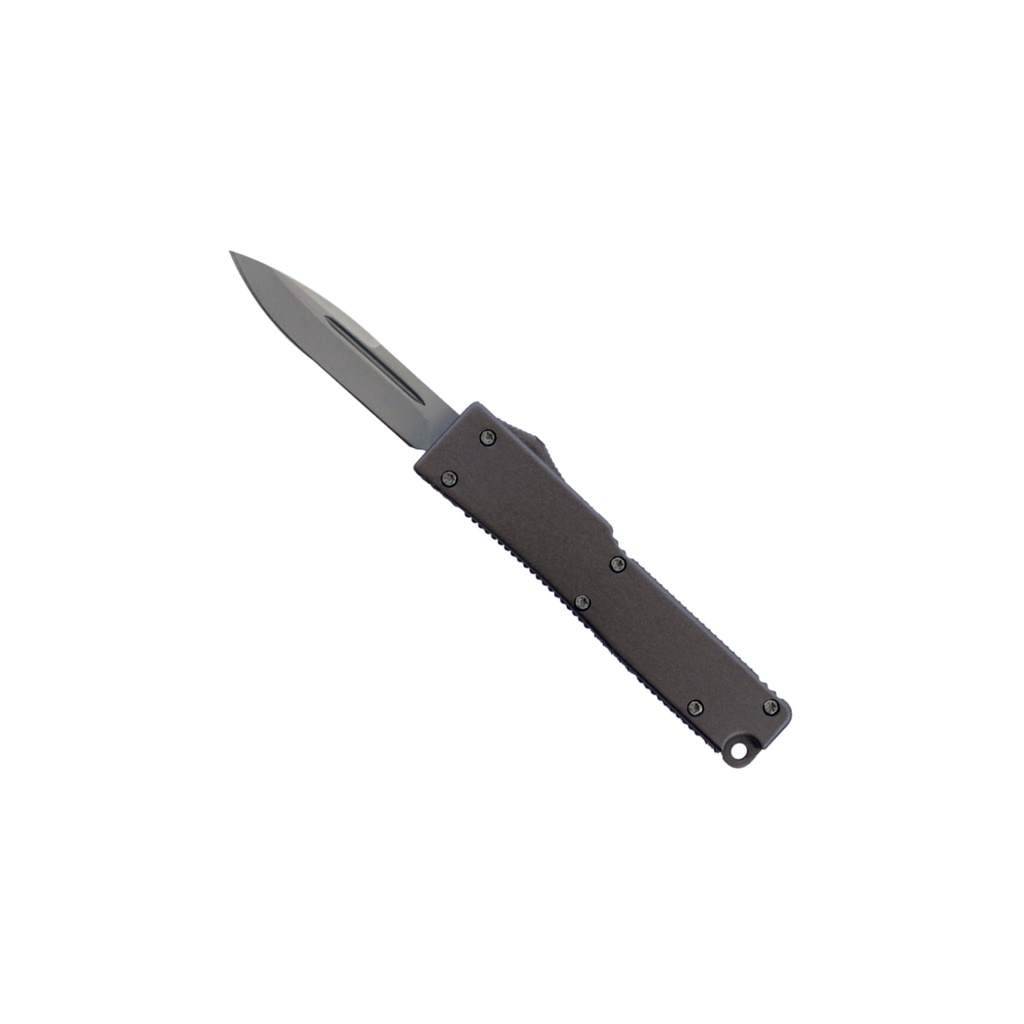

Silent Vector Double-Action OTF Knife - Gray Aluminum
You know that moment when you need a blade now—no fumbling, no drama? That’s where a double-action OTF knife quietly changes your day. This slim gray aluminum body disappears against your pocket, then snaps to life with a single forward push. The 440 stainless spear point feels clean in the hand, solid without bulk. You stop wondering if your everyday carry is enough. You already know it is—because it’s riding in your pocket, ready to move as fast as you do.
| Blade Length (inches) | 1.875 |
| Overall Length (inches) | 5.25 |
| Closed Length (inches) | 3.375 |
| Blade Color | Silver |
| Blade Finish | Matte |
| Blade Style | Spear Point |
| Blade Edge | Plain |
| Blade Material | 440 Stainless |
| Handle Finish | Matte |
| Handle Material | Aluminum |
| Button Type | Front Button |
| Theme | None |
| Pocket Clip | Yes |
You’ve had that split-second before—box on the doorstep, strap that won’t tear, something that actually needs a blade right now. Your hand goes to your pocket on instinct. In that moment, you don’t want to dig for a bulky tool, two-hand a folder open, or pretend your keys will cut it. You want one clean motion, one sure click, and a blade that’s there the instant you decide it should be.
That’s the quiet promise a double-action OTF knife makes every time it disappears into your pocket: when you call, it answers. No drama. No flash. Just out-the-front, in-and-back, on your terms.
When an OTF knife turns seconds into control
Picture this: your hands are full—mail in one, package under your arm, door half-open with a foot. You thumb forward the low-profile switch on your OTF knife. The spear point blade punches out of the handle with a decisive, mechanical snap. No wrist flick. No liner lock hunt. Just blade in line with your grip, exactly where you expect it to be.
This double-action mechanism means the same thumb motion that sends the blade out also pulls it back in. Push forward, the 440 stainless steel spear point launches. Pull back, it retracts into the matte gray aluminum body and vanishes again. You’re not babying it, you’re not wondering if it locked. You feel it engage. You hear it. You know.
And that matters more than specs on a page. What you’re really buying in an everyday carry OTF knife is trust in that moment between “I need this” and “done.” This one’s built to make that moment as short and clean as possible.
Why this OTF knife feels slim, solid, and invisible
The first thing you notice when you pick it up isn’t the blade—it’s the body. Matte gray aluminum, rectangular but softened at the edges so it doesn’t bite into your palm or your pocket. It feels like a piece of gear, not a toy. Light enough that it doesn’t drag your shorts down, solid enough that you don’t doubt it when you drive the point into thick cardboard.
The 440 stainless spear point blade is compact—about 1.875 inches of clean, matte-finished steel—but that size is the point. You’re not walking around with a folding sword. You’re carrying a daily-use OTF knife that actually fits urban life: opening packages, trimming loose threads, cutting cord, doing the small, constant work a real EDC blade sees.
The feel of real-world grip
Run your thumb along the handle and you’ll catch the jimping—small, deliberate texture along the spine and underside. That’s what keeps the knife from twisting in your hand when things get wet, cold, or rushed. It’s not aggressive, not cheese-grater sharp, but it anchors your grip when you slam the switch forward.
The hardware stays low and black against the gray aluminum, more industrial than ornamental. The look says, “Use me,” not, “Look at me.” If your idea of a tactical pocket knife is something that blends in until you need it, this hits that note exactly.
How an OTF knife actually carries in your real pockets
Think about your current carry: keys, phone, maybe a wallet, maybe something clipped. Now imagine slipping this slim body along the seam of your front pocket. The deep-carry clip tucks it low, so almost nothing shows above the fabric. No giant tactical billboard, no shiny distraction—just a slender gray line that reads more like a pen than a blade.
When you sit, it doesn’t jab you. At about 3.375 inches closed and 5.25 inches overall, it’s compact enough to move with you, not against you. You can crouch, drive, climb in and out of the truck without needing to constantly adjust it. After a few days, you’ll catch yourself patting your pocket to make sure it’s still there—not because it feels loose, but because it feels that unobtrusive.
Everyday carry that doesn’t scream for attention
There’s something quietly confident about a gray OTF knife. No neon. No skulls. Just matte gray aluminum and a silver blade that only your inner circle even knows you have. You can walk into an office, a shop, or a friend’s house without feeling like you’re broadcasting “tactical” to the room.
But when someone struggles with a clamshell package or a stubborn strap and you thumb that switch, the sound and speed say plenty. You’re the person who came prepared—with a tool that deploys faster than the thought, “Does anyone have a knife?” fully forms.
When an OTF knife beats a folder or fixed blade
You’ve probably owned a few knives already—maybe a classic folder, maybe a chunky assisted opener, maybe even a fixed blade you swear you’ll carry more than you actually do. So what does an OTF knife really change for you?
With a folder, there’s always a step: pull, rotate, lock. With a fixed blade, there’s always a presence: sheath, belt, print under a shirt. A double-action out-the-front bridges that gap. It rides like a slim pocket knife but answers like an automatic. Your thumb stays in one position. Your grip never shifts. The blade appears and disappears in a straight line, following your intent instead of asking you to adapt.
For quick utility work, light self-defense peace-of-mind, or simply knowing your everyday carry knife reacts as fast as you do, that difference is real. Once you get used to a front-switch deployment, going back to two-handed openers feels like rewinding your own instincts.
Questions People Ask Before Buying an OTF knife
Is a small OTF knife like this legal to carry where I live?
Legality depends entirely on your local and state laws, and those can change. Many areas treat an OTF knife like other automatic knives, so it’s smart to check your city and state regulations or talk to a local shop before you make it part of your daily carry. The compact size and discreet look help, but law still comes first.
Will this OTF knife hold up to everyday use, or is it fragile?
The combination of an aluminum handle and 440 stainless blade is built for daily tasks—boxes, cord, tape, light utility. It’s not a pry bar and it’s not a survival machete, but if you use it like a sane EDC blade, the mechanism and materials will handle real-world use without babying. A quick wipe-down and occasional oil on the track keep it running smoothly.
Is an OTF knife safe to carry in my pocket?
Yes, when you respect the mechanism and carry it clipped. The front switch requires a deliberate push to fire, and with the blade fully retracted into the handle, it’s not just waiting to jump out. Treat it like any automatic knife: keep lint out of the track, make sure the switch moves cleanly, and let the deep-carry clip keep it oriented in a consistent position.
What makes an OTF knife better than an assisted-opening pocket knife?
For many people, it’s about directness and speed. With an OTF, the blade travels straight out from the handle in line with your grip—no flipping, no swinging arc, no repositioning your fingers. That makes an OTF knife feel faster and more controlled, especially when your attention is on the task, not on managing a moving blade.
Owning an OTF knife that feels like it was made for your pocket
Imagine your next small emergency—the package your fingers can’t handle, the strap that won’t snap, the sudden moment you want a clean edge and not a workaround. Your hand drops to your pocket, finds the matte gray body, and your thumb rolls the switch forward. The blade of your OTF knife slides out with that sharp, satisfying click you’ve already come to trust.
In that instant, you’re not just “someone who carries a knife.” You’re the one who quietly solves small problems before they turn into big frustrations—the one whose gear is calm, compact, and ready. The knife isn’t the hero. You are. It just happens to be the tool that finally keeps up with the way you move through the world.