Split-Ridge Instinctive-Control Gut Hook Hunting Knife - Blue Pakkawood & Bone
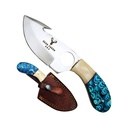
You’re in the field, gloves off, breath hanging in the cold air. Your gut hook hunting knife slides into your hand like it’s lived there for years. The control ring steadies your fingers, the full‑tang blade tracks exactly where you want it, and the blue pakkawood and bone feel solid, familiar. Leather creaks as you sheath it again. This isn’t a wall-hanger. This is the quiet, clean part of the hunt—where your hands, your knife, and your respect for the animal all line up.
| Blade Length (inches) | 4.25 |
| Overall Length (inches) | 7.25 |
| Weight (oz.) | 10 |
| Blade Color | Silver |
| Blade Finish | Satin |
| Blade Style | Gut Hook |
| Blade Edge | Plain |
| Blade Material | Stainless Steel |
| Handle Finish | Polished |
| Handle Material | Bovine Bone & Pakkawood |
| Theme | None |
| Handle Length (inches) | 3 |
| Tang Type | Full |
| Pommel/Butt Cap | None |
| Carry Method | Belt Loop |
| Sheath/Holster | Leather |
The light is going fast. That thin, blue hour in the woods when the noise of the day finally drops out and it’s just you, your breath, and the work in front of you. The deer is down. This is the part no one posts online—but it’s the part that decides how you feel driving home. This is where the knife in your hand either makes field dressing calm and clean… or turns it into something you’d rather forget.
When a Gut Hook Hunting Knife Turns Work Into Ritual
If you’ve ever fought a dull blade or a clumsy profile on a slope of wet leaves, you already know why a dedicated gut hook hunting knife matters. In this moment, you don’t want to be thinking about technique. You want your hands to know exactly what to do. A compact, full‑tang 4.25-inch stainless blade gives you that balance—enough edge to open, separate, and clean, without feeling like you’re wielding a machete in a tight space.
The hooked spine takes over where a straight edge struggles. Once you slip that gut hook under the hide, you feel the edge bite, then glide. No guessing, no panic about puncturing what you’re trying to avoid. You pull, the hook tracks the line, and the cut opens like a zipper. The job stops feeling risky and starts feeling controlled.
Why This Gut Hook Hunting Knife Disappears Into Your Hand
The first thing you notice when you pick this up isn’t the blue. It’s the way your index finger naturally finds that round control ring cut into the blade. That single design choice changes everything. Instead of pinching the spine or choking awkwardly up the handle, your finger locks into place. Suddenly, this gut hook hunting knife feels less like a tool you’re borrowing and more like an extension of your hand.
Underneath the polished surfaces, a full‑tang stainless steel core runs from tip to butt. You see that steel line sandwiching the handle, not as a spec on a box, but as a quiet promise: this isn’t going to twist, wiggle, or surprise you when things get slick. At 7.25 inches overall and roughly 10 ounces, it sits in that sweet spot—substantial enough to anchor your grip, compact enough to work deep inside without banging against bone.
The Feel of Bone, Wood, and Cold Steel
As your hand wraps the handle, you feel the temperature difference: cool bone through the middle, then the warmer, grippier blue pakkawood at the butt. The split-ridge pattern isn’t just decoration. That shift in texture tells your grip exactly where to settle without you ever needing to look down. Brass pins catch the light, but they also anchor everything tight, so there’s no rattle, no give—just a solid, continuous handle.
The satin-finished blade wipes clean with a pass of a rag or the inside of an old shirt sleeve. No deep coatings to chip, no fussy shine that shows every fingerprint—just a smooth surface that lets fat, blood, and mud slide off so you can get back to the fire faster.
Carrying a Gut Hook Hunting Knife That’s Always Where You Need It
There’s a small but important difference between owning a gut hook hunting knife and actually using it every season: how it carries. If it rides awkward, digs into your side, or feels like it might bail on you when you’re climbing a fence, it ends up in the truck, not on your belt.
The leather sheath on this one solves that quietly. A stitched brown sheath with a belt loop threads on without drama. It sits high enough to clear brush but low enough that you can draw the knife without contorting your shoulder. A simple snap strap clicks over the handle, so when you’re kneeling in snow or ducking under branches, the blade stays home.
That First Reach Without Looking
At some point, you’ll realize you’re not looking at your belt anymore. Your hand just drops, fingers find the handle shape through jacket and layers, and the motion becomes muscle memory. Leather creaks, snap pops, and the gut hook hunting knife slides out in one practiced pull. That’s when you know it’s truly part of your kit—not just another piece of gear you own.
Built for the Field, Not the Glass Case
There’s a certain kind of hunter who collects knives that never taste the field. If you’re still reading, that’s probably not you. You want a gut hook hunting knife that looks good but doesn’t demand to be babied. Stainless steel takes the worry out of a forgotten wipe-down or a wet ride home in the back of the truck. You can sharpen it, abuse it a bit, and it’s still going to hold up for the next season.
The deer head etched into the blade and the embossed leather aren’t there to scream for attention. They’re quiet nods to what this knife is for. You might not notice them when you’re elbow-deep in work, but later—back at camp, knife resting on the tailgate—they’re the details that make you smile a little and think, "Yeah, that one’s mine."
When a Compact Gut Hook Hunting Knife Makes All the Difference
Maybe you already own a long hunting blade, or a big camp knife you swear by. The question is where a compact gut hook hunting knife fits into your reality. The answer usually shows up in the worst moments: steep hillside, limited light, cold hands, and no room to move. A bulky knife becomes a liability. A smaller, purpose-built blade with a control ring and gut hook suddenly feels like the only smart option.
This is the knife that takes over once the big work is done. It’s what you reach for when you want precise, controlled cuts and the confidence that you’re not going to puncture what you shouldn’t. Over time, it quietly becomes the one you hand to someone you trust when they ask, "What should I carry for field dressing?"
Questions People Ask Before Buying a Gut Hook Hunting Knife
Is a gut hook hunting knife really better for field dressing?
If you’ve ever accidentally punctured the gut or bladder with a straight blade, you already know the answer. A gut hook hunting knife gives you a safe, controlled way to open the cavity without cutting too deep. You slip the hook under the hide and pull, letting the curve of the hook do the work while you focus on your line, not your angle.
Will this stainless steel blade hold up to regular hunting seasons?
Stainless steel won’t magically sharpen itself, but it will take a field edge and resist rust when your knife gets wet, bloody, or forgotten in the sheath overnight. With a quick touch-up before or after the season, a full‑tang stainless gut hook hunting knife like this is built to ride your belt year after year without becoming a maintenance project.
Is this too small to be my main hunting knife?
At 7.25 inches overall with a 4.25-inch blade, it’s compact, but that’s the point. For skinning, opening, and detailed work, a smaller gut hook hunting knife is often easier to control than a big, showy blade. Many hunters pair something like this with a larger camp knife—but when it’s time for clean, careful cuts, this is usually what gets the call.
Will the leather sheath stay secure on long hikes and rough terrain?
The belt-loop sheath is designed to be forgettable in the best way. Once you thread it onto your belt, it rides close to your body, with a snap strap that keeps the handle locked in. You can kneel, climb, and push through brush without feeling the knife wobble or worrying it’s going to bounce out somewhere on the trail.
Picture the next season opener. It’s dark when you step out of the truck, that first lungful of cold hitting your chest. You adjust your pack, then your hand drops to your belt—fingertips brushing leather, then the familiar split handle of blue pakkawood and bone. You don’t think about steel types or edge geometry. You just know that when the work is in front of you, this gut hook hunting knife will be where you need it, doing what you ask of it. And somewhere between the first cut and the last, it stops being "a knife you bought" and becomes part of how you hunt.