Stormgrain River-Edge Full-Tang Hunting Knife - Blue Wood
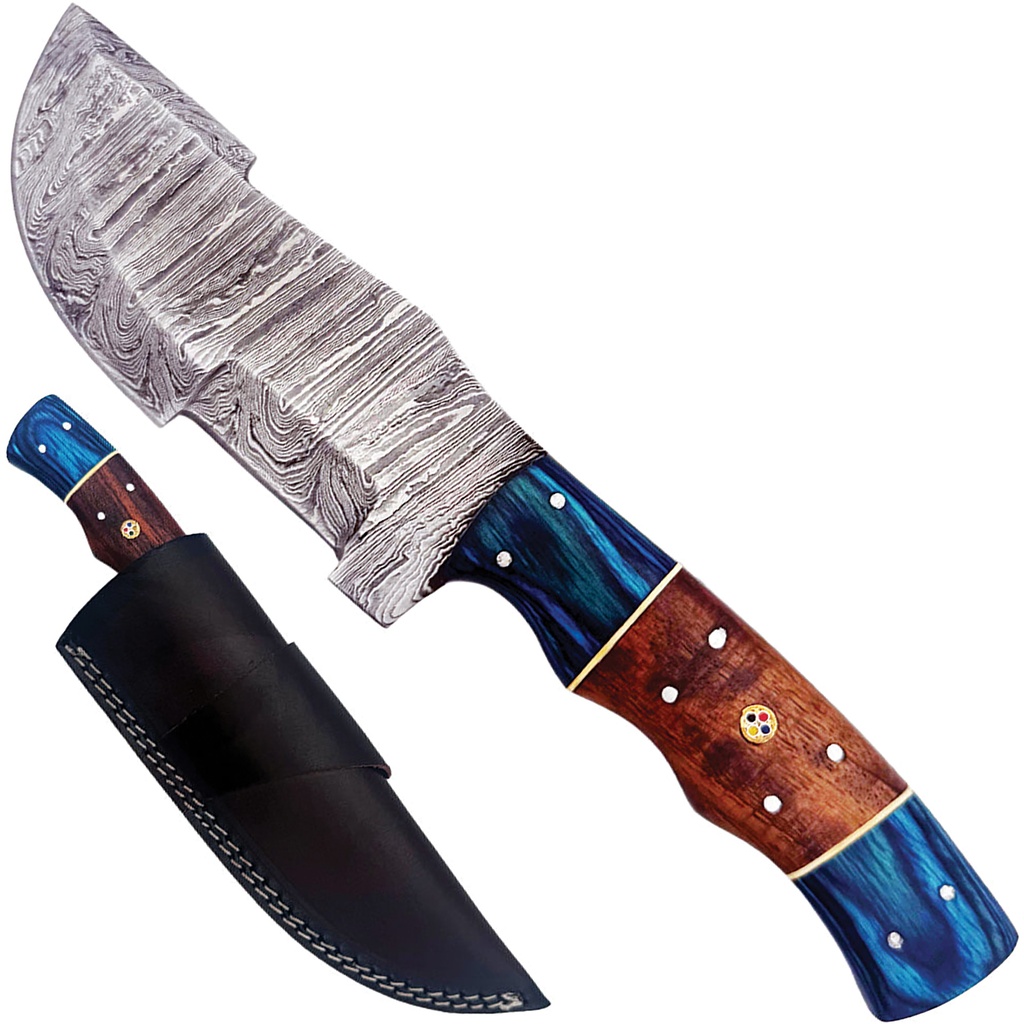
You know that moment on the trail when the air cools by the river and your hand goes to your belt without thinking? That’s where this Damascus hunting knife lives. The 5-inch clip-point feels like it grew into your grip, even wet, riding full tang through blue-and-brown wood. You get bite when you need it, finesse when you don’t, and a leather sheath that makes it feel less like gear and more like something that’s been yours for years.
| Blade Length (inches) | 5 |
| Overall Length (inches) | 10 |
| Weight (oz.) | 16 |
| Blade Color | Silver |
| Blade Finish | Patterned |
| Blade Style | Clip Point |
| Blade Edge | Plain |
| Blade Material | Damascus Steel |
| Handle Finish | Polished |
| Handle Material | Wood |
| Theme | Damascus |
| Handle Length (inches) | 5 |
| Tang Type | Full |
| Carry Method | Sheath |
| Sheath/Holster | Leather |
You’re standing over the game, steam rising in the cold morning air, fingers numb just enough to make clumsy dangerous. This is the moment your hand closes around the handle on your belt and you know, before the blade even clears leather, that your knife won’t fight you today. The Damascus pattern catches the low light like moving water, and your grip sinks into the blue-and-brown wood as if it’s been shaped by your hand alone.
Why a Damascus hunting knife changes the way you move in the field
A cheap blade makes you hesitate. You wonder if it will slip, if it will chip, if you’ll be sawing instead of cutting when it matters. A Damascus hunting knife flips that script. The layered steel isn’t just for looks—it’s for confidence. At about 5 inches, this clip-point gives you reach for opening up a deer or hog, yet it’s short enough to choke up on when you’re working tight around joints and bone.
The moment that hits you is usually small: the first clean draw up the belly, no snag, no stutter, just that controlled glide. You feel the full tang running the length of the blue wood handle, anchoring every ounce of force straight through your palm. Instead of wrestling the blade, you’re guiding it. That’s what this Damascus hunting knife really gives you—quiet control when the work gets real.
How this Damascus hunting knife earns its place on your belt
You’ve probably owned knives that looked good on a shelf and terrible after a season. This one is built for the part of your year that doesn’t make it to social media—the mud, the rain, the rushed field dress in fading light. The Damascus steel blade carries that rushing-water pattern, but its real value is in how it holds an edge through actual use. You cut cord, break down camp chores, slice kindling, and still have something sharp enough for clean field dressing.
The full-tang construction is the quiet backbone of this hunting knife. Steel runs in one solid piece from tip to pommel, visible along the spine between the slabs of blue and brown wood. That means no hidden weak points, no mystery metal buried in the handle. When you twist, pry a little, or bear down through gristle, you’re not wondering what’s happening under the scales—you can feel the solidity all the way through.
The feel of blue wood in a wet, cold hand
The first time you grab this handle with wet hands is when the design really clicks. Those finger grooves and the subtle palm swell aren’t decoration—they lock in your grip when everything else feels slick. The polished blue-and-brown wood looks almost too pretty at first, but once it warms against your palm and darkens a shade with use, it stops being pretty and starts being personal.
A small mosaic pin set into the handle catches your eye from time to time, but mostly it’s for you—a reminder that your hunting knife can be both a tool and a piece of craft. The brass-colored spacers between the wood segments add just enough contrast that, when the knife is resting on a tailgate or beside the cutting board at camp, you always know exactly which one is yours.
Carrying a Damascus hunting knife that’s ready before you are
There’s a difference between owning a blade and living with it. This Damascus hunting knife comes with a fitted black leather sheath that makes it feel like part of your daily rhythm in the field. The sheath rides on your belt, stitched in white so you can spot it easily in the truck or tent. Sliding the knife home becomes muscle memory: the soft resistance of leather, the quiet click when the guard settles into place.
At about 10 inches overall and 16 ounces, this isn’t some forgettable featherweight. You feel the presence on your hip—solid, reassuring, not dragging you down but reminding you it’s there. On a long stalk or a quick hike to hang a stand, you stop noticing the weight and start relying on the fact that, if something needs cutting, you’re already set.
From camp chores to clean cuts
Picture camp at the end of a long day: tarp rustling, fire starting to catch, someone wrestling with a knot of paracord and deadfall. You slide the Damascus hunting knife from its sheath, thumb along the spine, and it just does what you ask. Feather sticks, food prep, slicing tape off a new piece of gear—none of it feels like abuse. It feels like the job this blade was waiting for.
The clip-point profile gives you precision when you’re working in close, like tracing along a joint or easing through hide without blowing out the opening. The plain edge means no gimmicks, just an easy-to-maintain cutting surface you can bring back to razor on a stone at the tailgate.
When a Damascus hunting knife is the difference between fumbling and flow
You already know the moments where your knife matters most: a last-light recovery before the coyotes get curious; a sudden need to cut rope when a load shifts; that one time you had to build a quick fire in sideways rain. In all of those, a solid Damascus hunting knife becomes the quiet partner that lets you focus on the decision, not the tool.
This is where the design choices stack in your favor. The full tang keeps the knife from feeling fragile when you need to baton through small limbs or twist out a stubborn joint. The contoured handle keeps your hand indexed even when you can’t look down. The leather sheath means you know, without thinking, exactly where to reach. It’s not about having a fancy piece of Damascus. It’s about having a blade you trust when your margin for error gets thin.
Questions people ask before buying a Damascus hunting knife
Will this Damascus hunting knife actually hold an edge with real hunting use?
Yes, that’s where Damascus shines when it’s done right. The layered steel on this hunting knife is built for repeated field dressing, camp chores, and daily cutting without rolling over immediately. You’ll still want to touch it up—every serious blade needs that—but you won’t be babysitting a dull edge after one deer.
Is a Damascus hunting knife too nice to use hard?
It might look like a display piece with that rivergrain pattern, but it’s meant to work. The full-tang construction, 5-inch clip-point blade, and shaped blue wood handle are all designed for real hunting and outdoor use. It cleans up well, but you won’t hurt its feelings by putting it through blood, mud, and weather.
Is this hunting knife practical to carry every season?
If your main concern is practicality, the leather sheath and 10-inch overall length keep this Damascus hunting knife in the sweet spot. It rides comfortably on a belt without flopping around, and the weight feels reassuring rather than bulky. For many hunters and outdoorsmen, it becomes their go-to fixed blade from early scouting through late-season tracking.
How does a Damascus hunting knife compare to a standard stainless blade?
You’re trading a bit of low-maintenance convenience for character and cutting feel. A Damascus hunting knife like this one brings a more organic glide through tissue and wood, with a visual pattern that tells its own story. You’ll pay more attention to wiping it down and oiling lightly, but in return you get a tool that feels less disposable and more like a long-term companion.
Later, when you’re back home and the season’s first skull plate is drying in the shed, you’ll find yourself reaching for this Damascus hunting knife again—this time in the quiet. Maybe you’re touching up the edge on a stone, maybe just wiping a thin line of oil along the flowing pattern. The blue wood darkened a shade from weather and work, the leather sheath has learned the shape of your hip, and you realize this isn’t just another blade in the drawer. It’s the one you instinctively grab when it’s time to head out, because somewhere between the first clean cut and the last long drag, it stopped being a knife and became part of the way you hunt.