Tidebreak Survivor-Grade 550 Paracord - Blue Camo
You feel it the moment you thread this 550 paracord through a grommet or cinch it around a bundle—suddenly your gear stops being “good enough” and starts feeling dialed. The blue camo fades into water, sky, and tree shadow, while the 7‑strand core quietly carries the load. Shelter line, gear lash, boot repair—this becomes the cord you reach for without thinking. With this survival paracord in your kit, you stop hoping things hold and start knowing they will.
The first time you really notice your line is usually the moment something else fails. A strap pops. A zipper goes. A sudden gust grabs your tarp and turns your campsite into a sail. In that split-second between “oh no” and “what now,” you either have real 550 paracord within reach—or you don’t.
If you do, the scene changes. The panic shrinks. Your hands already know what to do.
How 550 paracord quietly changes the way you move outdoors
When you carry true 550 paracord, you stop treating the outdoors like a controlled experience. You stop assuming everything will go as planned and start trusting yourself to handle what doesn’t. That 100-foot coil of blue camo survival paracord in your pack isn’t just cord; it’s the difference between feeling like a guest in the wild and moving like you belong there.
You notice it in small moments first. Stringing up a tarp without babying the knots. Hanging a hammock between two less-than-ideal trees because you know the line will hold. Lashing a loose piece of gear to your pack and not wondering if it will still be there at the trailhead. Real 550 paracord, with its 550 lb rating and 7-strand core, gives you quiet permission to stop second-guessing every tie-off.
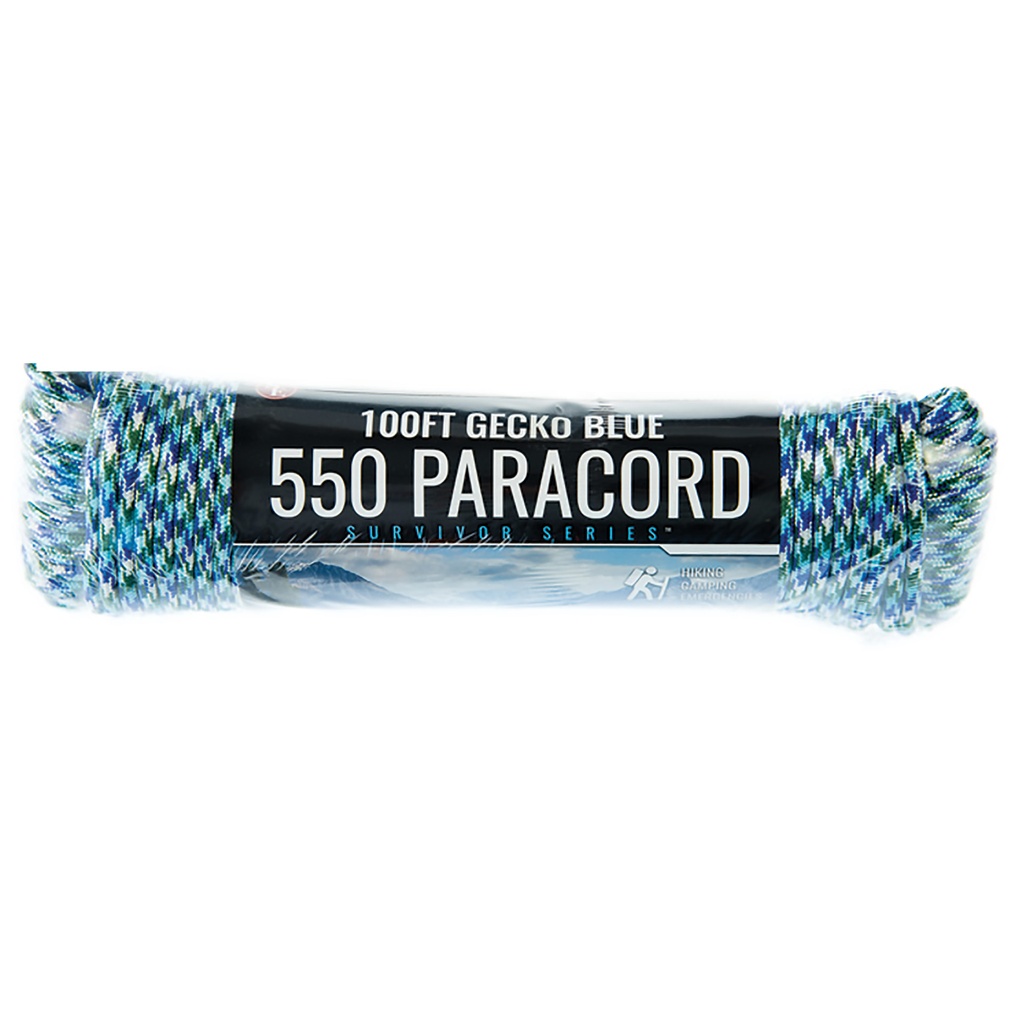
The blue camo braid on this survival paracord blends into creekbeds, alpine sky, and tree shadow. Visually, it disappears into the landscape instead of screaming for attention, so your camp setup looks intentional instead of improvised. But when you need to find it fast in your kit, that same pattern pops just enough to grab your eye.
Why this 550 paracord earns a permanent place in your kit
There’s a reason experienced hikers and EDC obsessives keep coming back to 550 paracord instead of random hardware-store rope: consistency. You pull this survival paracord from the coil and the first thing you feel is the tight, even braid of the sheath. No soft, mushy spots. No flat, lifeless sections. The tension feels the same from end to end, which means the knots you trust will behave the way you expect every single time.
Inside that sheath, seven inner strands sit ready. When you’re just running a ridgeline or tying down a load, they stay hidden—adding strength and stability. But when the situation shifts, you can strip the sheath and pull those inner lines free. Suddenly your 550 paracord becomes a small repair kit in itself: bootlace replacements, fishing line, emergency sewing thread, even makeshift snares if things get truly serious.
The feel of gear you don’t have to baby
Run this blue camo survival paracord through a gloved hand and you feel texture with enough bite to hold a knot, but not so rough it chews up your palms. The sheath doesn’t fuzz up the first time it hits bark or rock. It tolerates being dragged, cinched, re-tied. You coil it back up at the end of the weekend and it still looks ready, not wasted.
That’s what survivor-grade feels like—not flashy marketing, just cord that survives the trip without becoming disposable.
Carrying 550 paracord without feeling overloaded
It’s easy to talk yourself out of carrying extras. Weight creeps up. Pack space disappears. But a single 100-foot hank of survival paracord shifts that mental math. You realize how many items it quietly replaces: extra straps, backup laces, spare guy lines, random lengths of rope you “might need.” One tight coil rides in a side pocket or pack lid, out of your way until things get interesting.
On the trail, this 550 paracord becomes the piece of kit you lend out most. A friend’s rainfly starts flapping in the wind—you offer a length without even thinking. Someone’s trekking pole fails—you jury-rig a fix. You become the person people look to when something needs to be secured, hoisted, or repaired. Not because you talk the most about survival, but because you’re the one who actually came prepared.
Moments where survival paracord quietly saves the day
You’re miles from the nearest trailhead when a storm rolls in faster than the forecast promised. You throw a tarp between two trees, tension the 550 paracord just right, and watch the sheets of rain hit your shelter instead of your gear. Later, when the sky clears, the same cord becomes a clothesline drying soaked socks by the last light.
Or it’s not dramatic at all. It’s a broken zipper pull, a loose sternum strap, a snapped guyline. Little failures that, without real survival paracord on hand, slowly eat at your comfort and confidence. With it, they’re two-minute problems that barely register.
When survival paracord becomes more than backup
Over time, you stop thinking of 550 paracord as emergency-only gear. It becomes part of your everyday carry mindset. A few feet wrapped around a water bottle or flashlight. A bracelet plaited from the same blue camo cord, worn not as a fashion statement but as a quiet nod to the part of you that never wants to feel helpless.
For camping trips, you start designing your setup around it: color-coded lines for different uses, pre-tied loops ready for fast deployment, dedicated lengths for specific tasks. Shelter, food, repairs, safety—your survival paracord runs through all of it. The more you use it, the less you see it as “just cord” and the more you recognize it as the backbone of your kit’s flexibility.
And because it’s 100 feet, you don’t ration every inch like it’s gold. You’re willing to cut what you need, use what the moment calls for, and trust that you still have enough in reserve. That freedom to act decisively in the moment is a big part of what this survival paracord really gives you.
Questions people ask before buying 550 paracord
Is 550 paracord actually strong enough for real emergencies?
Yes. True 550 paracord is rated for a 550 lb minimum breaking strength, which makes it more than capable for shelter building, gear lashing, and most survival tasks. You shouldn’t use survival paracord for climbing or life-line applications, but for almost everything else in camp or on the trail, it’s strong, dependable, and predictable.
What’s the point of 7-strand survival paracord versus cheaper cord?
Those seven inner strands are what separate real 550 paracord from lookalike rope. With survival paracord, you can strip the sheath and use those inner lines individually for repairs, fishing, sewing, and light binding. Cheaper cord often lacks a proper core, frays quickly, and doesn’t give you that multi-use flexibility that makes 550 paracord so valuable in a survival kit.
How much 550 paracord do I actually need for camping or hiking?
For most people, a single 100-foot hank of survival paracord is the sweet spot. It gives you enough 550 paracord for ridgelines, tie-outs, and backups without overcrowding your pack. If you run a larger base camp or like dedicated lines for specific tasks, you might carry more, but one coil covers a surprising amount of real-world use.
Does the blue camo color make survival paracord harder to see?
The blue camo on this 550 paracord is designed to blend into natural settings without becoming invisible. In the wild, it looks at home against water, sky, and tree shadow, but in your pack or on your gear, the pattern stands out enough that you can spot it quickly when you need it. It hits the balance between low-profile and findable.
At some point, you stop wondering whether you should carry cord and simply feel wrong when you don’t. That’s where this blue camo 550 paracord takes you. One day you’re threading it through a tarp grommet at dusk, the air cooling around you, the line drawing tight with that familiar, reassuring resistance. In that small, precise moment, you feel it: you’re not just someone who goes outside—you’re someone who’s ready when outside stops playing nice. With survival paracord woven into your kit and your habits, you become the calm center of the situation, the person who already has what the moment needs.