Trailwarden Sawback Field Survival Knife - Wood Handle
You feel it before you ever use it—the quiet confidence of a survival knife that looks like it’s already seen a few winters. This fixed blade rides on your belt, sawback ready for branches, partial serrations hungry for rope and cord. The wood handle warms in your palm like it belongs there. Your camp chores get cleaner, faster, simpler. And somewhere between batoning kindling and cutting line, you notice the shift—you’re not borrowing gear anymore. You’re the one people borrow from.
| Blade Length (inches) | 6 |
| Overall Length (inches) | 10.5 |
| Blade Color | Silver |
| Blade Finish | Satin |
| Blade Style | Clip Point |
| Blade Edge | Partial-Serrated |
| Blade Material | Stainless Steel |
| Handle Finish | Gloss |
| Handle Material | Wood |
| Theme | None |
| Handle Length (inches) | 4.5 |
| Tang Type | Full Tang |
| Spine Thickness (inches) | 0.1375 |
| Pommel/Butt Cap | Rounded Pommel |
| Carry Method | Belt Carry |
| Sheath/Holster | Nylon Sheath |
The air is cold enough that your breath hangs in front of you, and the campsite is still more idea than reality—tarp rolled up, wood in uneven lengths, cord tangled where you tossed it last time. This is the moment a survival knife either slows you down or quietly makes you look like you’ve been doing this for years.
You reach to your belt, feel the nylon, the familiar shape, the weight that already feels like part of your routine. One smooth pull, one clean draw—and now there’s just you, a 6-inch satin clip-point blade with a sawback spine, and a morning that’s about to go a lot smoother.
How a Survival Knife Turns Camp Chaos into Calm
If you’ve ever tried to make camp with a dull, flimsy blade, you remember the frustration—feather sticks turning to splinters, rope chewing instead of cutting, branches laughing at your effort. Owning a reliable survival knife means you stop fighting your tools and start actually enjoying the work.
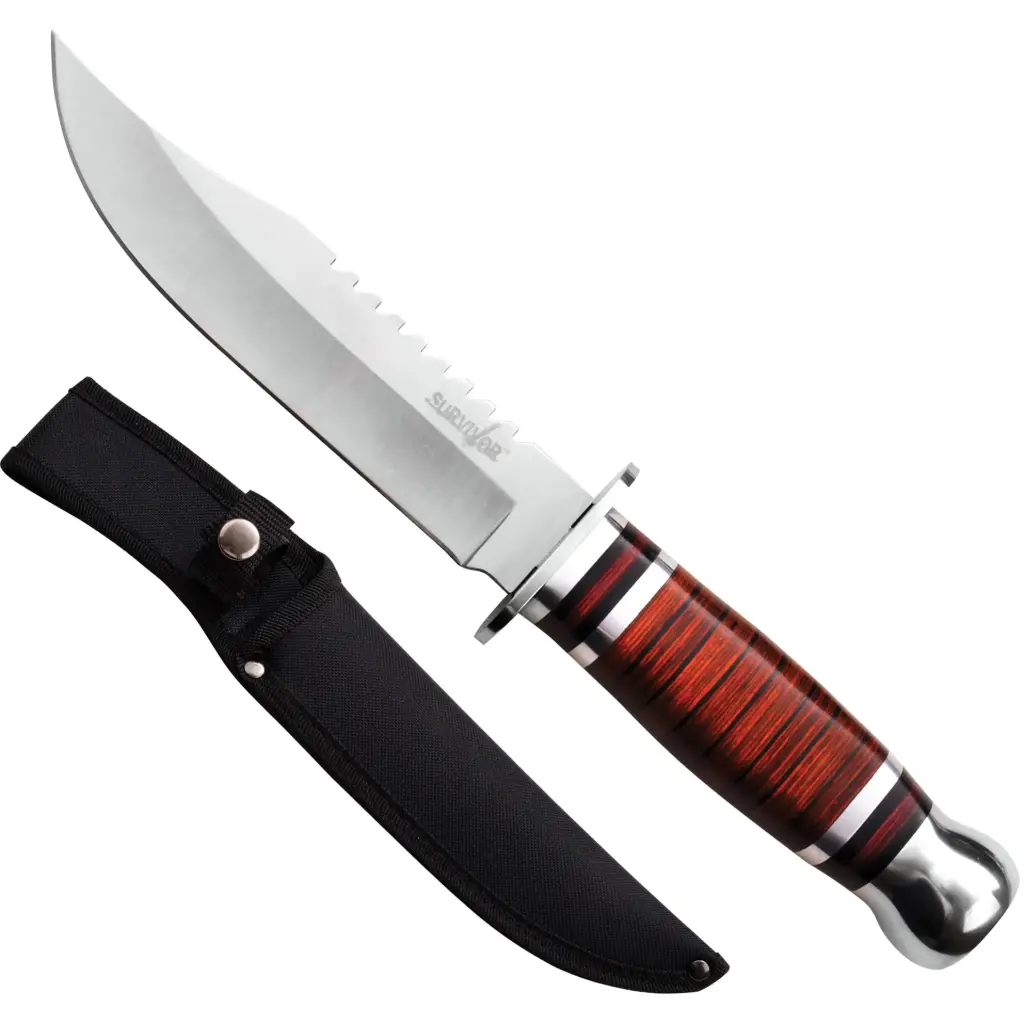
This fixed blade is built around that reality. The 6-inch clip-point profile gives you a fine, controllable tip for detail work—sharpening stakes, notching poles, slicing food—while the straight edge near the tip handles clean push cuts. Closer to the handle, the partial serrations bite through rope, webbing, and stubborn fibrous material without a second thought. When you hit thicker branches, the sawback spine turns the blade into a compact field saw, letting you work through green limbs without abusing the edge.
What that means for you is simple: fewer tools to pack, fewer moments where you wish you brought something else, and more confidence that whatever the day throws at you, the knife on your hip can probably handle it.
The Survival Knife That Feels Like It Was Always Yours
Some knives feel like they belong in a display case. This one feels like it belongs in your hand. The first thing you notice is the warmth of the striped wood handle—the reddish-brown grain catching light in a way synthetic scales never quite do. It’s smooth but not slippery, the kind of gloss that still lets you anchor your grip when your hands are cold, tired, or a little wet.
Beneath that wood is a full tang of stainless steel running the entire 10.5-inch length. You don’t see it at first, but you feel it. There’s no vague flex, no hollow rattle—just a solid, honest weight that tells you this survival knife is one piece of work-ready steel from tip to pommel. The straight crossguard between blade and handle gives your index finger a firm stop, so when you lean into a cut, your hand stays right where it should.
The quiet reassurance of real steel
Stainless steel isn’t glamorous, but when you’re out in the damp, the cold, or the unpredictable, it’s exactly what you want. It shrugs off moisture better than high-maintenance carbon, needs less babying, and still takes a working edge that’s easy to touch up in the field. You get durability without obsessing over rust every time the weather turns or you set it on wet ground.
Carry a Survival Knife That Actually Rides With You
Owning a solid fixed blade is one thing; actually carrying it is another. If a knife digs into your hip, flops around, or feels like a brick, it ends up staying at home when you need it most. This is where the belt carry setup earns its place.
The black nylon sheath is simple on purpose. It’s light, it’s tough, and it doesn’t demand attention. Thread it through your belt and it rides close to your body, the 10.5-inch overall length sitting just right—not so long it jabs your thigh when you sit, not so short it feels like a toy. A snap closure holds the handle securely, giving you that audible click of commitment when you holster it after a long day.
In the field, it’s the small moments that matter
You bend to gather branches and the knife doesn’t jab your ribs. You climb into the truck and don’t have to readjust it. You sit by the fire and forget you’re wearing it—until someone reaches for a cheap folder and glances over, quietly hoping you brought your fixed blade. That’s the carry comfort that turns a tool into part of your daily kit.
When a Survival Knife Becomes Your Backup Plan
There’s a difference between owning a knife and trusting one. Trust shows up in the moments you didn’t plan for. The unexpected storm. The longer-than-expected hike back. The piece of gear that fails when you’re already tired.
The sawback spine gives you options when you need to process branches for shelter or fire and your resources are limited. The rounded metal pommel at the end of the handle becomes a striking tool—tapping in stakes, breaking light material, or sending an attention-getting knock on metal or wood. At 0.1375 inches of spine thickness, the blade has enough meat to baton through smaller logs without feeling fragile.
What you get isn’t a gimmick-heavy tactical toy, but a survival knife that does the quiet work: breaking down kindling, cutting cordage, trimming saplings, handling camp food, opening stubborn packaging, and standing by when things don’t go according to your neat, pre-trip plan.
Questions People Ask Before Buying a Survival Knife
Will this survival knife hold up to real outdoor use?
Yes. The full-tang stainless steel construction, 0.1375-inch spine, and field-ready clip-point design are made for real work, not display. It’s built to handle camp chores, light batoning, and regular use without feeling delicate or disposable.
Is a fixed-blade survival knife practical to carry every trip?
If you run a belt, it is. The included nylon sheath keeps the knife close, light, and stable, so you’re not fighting bulk or awkward movement. Many people find that once they add a reliable fixed-blade survival knife to their kit, it becomes the thing they reach for first, not last.
Can one survival knife really replace multiple camp tools?
It won’t replace a full saw or axe on big jobs, but the sawback spine, partial serrations, and strong clip-point blade dramatically cut down on extras. For most weekend trips, this survival knife covers cutting, light sawing, rope work, and basic shelter prep without stuffing your pack with backups.
Is stainless steel a good choice for a survival knife?
For many people, yes. Stainless steel offers a strong, low-maintenance balance—especially if you’re around moisture, rain, or snow. You get a durable edge that’s easy to maintain and a survival knife that doesn’t punish you if you forget to wipe it down right away.
Owning the Moment Your Survival Knife Earns Its Place
Picture the first trip where this knife is truly yours. The sheath rides on your belt like it’s always been there. The wood handle fills your hand as you draw, the satin blade catching early light. Rope parts in one clean pull. Branches become shelter and fuel instead of obstacles. The sawback sings its rough, steady rhythm through green wood.
By the time the fire is steady and camp is settled, you’ll stop thinking of it as “that new survival knife” and start thinking in simpler terms: my knife. The one that turned a cold, scattered morning into a camp that looked like you knew exactly what you were doing. And from then on, that’s who you are every time your hand closes around that warm wood handle—someone who doesn’t just go outside, but knows how to handle it.