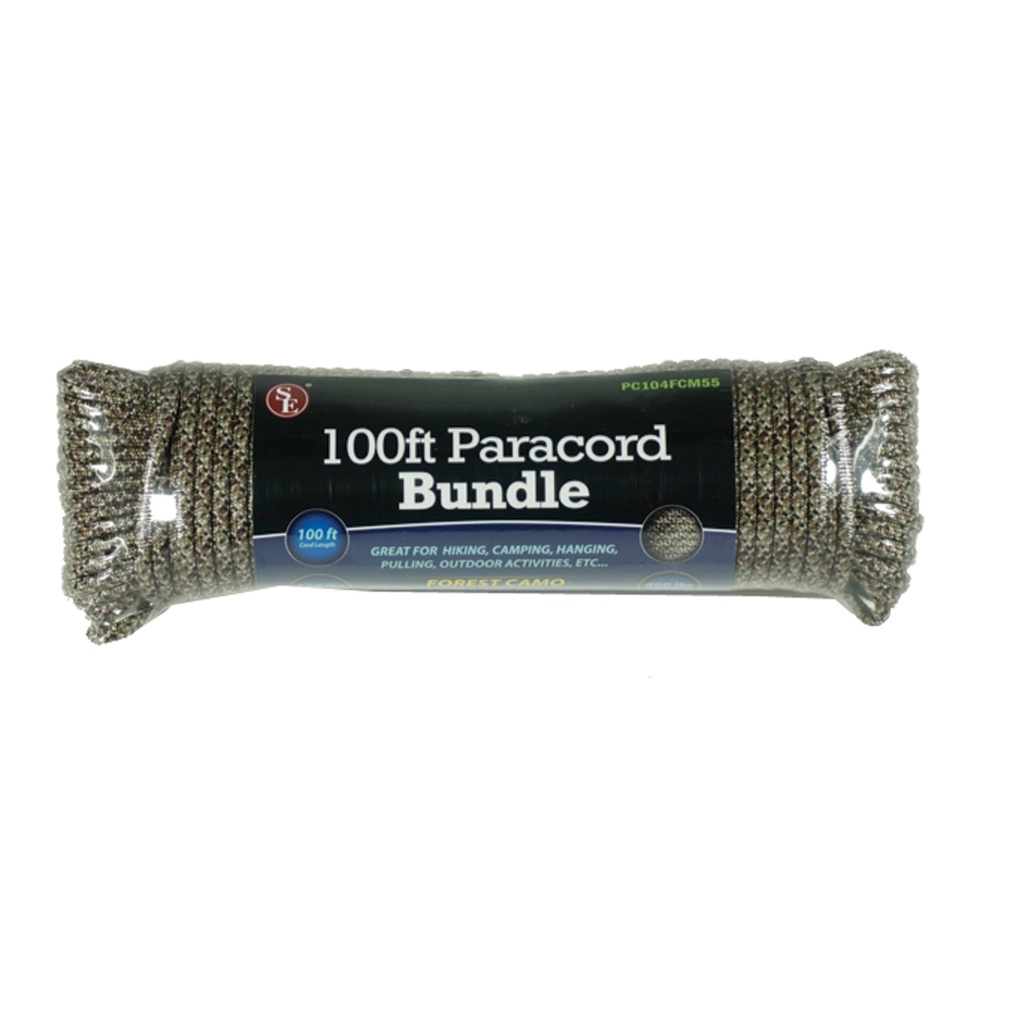

Treeline Phantom 550 Survival Paracord - Forest Camo
You’ve been out there when something snaps—the strap, the guyline, the plan. That’s when your 550 survival paracord stops being just cord and starts being the reason you stay calm. Forest camo melts into the treeline while seven inner strands lash, rig, fix, and improvise. In your pack, it’s just 100 feet of quiet readiness. In your hands, it’s the moment you realize you didn’t come out here unprepared—you came out here in control.
You don’t really notice the cord until something fails. A tent line pops in a midnight gust, a shoulder strap lets go halfway up the trail, or a buddy’s “it’ll be fine” knot decides otherwise. In that split second between the snap and the swear, you either feel panic—or you feel your hand already moving toward the 550 survival paracord you packed on purpose.
If you’re honest, that’s why you’re here. You don’t want more gear. You want fewer weak points. You want one length of cord you trust so much that every problem in camp starts to look…manageable.
When 550 Survival Paracord Turns Problems Into Projects
Owning 550 survival paracord isn’t about collecting another prepper box checkmark. It’s about how you handle the exact moment something goes wrong. With a hundred feet of seven-strand cord riding in your pack, a broken buckle or sagging tarp stops feeling like a trip-ender and turns into a small project you already know how to solve.
You run a line between two trees, tension it until the tarp sings, and suddenly the storm is just background noise. You lash a broken pack strap, melt the ends, and keep moving instead of turning back. You split out the inner strands and use them to tie on a makeshift zipper pull or fix a busted bootlace. The 550 rating isn’t a brag; it’s a quiet promise that when you lean your weight on this, it holds.
That’s the difference this cord brings: not just strength on paper, but the calm that comes from knowing your backup plan is already in your hands—long before anything fails.
Forest Camo 550 Survival Paracord That Blends Until It Matters
There’s a reason the weave runs in forest camo—greens, browns, and tans threaded together like the understory around your camp. You don’t want neon screaming across your ridgeline or bright cord announcing every improvised fix. You want your 550 survival paracord to disappear into the treeline, part of the landscape, part of the kit only you really notice.
Forest camo means your ridgeline doesn’t wreck the view. Your gear lashings don’t shout for attention on the side of your pack. A makeshift handhold, bow drill string, or shelter tie-out looks like it belongs there. And yet, in your hands, the pattern is clear enough that you can track where your line runs at a glance—no visual noise, just quiet, natural camouflage.
The feel of trust in your fingers
Run this cord through your fingers and you can feel the tight braid, that subtle resistance that tells you it’s real 550 and not bargain-bin filler. The sheath holds shape instead of fraying on the first knot. When you cinch down a trucker’s hitch, it bites and holds. When you melt the ends, they fuse into a clean, solid cap instead of bubbling into ash. These are the tiny details you only notice when you’ve used bad paracord—and swore you’d never make that mistake again.
How 100 Feet of 550 Survival Paracord Changes Your Kit
Think about your pack right now. There’s probably a few feet of random cord, some aging guy lines, maybe a spare shoelace you’ve kept around "just in case." Swapping that chaos for a single 100 ft hank of 550 survival paracord is less about adding weight and more about simplifying your decisions in the field.
Need to hang a bear bag? You’ve got the length. Rig a tarp shelter for a surprise overnight? Still got length to spare. Lash trekking poles into a splint, run a clothesline, build a drag for game, secure a load to the roof rack on the drive home—every one of those tasks pulls from the same coil, the same known strength, the same seven-core reliability.
Everyday carry for the backcountry mind
You might not pocket this like a blade, but it becomes part of your everyday carry mindset. A dozen wraps on a trekking pole. A bracelet braided around your wrist. A small bundle stuffed in the glove box. The way you use 550 survival paracord says something about you: you expect things to fail, but you don’t expect yourself to.
Why Real 550 Survival Paracord Beats “Just Rope” When It Counts
You could grab some random hardware-store rope and call it a day. But you already know what happens: it kinks, it rots, it slips when it’s wet, and it gives up right when you lean on it the most. 550 survival paracord is different because it’s built with a job in mind—not just tying things, but solving real problems under real stress.
Inside the sheath are seven inner strands, each of which can be pulled and used on its own. That means one length of cord can become multiple fishing lines, sewing thread for torn gear, or delicate lashings for a shelter frame. The outer sheath stays strong enough to work as light-duty cordage on its own. You’re not carrying one line—you’re carrying a small system of options.
And when you’re improvising under pressure, more options mean less panic. You stop thinking, “What do I have?” and start thinking, “What can I make?” That shift is where confidence lives.
When 550 Survival Paracord Makes the Difference Out There
Picture this: you roll into camp later than planned, light fading faster than you’d like. The forecast lied; the wind is picking up. You can fight with sagging store-bought lines, or you can run a tight, clean ridgeline with your 550 survival paracord, stake out solid guy points, and feel the shelter lock into place. When the gusts hit at 2 a.m., you’re not out in the rain re-tying sloppy knots—you’re inside, listening to gear you trust do its job.
Or maybe it’s simpler. You’re car camping with people who don’t really think about this stuff. A cooler handle breaks, a hammock needs a better hang, someone wants a quick clothesline. You reach for your paracord, solve the problem in a quiet minute, and everyone just assumes things “worked out.” But you know it wasn’t luck. It was the decision you made long before the trip to carry cord that could handle more than the bare minimum.
Questions People Ask Before Buying 550 Survival Paracord
Is 550 survival paracord really strong enough for serious outdoor use?
Yes. Genuine 550 survival paracord is rated to hold up to 550 pounds of static weight, which is more than enough for shelter building, gear repair, hanging bear bags, and daily camp tasks. It’s not climbing rope, but for general outdoor and survival use, it’s the dependable middle ground between overkill and too-weak.
What makes 550 survival paracord better than basic cord or utility rope?
The difference is in the construction. 550 survival paracord uses a woven outer sheath around a seven-strand inner core, giving you both strength and versatility. You can use it as a single line, or strip out the inner strands for fishing, sewing, and fine lashing. Cheap utility rope usually frays, stretches, and fails long before this kind of cord would.
Will forest camo 550 paracord be too hard to see when I’m using it?
Forest camo is designed to blend into natural environments, which is great for low-visibility shelter lines and lashings. In practice, you can still track the cord easily at normal distances because the pattern has contrast—you just won’t have loud, bright lines cutting across your camp or pack.
How much 550 survival paracord do I really need to carry?
For most hikers, campers, and preppers, 100 feet hits the sweet spot. It’s enough to rig shelter, hang food, handle repairs, and still have extra for improvised tasks. You can always cut it into sections or wrap smaller lengths on your gear, but starting with a full 100 ft bundle gives you real freedom.
At some point soon, something out there is going to break, slip, or sag. When it does, you’ll either be the one shrugging and heading home early—or the one quietly reaching for the 550 survival paracord you chose on purpose. Forest camo turns that lifeline into part of the landscape; the seven-strand core turns stress into a process you already know how to handle. And the next time someone says, “What now?” you’ll already be uncoiling the answer from your pack.