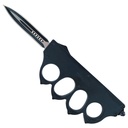
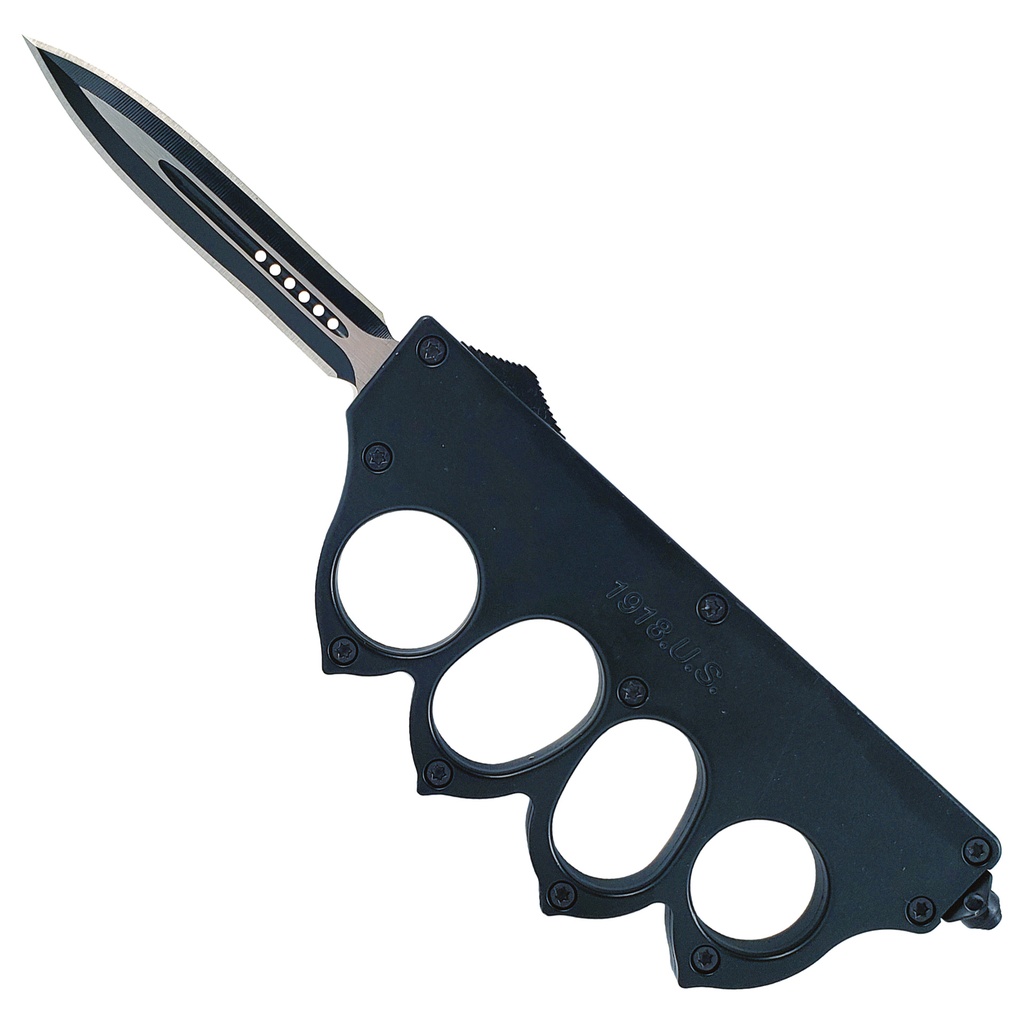
Trench Heritage Knuckle-Guard OTF Knife - Matte Black Metal
You don’t pick up this OTF knife to blend in. You pick it up because the 1918-style knuckle guard locks your hand into a story you’ve only seen in war photos and museum glass. The double-edge dagger snaps out the front with a clean, modern click, all wrapped in matte black metal that feels like it’s seen things. Carry it, and your everyday kit suddenly has a backbone—and a history lesson—built in.
| Blade Length (inches) | 3.25 |
| Overall Length (inches) | 9.375 |
| Closed Length (inches) | 5.875 |
| Weight (oz.) | 8.6 |
| Blade Color | Silver |
| Blade Finish | Matte |
| Blade Style | Dagger |
| Blade Edge | Plain |
| Blade Material | Steel |
| Handle Finish | Matte |
| Handle Material | Metal |
| Button Type | Switch |
| Theme | Trench |
| Double/Single Action | Single |
| Pocket Clip | No |
You notice it first in the weight. That solid, matte black frame settling into your palm doesn’t feel like another flashy toy—it feels like something that’s been around longer than the arguments people have about knives on the internet. Your fingers slip through the knuckle guard almost without thinking, and for a second you’re not just holding an OTF knife. You’re holding a trench silhouette that someone in 1918 would recognize on sight—only now the blade doesn’t swing, it fires straight out the front.
When an OTF knife carries a century of history in your hand
Most days, you’ll just call it your OTF knife. But the first time you feel the top-mounted switch under your thumb, there’s that quiet click before the double-edge dagger launches forward, and you know this isn’t the same kind of everyday carry blade your friends flip in and out of their pockets. The full 9.375-inch profile, the 3.25-inch dagger blade, the four-finger knuckle guard—it all adds up to something that feels less like an accessory and more like a compact piece of history you actually get to use.
The 1918 U.S. stamp molded into the matte black handle doesn’t shout at you; it just sits there, part of the metal, like it was always meant to be. You feel it with your fingertips every time you adjust your grip, a raised reminder that this design was born in muddy trenches long before OTFs and EDC were search terms. And yet, with the single-action mechanism sending that silver dagger out the front, your reality is simple: thumb forward, blade out, no hesitation, no drama.
How this OTF knife turns old trench steel into modern readiness
You’ve seen reenactment pieces and wall hangers—long, awkward, fixed trench knives that live in display cases, not in real carry kits. This is where the design makes sense. By folding the old trench silhouette into a compact OTF knife, you get the aggressive, squared-off knuckle-guard profile without giving up the speed and control of a modern automatic. The steel dagger blade rides inside the handle until the moment you call it forward; then the linear fuller and dual edges appear in a straight, no-nonsense line that feels built for thrust, not show.
There’s no pocket clip tugging at your waistband, no flashy logos to distract from the matte black metal. Instead, you get a dense, 8.6-ounce block that feels anchored in your grip. The glass-breaker style point at the base gives your off-hand something solid to brace against if you ever need to strike with more than the blade. It’s the kind of design choice you only notice when you actually hold it—and once you have, you can’t un-feel that security.
The weight, the metal, the sound it makes
The first deployment is always the moment. The sound isn’t hollow or tinny; it’s a short, confident snap that matches the all-metal construction. The matte finish on both handle and blade diffuses light instead of flashing it, turning that black-and-silver contrast into something quiet and serious. Cold steel at the edges, warm knuckles around the guard—this is a tool you don’t just see in photos, you remember in your hand.
Carrying an OTF knife that doesn’t disappear into your pocket
If you like tiny, forget-it’s-there knives, this won’t pretend to be one. This OTF knife rides in a bag, on a belt rig, in a vehicle console, or in a locker—somewhere you can reach for it with intention. The closed 5.875-inch length means it still fits in most cargo pockets or a jacket, but the moment it settles into your grip, you’re aware of it in a way a slim folder can’t match.
Because there’s no pocket clip, you choose how it lives in your setup. Maybe it shares a pouch with a flashlight and multitool, or sits on the shelf near your range gear. Either way, when you thread your fingers through the knuckle guard, you feel that instant lock-in—four finger holes forming a solid bridge between you and the metal. No worrying about your hand sliding forward, no wondering if your grip will hold under pressure. It’s already anchored.
From display conversation piece to real daily carry blade
At first, you might buy it because of the 1918 story. You set it on the table, people ask what it is, you show the blade firing out the front and they lean in closer. But over time, it starts creeping into more of your real-life moments—opening stubborn packaging, cutting cord, staking down a tarp edge, even just being the thing you reach for when a job in front of you needs a serious blade, not a small talker.
When an OTF knife becomes your answer to “What do you carry?”
Everyone in the EDC world has an opinion. Assisted vs automatic, folder vs fixed, sleek vs rugged. You don’t need to win arguments; you just need to know why you carry what you carry. With this trench-style OTF knife, your answer is simple: it combines the identity of a heritage trench weapon with the practicality of a modern out-the-front mechanism.
Compared to a typical tactical pocket knife, you gain that locked-in knuckle guard, the double-edge dagger profile, and the psychological solidity of a full-metal frame. You trade away some pocket invisibility, sure—but you gain presence. In a glove, in the dark, under stress, the shape tells your hand exactly where it is and how to hold it. That’s not a spec sheet promise; that’s something you feel the third or fourth time you draw it without looking.
Questions People Ask Before Buying an OTF knife
Is this OTF knife legal to carry where I live?
Laws around an OTF knife and knuckle-guard designs vary a lot by state, city, and even country. Before you carry it daily, check your local regulations on automatic knives and trench or knuckle-guard styles. Many owners treat this as a collection or home-defense piece when public carry rules are strict.
Can I actually use this as an everyday carry blade, or is it just a display piece?
You can absolutely put this OTF knife to work on daily cutting tasks—opening boxes, cutting rope, light utility jobs. The double-edge dagger shape leans more tactical than utility, so if you do a lot of detailed slicing, you may pair it with a smaller pocket knife. But as a serious, ready blade in your kit, it holds its own.
How durable is the mechanism on a trench-style OTF knife like this?
The single-action mechanism is built into a solid metal frame, secured with multiple screws you can actually see. As with any automatic OTF knife, keeping lint and grit out of the track and avoiding prying with the blade will keep it running smoothly. Treat it like a real tool, not a fidget toy, and it rewards you with reliable deployment.
Does the knuckle guard make it uncomfortable to hold or use?
Surprisingly, no. The finger holes are spaced to let your hand settle naturally, and the rectangular handle gives your palm a flat surface to press into. Instead of feeling awkward, the knuckle guard makes the OTF knife feel more locked-in and controlled, especially if you’re wearing gloves or working in the cold.
At some point, you stop thinking of it as “that 1918 trench piece” and start knowing it simply as your OTF knife. It sits where you can reach it—matte black metal against wood, gear, or concrete—waiting. Your fingers find the guard without looking, the switch under your thumb feels familiar, and the silver dagger blade snaps into place like it’s just finishing a sentence you started long ago. In that moment, you’re not collecting history. You’re carrying it, shaping it, and folding it into your own story, one deliberate deployment at a time.